Home Projectors That Actually Deliver a Sharp, Bright Image
For movie night color accuracy, the BenQ HT3550 leads with near full Rec.709 coverage. The Epson Home Cinema 2350 is the strongest all-around pick for a bright living room. Gamers should look at the Optoma UHD35 for its low input lag at 1080p and 4K resolutions.
The BenQ HT3550 earns the top spot for picture quality thanks to near full Rec.709 color coverage, a figure that matters more to accurate skin tones and shadow detail than resolution alone. The Epson Home Cinema 2350 suits a brighter living room where some ambient light stays on during a movie, trading a touch of color precision for higher usable brightness. Gamers chasing responsiveness should skip both and look at the Optoma UHD35 instead, built around low input lag rather than color science.
Resolution gets most of the marketing attention, but brightness measured in lumens and how a projector reaches 4K, whether through a native panel or pixel shifting, change what a picture actually looks like on a wall. We compared published lumens, color coverage, light source type and input lag figures, along with owner feedback on setup and fan noise, before narrowing the field to these seven.
Our top picks

Epson Home Cinema 2350 3-Chip 3LCD Projector
Epson rates this 2350 at 2800 lumens of color and white brightness using 3-chip 3LCD technology, which avoids the rainbow artifact some single-chip DLP projectors show under fast motion. Native resolution is 1080p with 4K pixel-shifting support for compatible sources. A lens shift and keystone correction make off-center placement easier than on a fixed-lens unit.
Pros
- High usable brightness for rooms with some daylight
- No rainbow artifact thanks to 3LCD design
- Lens shift simplifies off-center mounting
Cons
- Lamp needs periodic replacement over the years
- Not a true native 4K panel

BenQ HT3550 4K HDR Home Theater Projector
BenQ built this HT3550 around color accuracy, reaching near full Rec.709 coverage out of the box with a factory calibration report included. The DLP panel uses XPR pixel shifting from a 1080p chip to display 4K content rather than a native 4K panel. Brightness sits lower than lifestyle models at roughly 2000 lumens, which favors a dim or dark room.
Pros
- Accurate color out of the box without extra calibration
- HDR support adds contrast on compatible sources
- Compact body fits smaller equipment shelves
Cons
- Lower brightness struggles with any ambient light
- DLP color wheel can show rainbow artifact to sensitive viewers
Optoma UHD35 4K UHD Gaming Projector
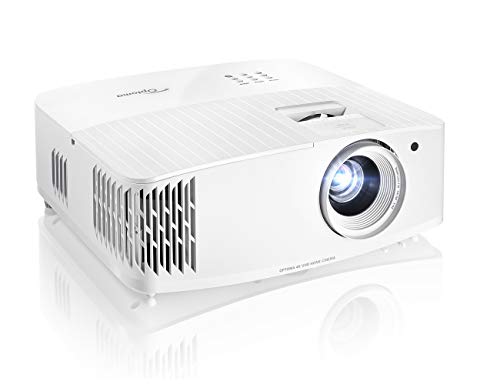
Optoma tunes this UHD35 for gamers with a rated input lag near 15 milliseconds at 1080p and 120Hz, well below most home theater projectors built for film playback. The DLP panel reaches 4K through pixel shifting and is rated at 3600 lumens, bright enough for daytime gaming sessions. Enhanced Gaming Mode toggles directly from the remote without digging through menus.
Pros
- Noticeably lower input lag than film-focused projectors
- High brightness works in partially lit rooms
- Quick toggle between gaming and cinema modes
Cons
- Color accuracy trails the BenQ out of the box
- Fan noise is more noticeable at full brightness
XGIMI Horizon Pro 4K Projector
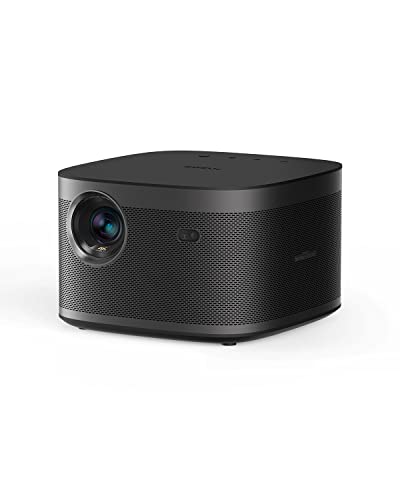
XGIMI combines a laser and LED hybrid light source in this Horizon Pro, aiming for a middle ground between lamp longevity and laser brightness. Native resolution is a true 4K panel rather than pixel shifting, paired with built-in Android TV so no separate streaming stick is needed. Harman Kardon speakers handle audio without an external soundbar for casual viewing.
Pros
- Native 4K panel without pixel shifting
- Streaming apps run without an extra device plugged in
- Built-in speakers are usable without a soundbar
Cons
- Brightness trails dedicated laser models at this price
- Auto focus occasionally needs a manual nudge
Epson LS800 Ultra Short Throw Laser Projector
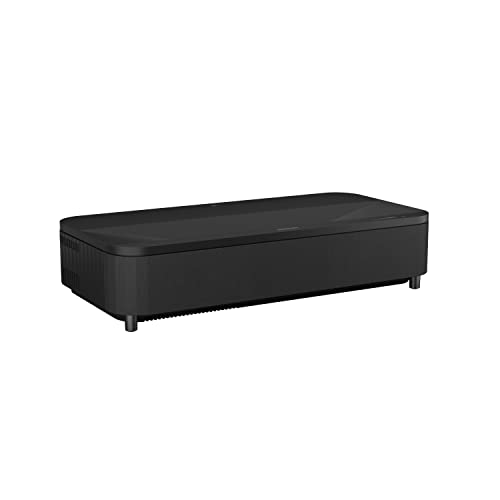
This LS800 projects a large image from a cabinet just inches away from the wall, replacing the ceiling mount and long throw distance a typical projector needs. A laser light source rated at 4000 lumens keeps the image usable with some room light on, closer to a television viewing experience. 3LCD technology again avoids the rainbow artifact seen on single-chip DLP units.
Pros
- No ceiling mount or long cable run required
- High brightness suits a living room with some light
- Laser light source skips lamp replacement
Cons
- Needs a specific screen type for best contrast
- Costs more than a standard throw-distance projector

JMGO N1 Ultra Tri-Laser 4K Projector
JMGO uses a tri-color laser light source in the N1 Ultra, rated at roughly 3300 ISO lumens, among the brightest figures in this lineup. Automatic focus and obstacle avoidance adjust the image when the projector is moved rather than requiring a manual refocus each time. Native resolution reaches 4K without relying on pixel shifting.
Pros
- Highest brightness figure in this lineup
- Automatic focus saves setup time after moving it
- Tri-laser source improves color volume over single-laser designs
Cons
- Premium price compared to lamp-based alternatives
- Fan noise increases noticeably at peak brightness

Anker Nebula Cosmos Laser 4K Projector
Anker’s Nebula Cosmos Laser 4K pairs a laser light source with built-in Fire TV, so streaming apps load without plugging in a separate stick. Brightness is rated around 1500 ANSI lumens, which favors a dim room over a sunlit one. Support for 4K HDR content comes through pixel shifting rather than a native 4K chip.
Pros
- Fire TV built in removes the need for a separate stick
- Laser light source lasts longer than a traditional lamp
- Lower price than most laser competitors here
Cons
- Lower brightness limits daytime use
- Color accuracy trails the BenQ and JMGO
How they compare
| # | Model | Brightness | Best for | Score | Price |
|---|---|---|---|---|---|
| 1 | Epson Home Cinema 2350 3-Chip 3LCD Projector | 2800 lumens | Best overall | 9.3 | Check price |
| 2 | BenQ HT3550 4K HDR Home Theater Projector | 2000 lumens | Best color accuracy for movie night | 9.1 | Check price |
| 3 | Optoma UHD35 4K UHD Gaming Projector | 3600 lumens | Best for gaming | 8.9 | Check price |
| 4 | XGIMI Horizon Pro 4K Projector | 2200 ISO lumens | Best portable lifestyle projector | 8.7 | Check price |
| 5 | Epson LS800 Ultra Short Throw Laser Projector | 4000 lumens | Best ultra short throw | 9.0 | Check price |
| 6 | JMGO N1 Ultra Tri-Laser 4K Projector | 3300 ISO lumens | Best premium brightness | 9.2 | Check price |
| 7 | Anker Nebula Cosmos Laser 4K Projector | 1500 ANSI lumens | Best value smart projector | 8.5 | Check price |
Before you buy
What picture quality actually depends on Resolution gets the headline, but brightness measured in lumens and how evenly that light spreads across the image matter just as much for a sharp-looking picture. A dim 4K projector in a bright room often looks worse than a brighter 1080p unit. Color coverage figures, like the Rec.709 percentage BenQ publishes for the HT3550, describe how close colors land to a studio reference rather than just how saturated they look.
Native 4K, pixel shifting and light source choices A native 4K panel, like the one in the XGIMI Horizon Pro or JMGO N1 Ultra, displays every pixel directly. Pixel-shifting designs, common on DLP projectors like the BenQ HT3550 and Optoma UHD35, flash a lower resolution chip twice per frame at a slight offset to approximate 4K detail. Light source matters too: lamps are cheaper upfront but dim over time and need replacement, while laser and laser hybrid sources hold brightness longer and skip that maintenance.
Best for a dark room versus a bright living room A dedicated dark room rewards color accuracy over raw brightness, which is why the BenQ HT3550’s lower lumen count still produces a strong image once the lights go off. A living room with windows or evening lamp use needs the higher brightness of the Epson Home Cinema 2350, Epson LS800 or JMGO N1 Ultra to keep the picture from washing out. Ultra short throw models like the LS800 also suit rooms where a ceiling mount is not practical.
Gaming and input lag considerations Input lag, the delay between a controller press and the image updating, matters far more for competitive gaming than for watching a film. The Optoma UHD35’s roughly 15 millisecond lag at 1080p and 120Hz stands out because most home theater projectors optimize for smooth video processing instead, which adds lag. Anyone splitting time between movies and fast-paced games should confirm a projector has a dedicated low-lag or game mode before buying.
Questions worth asking
Is 4K necessary for a good quality projector picture?
Not always. A bright, color-accurate 1080p projector can look sharper in practice than a dim 4K one, especially on a smaller screen size where pixel density matters less than contrast and brightness.
What is the difference between lumens and ANSI lumens?
ANSI lumens follow a standardized measurement method across a nine-point grid, making it a more comparable figure between brands than a manufacturer’s own lumen rating, which can be measured less consistently.
Do laser projectors look better than lamp based projectors?
Laser light sources generally hold consistent brightness and color longer over thousands of hours, while lamps dim gradually and eventually need replacement. Picture quality at the time of purchase depends more on the specific model than the light source alone.
Can projectors work well with some daylight in the room?
Higher lumen models like the Epson LS800 or JMGO N1 Ultra handle some ambient light better than lower-brightness home theater units like the BenQ HT3550, which are built for darker rooms.
What is the difference between native 4K and pixel-shifted 4K?
Native 4K panels, found in projectors like the XGIMI Horizon Pro, display the full pixel count directly. Pixel-shifted designs flash a lower resolution chip rapidly at a slight offset to approximate the same detail, a common and effective technique on DLP projectors.
Do I need a special screen for a projector?
A dedicated screen improves contrast and color uniformity over a painted wall, and ultra short throw models like the Epson LS800 often benefit most from a screen designed for their specific throw angle.
Is throw distance the same for every projector?
No. Standard throw projectors need several feet of distance to fill a screen, while ultra short throw models like the LS800 sit just inches from the wall, which changes where the unit can be placed in a room.
How long do projector lamps typically last?
Lamp life varies by model and brightness setting, but many lamp-based projectors are rated for several thousand hours before brightness drops noticeably, after which a replacement bulb restores output.
Is higher brightness always better for picture quality?
Not for every room. A dark dedicated theater space often looks better with a lower-lumen, higher color-accuracy model like the BenQ HT3550 rather than a projector tuned for daytime brightness.
Does a projector or a television give better picture quality?
A well-placed, bright projector can match or exceed a television’s perceived sharpness at large screen sizes, but televisions generally hold an edge in contrast and color in a fully lit room.
Final word
The BenQ HT3550 is the pick for anyone prioritizing accurate color in a dim or dark room, since its Rec.709 coverage beats the rest of this lineup out of the box. Living rooms with daytime use or evening lamps are better served by the brighter Epson Home Cinema 2350 or Epson LS800. Gamers who care more about responsiveness than color precision should choose the Optoma UHD35 for its lower input lag instead.
Marcus Chen
Marcus covered consumer electronics for enthusiast tech publications for six years before joining ChoiceCrest. He specializes in translating manufacturer spec sheets into plain-language buying advice, with a focus on audio, computing accessories and smart-home gear.


