Which Wheel Chocks Actually Hold a Loaded Trailer?
MaxxHaul’s rubber wheel chock holds the heaviest loads on asphalt and gravel without sliding. Komokeru’s four-pack plastic chocks suit owners who want spares for a dual-axle trailer, and Nilight’s compact stoppers fit smaller cars and light trailers better than full-size rubber chocks.
A chock that slides under load does nothing, and plastic chocks rated for a sedan will not hold a loaded equipment trailer on a slope. MaxxHaul’s rubber wheel chock uses an oil-resistant rubber compound with a steel eyebolt for securing it in place, handles heavier trailers reliably, and only loses ground on cost against basic plastic multi-packs.
We compared chocks by the material’s grip on asphalt and gravel, published weight ratings, and how many chocks come in a set. Owners with dual-axle trailers need more chocks on hand than single-axle owners, which shaped several of these picks.
What matters most
Rubber versus plastic chocks Rubber chocks grip smooth or oily surfaces noticeably better than hard plastic and generally hold higher weight ratings. Plastic chocks are lighter, cheaper, and easier to carry in multiples, which makes them a reasonable fit for lighter trailers and casual use.
How many chocks a trailer actually needs A single-axle trailer typically needs just one chock per side, but a dual-axle or tandem trailer benefits from chocking both axle positions, which means four chocks rather than two. Buying a 4-pack upfront, like Komokeru’s or HOXWELL’s, avoids a second purchase later.
Matching weight rating to your trailer Check the chock’s published weight rating against your trailer’s loaded weight, not its empty weight, since an underrated chock can compress or slip under a heavier load than it was designed for. Solid rubber designs like Extreme Max’s generally rate higher than hollow plastic chocks.
For light trailers, cars, and compact storage Owners with a small utility trailer or a car that occasionally needs chocking do not need full-size rubber chocks. Compact options like Nilight’s stoppers or the Amazon Basics 2-pack cover that lighter use case without the bulk of commercial-grade rubber.
The best picks, ranked

MaxxHaul 70459 Rubber Wheel Chock
This rubber chock grips asphalt and gravel better than plastic alternatives thanks to an oil-resistant compound that stays tacky in hot and cold weather. A steel eyebolt lets owners tie it off or hang it for storage.
Pros
- Rubber grips far better than hard plastic on smooth surfaces
- Steel eyebolt allows secure tie-off or hanging storage
- Handles heavier trailers than most plastic chocks
Cons
- Heavier to carry than plastic multi-packs
- Costs more per chock than basic sets

Komokeru Wheel Chocks with Rope
Komokeru’s set gives dual-axle trailer owners four chocks instead of the usual pair, which actually matches how many wheels need chocking on a tandem-axle setup. A rope on each chock makes retrieval easier from under the trailer.
Pros
- Four chocks match dual-axle trailers without buying two sets
- Pull rope simplifies removal from under the wheel
- Lightweight plastic is easy to store and carry
Cons
- Less grip than rubber on wet or oily pavement
- Lower weight rating than solid rubber chocks
OULEME Heavy Duty Rubber Wheel Chocks
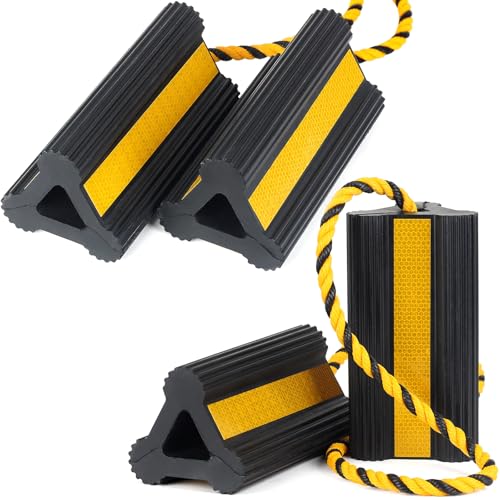
OULEME’s rubber chocks add both an eyebolt and a rope, giving two different ways to anchor or retrieve the chock depending on the situation. The rubber compound resists oil and fuel exposure near the trailer tires.
Pros
- Dual anchoring options with eyebolt and rope
- Oil and fuel resistant rubber compound
- Anti-slip base holds on wet pavement
Cons
- Comes in a pack of two, not enough for dual-axle alone
- Rubber weight adds to storage bulk

Nilight Heavy Duty Wheel Stoppers
Nilight’s stoppers are sized smaller than full trailer chocks, aimed at cars, light utility trailers, and small campers rather than heavy equipment haulers. The compact size also makes them easier to store in a tight trunk or compartment.
Pros
- Compact footprint fits tight trunks and compartments
- Lighter weight than full-size rubber chocks
- Affordable for light-duty use
Cons
- Not rated for heavy equipment or cargo trailers
- Smaller size offers less holding force on slopes
HOXWELL Non-Slip Wheel Chocks
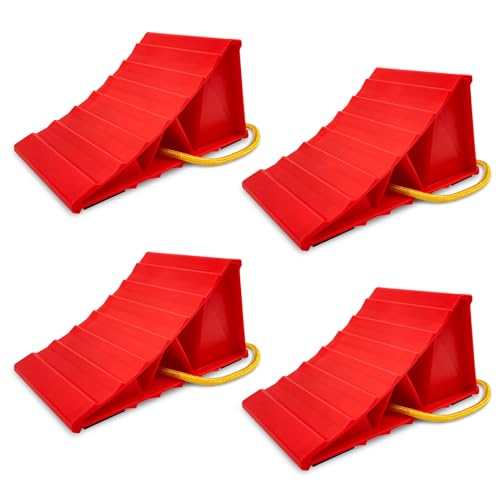
HOXWELL sells these as two pairs, which again lines up with chocking all four wheel positions on a tandem-axle trailer. A ridged non-slip base adds grip beyond what smooth plastic chocks offer.
Pros
- Four-chock set matches tandem-axle wheel positions
- Ridged base adds grip over smooth plastic designs
- Lightweight enough to carry all four at once
Cons
- Still less grip than rubber on oily surfaces
- Bulkier to store than a standard 2-pack

Amazon Basics Automotive Wheel Chocks
This is the no-frills option for owners who just need basic chocks for occasional use and do not need extra hardware or rope accessories. It covers light trailers and daily driver cars without added cost.
Pros
- Lowest cost option on this list
- Simple design with no extra parts to lose
- Adequate grip for light, occasional use
Cons
- No rope or eyebolt for retrieval or anchoring
- Not suited to heavier equipment trailers

Extreme Max 5001.5772.4 Solid Rubber Wheel Chock
Extreme Max molds these chocks from solid rubber rather than a hollow shell, giving them more resistance to crushing under heavy RV or commercial trailer weight. A molded handle makes carrying a full four-pack easier.
Pros
- Solid rubber resists crushing under heavy loads
- Four-chock pack suits dual-axle RVs and trailers
- Molded handles simplify carrying the full set
Cons
- Heaviest option on this list to store and carry
- Priced above plastic multi-packs
Side by side
| # | Model | Material | Best for | Score | Price |
|---|---|---|---|---|---|
| 1 | MaxxHaul 70459 Rubber Wheel Chock | Oil-resistant rubber | Best overall | 9.2 | Check price |
| 2 | Komokeru Wheel Chocks with Rope | Hard plastic | Best value multi-pack | 8.6 | Check price |
| 3 | OULEME Heavy Duty Rubber Wheel Chocks | Rubber | Best for secure anchoring | 8.7 | Check price |
| 4 | Nilight Heavy Duty Wheel Stoppers | 8.7 x 4.8 x 4.2 in | Best compact size | 8.3 | Check price |
| 5 | HOXWELL Non-Slip Wheel Chocks | Hard plastic | Best for dual-axle trailers | 8.4 | Check price |
| 6 | Amazon Basics Automotive Wheel Chocks | Plastic | Best budget | 8.0 | Check price |
| 7 | Extreme Max 5001.5772.4 Solid Rubber Wheel Chock | Solid rubber | Best for heavy commercial and RV use | 9.0 | Check price |
Good to know
Are rubber or plastic wheel chocks better?
Rubber chocks grip better on smooth, wet, or oily pavement and generally hold higher weight ratings, while plastic chocks are lighter and more affordable for lighter-duty use. The right choice depends on trailer weight and the surfaces you typically park on.
How many wheel chocks do I need for a dual-axle trailer?
Most owners chock both axle positions on a tandem trailer, which means four chocks total rather than the two that work for a single-axle trailer. Buying a 4-pack upfront avoids needing a second set later.
What weight rating do wheel chocks need?
Match the chock’s rating to your trailer’s loaded weight, including cargo, not just the empty trailer weight. Heavier equipment and cargo trailers need rubber chocks rated well above basic plastic designs.
Can wheel chocks replace a parking brake?
No, chocks supplement the parking brake and leveling jacks rather than replacing them. They are meant to stop rolling if the brake or jack fails, not serve as the primary method of keeping a trailer stationary.
Do wheel chocks work on gravel and dirt?
Most chocks work on gravel and dirt, but a wider, grippier base like rubber chocks offer handles loose surfaces better than smaller plastic chocks, which can shift on loose gravel under heavier loads.
How do I retrieve a chock from under a heavy trailer tire?
Chocks with an attached rope or pull strap, like Komokeru’s or HOXWELL’s, let you pull the chock free without reaching directly under the tire. This matters more on loaded trailers where the chock compresses under weight.
Will plastic chocks crack in cold weather?
Plastic chocks can become more brittle in freezing temperatures, especially older or lower-quality plastic. Rubber chocks generally hold up better across a wider temperature range.
Can I chock a car with trailer-rated wheel chocks?
Yes, trailer chocks generally exceed what a typical car needs, though a compact chock like Nilight’s or Amazon Basics’ is easier to store in a car’s trunk than a full-size rubber trailer chock.
The verdict
The MaxxHaul 70459 is the strongest all-around pick for anyone towing a moderately loaded trailer on mixed surfaces. Owners with a dual-axle RV or heavy commercial trailer should step up to the Extreme Max solid rubber 4-pack instead, since it is built for sustained heavier loads across all four wheel positions. Drivers with a light utility trailer or car get more practical value from a compact set like Nilight’s than from oversized rubber chocks they will rarely need at full capacity.
Tony Russo
Tony trained as an automotive technician and spent years in service and parts retail before moving into writing. He focuses on garage tools, car care products and accessories from a hands-on maintenance perspective.