Why Do Wheel Chocks Matter Even When a Vehicle Is in Park?
Park relies on a small mechanical pawl inside the transmission, and the parking brake relies on friction at the pads or shoes, and both of those can slip or wear enough to let a heavy vehicle creep, especially on a slope or under load. A wheel chock adds a purely physical block against the tire itself that does not depend on anything staying mechanically engaged, which is exactly why it still earns a place in situations that already feel secured.
What Park actually does mechanically
Shifting into Park engages a small parking pawl that drops into a notch on a gear inside the transmission. That pawl is a relatively small component, not designed to hold a loaded vehicle indefinitely on a steep grade, and repeated strain can bend or wear it enough to let the gear slip past over time. Manufacturers generally describe the pawl as a backup to the parking brake, not the primary holding mechanism, which many drivers don’t realize.
Why a parking brake alone isn’t always enough on a grade
A parking brake works through friction at the brake pads or shoes, and that friction can be overcome by enough weight on a slope, especially if cables have stretched over time or the surface is wet, icy, or loose gravel reducing the brake’s effective grip. A trailer or heavy load adds weight the parking brake wasn’t necessarily adjusted to hold with full margin, which compounds the risk further on an incline.
Where chocks matter most
Wheel chocks are most important when leveling jacks are extended under an RV or trailer, since those jacks are rated for vertical support, not for resisting horizontal rolling. They also matter when changing a tire, since a jack can shift if the vehicle moves even slightly while raised, and when working underneath any vehicle parked on so much as a gentle slope.
What can happen without a chock in these situations
A jack can slip out from under a vehicle that shifts slightly during a tire change, an RV can roll a few inches while a trailer is being hooked up or unhooked, and repeated rocking on a slope can gradually stress a parking pawl toward failure. None of these outcomes require a steep hill, since even a subtle grade most people wouldn’t notice while walking can be enough under the right load.
Where to place chocks for the best effect
Chocks go against the side of the wheel the vehicle would roll toward if it moved, typically both front and back of one wheel when the direction of a potential roll isn’t completely certain, with the chock size matched to the tire’s diameter for a secure wedge. Placing a chock against a tire that’s already fully stopped, rather than trying to wedge it under a rolling wheel, gives the most reliable hold.
Chocks versus wheel stops versus tire locks
A wheel chock is a temporary, portable wedge placed by hand for a specific task, a wheel stop is a permanent fixture built into a parking space, and a tire lock or clamp is an anti-theft device, not a rolling-prevention tool, so each serves a different purpose despite looking similar. Confusing the three can lead someone to assume a parking space’s built-in wheel stop offers the same protection a portable chock would during active jacking or leveling work, which it doesn’t.

Camco 44432 Wheel Chock
A widely used rubber wheel chock sized for RV and trailer tires during leveling and parking.
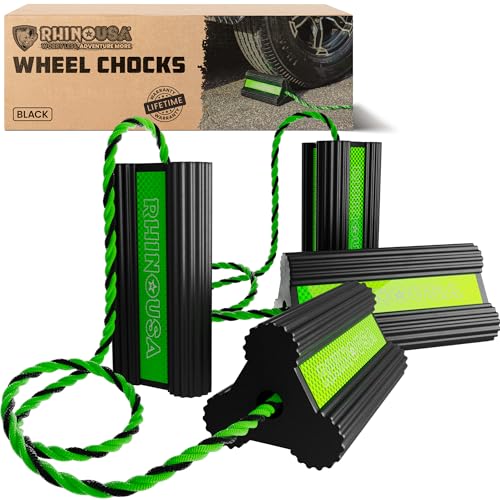
Rhino USA Wheel Chock Chalks
A set of heavy-duty rubber chocks often used for vehicles, trailers, and equipment on uneven ground.
Common questions
Can a car roll in Park on a steep hill without a chock?
Yes, though uncommon, a parking pawl can slip or bend under enough sustained weight on a steep enough grade, letting the vehicle creep slightly or more.
Do wheel chocks replace the need for a parking brake?
No, a chock works alongside the parking brake as an added physical block, not as a substitute for using the brake in the first place.
Why do RVs need wheel chocks when leveling?
Leveling jacks are rated for vertical support only, so a chock prevents the RV from rolling horizontally while the jacks bear the vehicle’s weight.
Can using a jack without a wheel chock be dangerous?
Yes, if the vehicle shifts even slightly while raised, an unchocked wheel on the ground can roll and cause the jack to slip out from under the car.
Do wheel chocks work on ice or loose gravel?
They are less effective on very slick or loose surfaces, since the chock itself can slide, so extra caution or additional chocks are often needed there.
How many chocks does a typical RV or trailer need?
Most RVs use at least one chock per axle side, with some owners adding a second chock on the opposite side of the same wheel for extra security.
Can wheel chocks damage tires if left too long?
Properly sized rubber chocks placed for normal durations don’t damage tires, though leaving a vehicle resting against a hard-edged chock for months isn’t ideal.
Should wheel chocks be used on a flat driveway?
They’re less critical on a truly flat surface, but still useful during jacking or hitching tasks where any unexpected movement could be a problem.
What size wheel chock fits a given tire?
Chock size is typically matched to tire diameter, with manufacturers listing a tire size range each chock model is designed to wedge securely against.
Is rubber or plastic better for wheel chocks?
Rubber generally grips the ground and tire surface better than hard plastic, which can slide more easily on smooth or wet pavement.
Do wheel chocks prevent a parking pawl from failing?
They don’t prevent wear on the pawl itself, but they remove the load that would otherwise rely on the pawl holding the vehicle in place.
Can a chock pop out from under a vehicle once placed?
It can if undersized for the tire or placed at the wrong angle, which is why matching chock size to tire diameter and firm placement both matter.
Should chocks be placed uphill, downhill, or both sides of the wheel?
Placing a chock on the downhill side blocks the most likely direction of roll, though chocking both sides removes any doubt about which way the vehicle might move.
Do mechanics use wheel chocks differently than RV owners?
Mechanics typically chock a wheel opposite the one being lifted during repairs, while RV owners chock wheels to stabilize the rig during leveling or hitching.
Is it safe to tow a trailer without chocking it first during hookup?
Skipping a chock during hookup risks the trailer rolling slightly while it’s only partially connected, which is exactly the moment a chock is most useful.
Can automatic transmissions be more prone to Park failure than manuals?
Automatics rely specifically on the parking pawl design discussed here, while manual transmissions left in gear use engine compression instead, which carries its own separate set of limitations on a grade.
Do heavier vehicles need larger or additional wheel chocks?
Yes, a heavier vehicle or a loaded trailer puts more force against a chock, so using a correctly rated, larger chock matters more as weight increases.
Can temperature affect how well a rubber wheel chock performs?
Extreme cold can make rubber slightly stiffer and less grippy initially, though most quality chocks are designed to perform reasonably well across a normal range of outdoor temperatures.
Is it necessary to chock a vehicle on level pavement before an oil change?
Many shops still chock a wheel during an oil change as a basic precaution, since even a seemingly flat shop floor can have a slight unnoticed grade.
Do wheel chocks need to be replaced periodically?
Rubber chocks can crack or harden with age and UV exposure, so inspecting them occasionally and replacing a chock that looks worn is a reasonable habit.
Where this leaves you
Park and a parking brake are both mechanical systems that can wear, slip, or lose grip under the wrong conditions, which is why they shouldn’t be the only thing holding a vehicle still during jacking, leveling, or hitching. A chock adds a block that doesn’t depend on anything staying engaged, which is the whole reason it still matters even when a vehicle already looks parked, and why it remains standard practice among people who work under vehicles regularly.
Tony Russo
Tony trained as an automotive technician and spent years in service and parts retail before moving into writing. He focuses on garage tools, car care products and accessories from a hands-on maintenance perspective.


