Tool Chests Compared by Slides, Steel Gauge and Casters
CRAFTSMAN’s 26-Inch 5-Drawer CMST82765BK balances drawer capacity with ball bearing slides for a typical home garage. Torin’s Big Red rolling chest packs the most drawer volume against its price point. Milwaukee’s PACKOUT 3-Drawer Tool Box suits tradespeople moving tools between a truck and a jobsite daily.
CRAFTSMAN’s CMST82765BK suits a typical home garage best, Torin’s Big Red rolling chest delivers the most drawer space for the outlay, and Milwaukee’s PACKOUT system wins once tools need to travel.
Drawer counts sell tool chests, yet a count alone says nothing about whether a loaded drawer still glides smoothly in three years. We compared slide types, published per-drawer load ratings, steel gauge and caster specs across seven widely stocked listings, weighting hardware durability over headline drawer numbers.
The shortlist, ranked
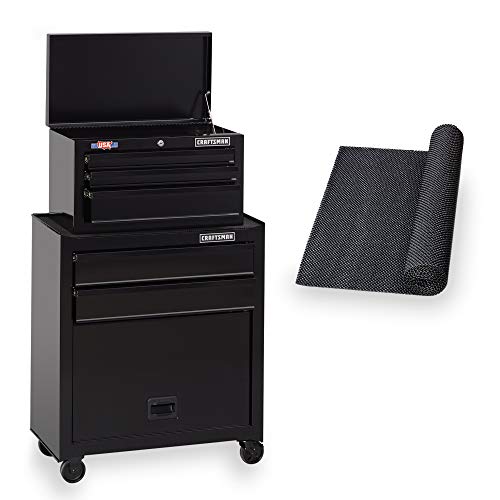
CRAFTSMAN 26-Inch 5-Drawer Tool Chest CMST82765BK
Ball bearing slides sit on all five drawers, so a loaded socket set won’t bind the mechanism. Width matches common 26 inch rolling cabinets, letting owners add a base later without replacing the top chest. Drawer liners hold their position better than many chests in this class, according to owner feedback.
Pros
- Ball bearing slides on every drawer
- 26 inch width fits standard rolling cabinets
- Lid compartment holds long or bulky items
Cons
- Sits on a bench rather than rolling on its own
- Lock is a single basic mechanism

Torin Big Red Rolling Tool Chest with Drawers
Pairing a rolling cabinet with a top chest gives more drawer volume than the price point suggests. Steel gauge falls short of jobsite grade chests, though a dry home garage rarely tests that limit. Front casters lock according to the listing, which helps on a sloped garage floor.
Pros
- Large drawer volume for the price
- Locking front casters hold position on slopes
- Mixed drawer depths fit varied tool sizes
Cons
- Steel gauge thinner than professional chests
- Assembly takes longer than a pre-built unit

VEVOR Rolling Tool Chest with Drawers
Deep lower drawers hold power tools that won’t fit a standard shallow chest, the usual reason a first cabinet gets outgrown. Heavy duty casters roll well once loaded, and the top surface doubles as a small work area. Owners report the cabinet gets heavy fast, so plan its final position before filling it.
Pros
- Deep drawers fit corded and cordless power tools
- Casters handle a fully loaded cabinet
- Top surface works as extra bench space
Cons
- Weight makes repositioning difficult once loaded
- Finish shows scuffs faster than painted steel

Seville Classics UltraHD Rolling Storage Cabinet
Heavier gauge steel and a stainless-look top give this cabinet more rigidity than typical garage storage at this level. A cupboard section joins the drawers, useful for chemicals and larger items next to hand tools. Large diameter casters roll smoothly over expansion joints in a garage floor.
Pros
- Heavy gauge steel resists denting under load
- Cupboard plus drawer layout adds flexibility
- Large casters roll over floor joints easily
Cons
- Fewer drawers than a dedicated tool chest
- Footprint demands more floor space than a chest

Homak 27-Inch 6-Drawer Rolling Tool Cabinet
Six drawers across a 27 inch width let tools sit in separate categories instead of one crowded layer. A single lock secures every drawer at once, useful in a garage shared with family or roommates. This layout has stayed common in home workshops for years, per the listing history.
Pros
- Six drawers give better sorting than a basic chest
- One lock secures the entire cabinet
- Familiar layout backed by a long production run
Cons
- Drawers run shallow for bulky power tools
- Slides perform adequately rather than smoothly

Keter Rolling Tool Chest with Storage Drawers
Resin construction can’t rust, the deciding factor in an unheated garage or a coastal shop where steel corrodes. Weight drops well below a steel equivalent, so moving it around takes less effort. Drawer action stays quieter than steel too, though load capacity per drawer trails steel chests.
Pros
- Resin body eliminates rust risk entirely
- Lighter weight simplifies repositioning
- Quieter drawer action than steel equivalents
Cons
- Load rating per drawer sits below steel chests
- Panels flex under very heavy loads

Milwaukee PACKOUT 3-Drawer Tool Box
Drawers clip onto Milwaukee’s PACKOUT stacking system, so tools travel to a job instead of staying in one cabinet. A weather sealed lid keeps contents dry when closed, even in a truck bed. Tradespeople and anyone splitting time between shop and jobsite gain the most from this setup.
Pros
- Modular drawers move between truck and shop
- Weather sealed lid protects contents outdoors
- Compatible with a wide PACKOUT accessory lineup
Cons
- Cost per drawer runs higher than a static chest
- Value depends on buying into the PACKOUT system
How they compare
| # | Model | Width | Best for | Score | Price |
|---|---|---|---|---|---|
| 1 | CRAFTSMAN 26-Inch 5-Drawer Tool Chest CMST82765BK | 26 inches | Best overall | 9.4 | Check price |
| 2 | Torin Big Red Rolling Tool Chest with Drawers | Rolling chest with drawers | Best value | 9.2 | Check price |
| 3 | VEVOR Rolling Tool Chest with Drawers | Rolling cabinet | Best for large collections | 9.0 | Check price |
| 4 | Seville Classics UltraHD Rolling Storage Cabinet | Rolling cabinet with drawers and cupboard | Best build quality | 8.8 | Check price |
| 5 | Homak 27-Inch 6-Drawer Rolling Tool Cabinet | 27 inches | Best drawer count | 8.5 | Check price |
| 6 | Keter Rolling Tool Chest with Storage Drawers | Weather resistant resin | Best for damp garages | 8.2 | Check price |
| 7 | Milwaukee PACKOUT 3-Drawer Tool Box | Modular stacking drawer box | Best portable | 8.0 | Check price |
How to choose
What to check before buying a tool chest Friction slides feel fine empty and bind the moment a drawer holds a socket set. Ball bearing slides cost more upfront and keep gliding under a full load, the single spec worth prioritizing. Check the stated per-drawer load rating too. A chest advertising a large total capacity can still rate each individual drawer for very little.
How much drawer depth do you actually need? Shallow drawers suit wrenches, sockets and screwdrivers because everything stays visible in one layer. Power tools, grinders and cordless kits need deep drawers instead. An all-shallow chest pushes bulky items onto the floor, while an all-deep chest turns into a pile you dig through. Match the mix to how your own collection actually breaks down.
Rolling cabinet or static top chest, and where it sits A static top chest costs less and takes no floor space, but it can’t follow tools to the truck. Rolling cabinets are standard in most garages, and caster diameter matters more than shoppers expect since small wheels catch on floor joints and cracked concrete. Locking casters become essential the moment a garage floor slopes.
Which build handles a damp or unheated garage best? Thicker steel resists denting and keeps drawers square under load, the trait separating a professional chest from a budget one at matching drawer counts. Condensation is the real threat in an unheated or coastal garage, and powder coating plus a rust inhibitor packet extends steel drawer life. Resin cabinets sidestep corrosion entirely, trading away some load capacity to do it.
Common questions
How many drawers does a home garage tool chest need?
Five or six drawers gives enough separation to find tools quickly in most home garages. Beyond that count, you’re buying sorting convenience rather than extra capacity, worthwhile for anyone working on cars regularly.
Are ball bearing slides worth paying extra for?
Yes. They’re the difference between a loaded drawer that opens with one finger and one that needs to be wrestled open. Check this spec before anything else on a tool chest listing.
Should you buy a rolling cabinet, a top chest, or both?
A rolling cabinet alone makes the most flexible starting point. Adding a matching top chest later doubles storage without adding floor space, so pick a cabinet width that a future chest can match.
How do you keep tools from rusting in a tool chest?
Line the drawers, keep the garage as dry as possible, and add rust inhibitor packs alongside steel tools. Wiping tools down before storing them matters more than any single chest feature.
What weight can a tool chest drawer hold?
Budget chests often rate drawers around 20 to 40 pounds each, while professional models rate them well above that. Check the per-drawer figure on the listing rather than the cabinet’s total stated capacity.
Do tool chests need a lock?
In a shared garage, a rental unit, or any space with children nearby, yes. A single lock covering every drawer proves far more convenient than separate locks per drawer.
Are resin tool chests as good as steel ones?
Resin performs better in damp or coastal conditions where steel corrodes, and it’s lighter to move. It carries less weight per drawer, so keep the heaviest steel tools in a separate steel cabinet.
Tool chest vs rolling tool cabinet, what’s the difference?
A tool chest sits on a bench or another cabinet and doesn’t move on its own. A rolling cabinet adds casters underneath, letting the whole unit travel across a garage or shop floor.
Can you move a fully loaded tool chest?
Only short distances, and only on quality casters over a flat floor. A loaded chest can weigh several hundred pounds, so empty the top drawers first and never tow one behind a vehicle.
Is a modular system like PACKOUT worth it over a standard chest?
It’s worth it if tools genuinely travel between a truck, jobsite and shop. A static chest costs less per drawer for tools that stay in one garage.
The verdict
CRAFTSMAN’s CMST82765BK suits most home mechanics first, since ball bearing slides and a standard 26 inch footprint mean it works now and expands later. Torin’s Big Red rolling chest wins on raw drawer volume against its price point. Milwaukee’s PACKOUT 3-Drawer Tool Box makes sense once tools need to leave the garage regularly.
Jake Monroe
Jake worked as a residential contractor for over a decade before shifting to full-time writing. He evaluates power tools, hand tools and workshop gear through the lens of someone who has actually used them on job sites, not just read the box.


