What Makes a Tool Bag Survive a Job Site?
Klein Tools Tradesman Pro Organizer 55421BP-14 leads with a rigid moulded base and 39 clearly laid-out pockets. Veto Pro Pac TECH PAC suits daily professional carry with vertical pockets and a five-year warranty, while the CLC 1539 Tool Carrier delivers the most capacity for the price.
Klein Tools Tradesman Pro Organizer 55421BP-14 stands out for keeping its shape and letting you find a driver without emptying the whole bag. Veto Pro Pac TECH PAC suits professionals carrying tools daily, and CLC’s 1539 delivers broad capacity at a fraction of the outlay.
Bags are hard to compare on paper, since pocket counts say nothing about whether the pockets are the right shape. Fabric denier ratings also don’t reveal how a base handles wet concrete. We compared published dimensions, pocket layouts, base construction, and closure designs, alongside recurring owner reports about zips failing, straps tearing, and bags collapsing when half empty.
Our top picks

Klein Tools Tradesman Pro Organizer 55421BP-14
Thirty-nine pockets and a bright orange interior make finding a specific tool faster, especially in poor light. A moulded base keeps the bag upright on wet or uneven ground and resists the abrasion that wears out cheaper bags first. Owners report the padded shoulder straps stay comfortable even with a full electrical kit loaded in.
Pros
- Moulded base stands up to wet job sites
- Bright interior speeds up finding tools
- Backpack carry keeps hands free on ladders
Cons
- Deeper pockets can swallow small items
- Fully loaded weight builds up quickly
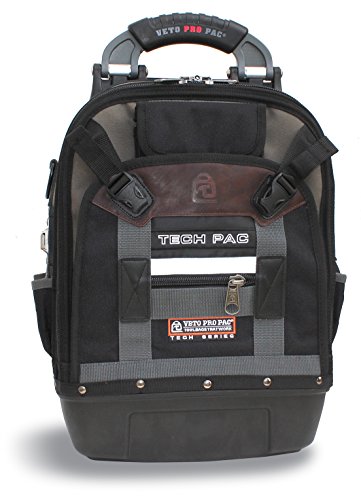
Veto Pro Pac TECH PAC
Vertical tool pockets show every handle at a glance, a genuinely different way of organizing gear than horizontal slots. Heavy 1680 denier fabric, a waterproof injection moulded base, and a five-year warranty back up the higher price. Owners describe it as expensive once, then forgotten about for a decade.
Pros
- Vertical pockets make every tool visible
- Exceptional materials and stitching quality
- Long warranty backs the investment
Cons
- Highest outlay in this group
- Heavy even before tools go in
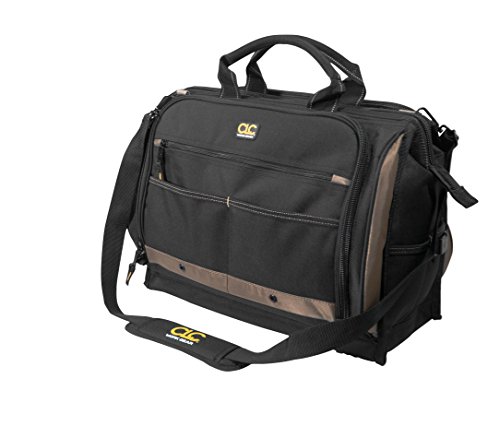
CLC Custom Leathercraft 1539 Multi-Compartment Tool Carrier
An open top and a large central compartment suit anyone who prefers grabbing tools without unzipping anything first. It holds a surprising amount of gear for the price, and padded handles stay comfortable for short carries. No closure means no weather protection, so it fits indoor and van-based work best.
Pros
- Very large capacity for the outlay
- Open top gives instant access to tools
- Comfortable padded handles
Cons
- No closure to keep rain or dust out
- Sides sag when lightly loaded

Milwaukee PACKOUT Tote 48-22-8322
Clipping into the wider PACKOUT stacking system means this tote rides on a rolling box rather than a shoulder. An impact-resistant base and a reinforced frame hold the mouth open while you work. It only makes full sense once you already own, or plan to buy, other PACKOUT components.
Pros
- Locks into the PACKOUT stacking system
- Frame holds the opening wide for access
- Very tough base and fabric
Cons
- Best value only within the PACKOUT ecosystem
- Open design offers no weather cover

DEWALT DGL573 Lighted Tool Bag
An LED light built into the bag itself proves genuinely useful in lofts, crawl spaces, and unlit basements. Thirty-three pockets surround a large central cavity, backed by a moulded base that resists water. Batteries for the light need occasional replacement, the one small ongoing cost.
Pros
- Integrated light helps in unlit spaces
- Solid moulded base for damp ground
- Wide opening for large tools
Cons
- LED batteries need periodic replacing
- Fewer pockets than dedicated organizer bags

Carhartt Legacy Tool Bag 18-Inch
Duck fabric and a rain defender coating make this the most weather-resistant bag in the group. A moulded base and full-length zip pair with a straightforward 18-inch shape that ages well over years of use. Interior organization stays simpler than dedicated trade bags, so small tools need their own pouches.
Pros
- Handles rain far better than untreated bags
- Durable fabric ages well
- Full-length zip keeps contents secure
Cons
- Fewer internal dividers than trade-specific bags
- Heavier fabric adds empty weight

Bucket Boss Bucket Tool Organizer 10030
Wrapping a standard five-gallon bucket with inside and outside pockets turns a bucket you probably already own into a tool caddy. It’s by far the cheapest route to organized tool carry, and the bucket doubles as a seat or a parts washer. No weather protection comes with the basic fabric used here.
Pros
- Cheapest route to organized tool carry
- Bucket doubles as a seat or container
- Pockets on both sides maximize capacity
Cons
- Requires a bucket that isn’t included
- Basic fabric wears faster than trade bags
What matters most
Why the base decides how long a tool bag lasts Fabric bases soak up water from concrete and wear through wherever the bag gets dragged. A moulded rubber or plastic base keeps contents dry, holds the bag upright, and absorbs the abrasion instead of the fabric. It’s the single feature most worth paying extra for.
Tote, backpack, or zipped bag: matching format to your work Open totes work quickest for grabbing tools repeatedly in one spot. Zipped bags protect against rain and dust in transit. Backpacks free your hands for ladders and long walks across a site. Many tradespeople own two formats and switch based on the day’s job.
Why pocket layout matters more than pocket count Fifty shallow pockets are useless if your pliers fall straight into the main cavity instead. Look for narrow sleeves for drivers, wider pockets for meters, and at least one deep central space for larger items. Vertical pocket designs, like Veto Pro Pac uses, make identifying tools much faster.
How much weight a fully loaded tool bag actually carries A large bag tempts you to pack tools you rarely use, and a fully loaded organizer can pass forty pounds. Padded straps and a chest clip help distribute that weight. The real fix is often a smaller daily bag paired with a larger one that stays in the van.
The lineup, side by side
| # | Model | Pockets | Best for | Score | Price |
|---|---|---|---|---|---|
| 1 | Klein Tools Tradesman Pro Organizer 55421BP-14 | 39 total including exterior | Best overall | 9.4 | Check price |
| 2 | Veto Pro Pac TECH PAC | 56 including clear front panels | Best for daily professional use | 9.2 | Check price |
| 3 | CLC Custom Leathercraft 1539 Multi-Compartment Tool Carrier | 50 total | Best value | 9.0 | Check price |
| 4 | Milwaukee PACKOUT Tote 48-22-8322 | Open tote with rigid frame | Best for modular storage | 8.8 | Check price |
| 5 | DEWALT DGL573 Lighted Tool Bag | 33 total | Best for dark work areas | 8.6 | Check price |
| 6 | Carhartt Legacy Tool Bag 18-Inch | Water repellent duck with rain defender | Best weather resistance | 8.3 | Check price |
| 7 | Bucket Boss Bucket Tool Organizer 10030 | 30 inside and outside | Best budget option | 8.0 | Check price |
Questions worth asking
What size tool bag should I buy?
A general repair kit fits in 14 to 18 inches. Electricians and technicians carrying meters and many hand tools usually prefer a backpack or a large organizer. Pick the smallest bag that fits your actual daily kit.
Are tool backpacks better than totes?
Backpacks work better when you climb ladders, walk long distances, or use public transport, since your hands stay free. Totes are faster when you work in one spot all day and keep reaching for different tools.
What fabric should a tool bag use?
Look for 1200 denier polyester as a minimum, with 1680 denier ballistic nylon on premium bags. Denier alone isn’t the whole story, since stitching quality and base construction usually fail before the fabric does.
Are tool bags waterproof?
Very few are fully waterproof. Many have water-resistant moulded bases and treated fabrics that handle a shower, but zips and seams still let water through in sustained rain.
How do I stop a tool bag from sagging?
Choose a bag with a rigid frame or moulded base, and pack heavier tools low and against the sides. Some owners cut a sheet of thin plywood to fit the bottom of a soft bag, restoring its shape.
How should I organise a tool bag?
Keep frequently used tools in outer pockets, put sharp items in dedicated sleeves so they don’t damage the lining, and reserve the central cavity for bulky items. Reviewing contents monthly stops the bag from getting heavier over time.
Can a tool bag be washed?
Most can be emptied, vacuumed out, and scrubbed with warm soapy water and a brush. Avoid machine washing, since it can distort moulded bases and damage stiffeners.
Is a modular tool box system better than a bag?
Systems like PACKOUT work well when you move a large kit between a van and a site, since everything rolls together. A bag stays lighter and faster for smaller jobs, which is why many tradespeople keep both.
What is the best tool bag for electricians?
The Klein Tools Tradesman Pro Organizer 55421BP-14 suits electricians well, with 39 pockets and an orange interior that speeds up finding small parts in poor light.
Tool bag versus tool box, which holds up better on a job site?
A tool bag flexes into tight spaces and rides comfortably on a shoulder or back, while a hard tool box protects contents better from crushing or heavy impact. Many trades carry both, using the box for storage and the bag for daily access.
Our take
The Klein Tools Tradesman Pro Organizer 55421BP-14 suits the most people, combining a durable moulded base with an interior you can actually see into. The Veto Pro Pac TECH PAC is the one to buy for daily professional use, built to outlast several vans, while the CLC 1539 gives most of the capacity for a fraction of the cost. Prioritize the base and pocket layout over headline pocket counts.
Jake Monroe
Jake worked as a residential contractor for over a decade before shifting to full-time writing. He evaluates power tools, hand tools and workshop gear through the lens of someone who has actually used them on job sites, not just read the box.


