Which Solar Path Lights Actually Last All Night?
GIGALUMI Solar Pathway Lights lead this comparison, pairing a proportionate panel with steady output for driveways and garden paths. Beau Jardin Solar Path Lights deliver the lowest cost per light in a large multipack. SOLPEX Solar Garden Lights suit anyone lining a long driveway on a tight budget without sacrificing basic reliability.
GIGALUMI Solar Pathway Lights combine a glass style lens with a panel sized to match the battery, so light output holds up past midnight. Beau Jardin Solar Path Lights spread more light per pack for less, useful for longer garden borders. SOLPEX Solar Garden Lights cost the least per unit, a practical pick for lining a long driveway.
Solar path lights disappoint for a predictable reason. A bright LED paired with a small battery looks great for two hours, then fades fast. Panel size and battery capacity in milliamp hours matter more than the lumen number printed on the box. We compared listed specifications, ingress ratings and stake designs, checked owner feedback after a full winter, then ranked seven sets by the job each does best.
The shortlist, ranked

GIGALUMI Solar Pathway Lights
A stake light with a glass style lens that casts a warm, patterned glow instead of a flat white circle. Panel size matches the battery, which owners credit for longer runtime than similarly priced sets. Metal stakes resist bending in compacted soil better than the plastic stakes used elsewhere in this comparison.
Pros
- Runtime outlasts most sets in this comparison
- Patterned glow rather than harsh glare
- Metal stakes handle firm or compacted soil
Cons
- Not the brightest light in this lineup
- Glass lens needs occasional wiping to stay clear

Beau Jardin Solar Path Lights
Sold in large multipacks with a two piece stake that adjusts for height, useful for clearing low planting. A frosted lens throws light sideways along a walkway instead of straight down. Owners report the sealed head survives wet seasons better than open designs.
Pros
- Low cost per light in larger packs
- Adjustable stake height clears low plants
- Sideways spread suits narrow walkways
Cons
- Two piece stakes loosen in soft soil over time
- Each light is dimmer alone than paired with others

SOLPEX Solar Garden Lights
The cheapest sensible way to line a long driveway, sold in packs large enough to space evenly across real distance. Build quality is basic and runtime trails the premium sets here. Low price per unit makes replacing a broken light painless rather than a budget concern.
Pros
- Lowest price per light in this comparison
- Enough units included to cover a long run
- Installs in minutes with no tools
Cons
- Shorter runtime than the premium sets above
- Plastic housing fades faster under strong sun

Linkind Solar Pathway Lights
Built for anyone who wants a path genuinely lit rather than gently marked, using a higher output LED and a battery sized to support it. That extra draw makes full sun placement more important than with dimmer sets. Based on specifications, it is one of the few sets here suited to lighting steps safely.
Pros
- Bright enough to make steps safer at night
- Larger panel supports the higher power draw
- Even beam spread instead of hot spots
Cons
- Needs direct sun to reach full runtime
- Costs more per light than budget multipacks

URPOWER Solar Lights 2-in-1
Switches between a ground stake and a wall mount, useful where a path runs beside a fence or garage wall. The head tilts, so light aims at the walking surface instead of a neighbour’s window. Mounting hardware is the part owners say to inspect after a season outdoors.
Pros
- Two mounting options built into one fixture
- Tilting head directs light where it is needed
- Works on hard ground where stakes will not go
Cons
- Cool white reads harsher than warm white sets
- Wall mount hardware needs periodic checking
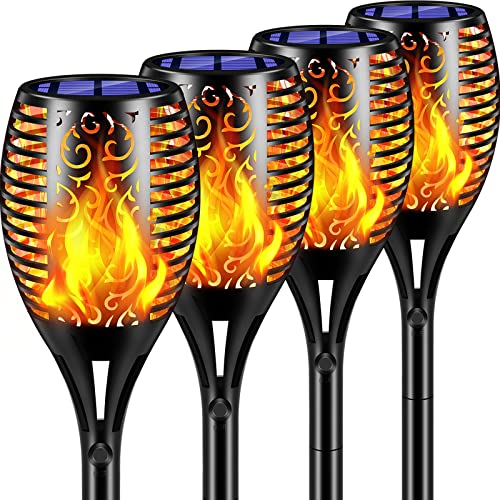
TomCare Solar Lights Flickering Flame Torch
A flame effect torch that marks a path edge with movement instead of illuminating the ground. It stands out along a patio border or driveway entrance, though it will not help anyone see where they are stepping. Best treated as garden decoration that happens to run on solar power.
Pros
- Distinctive flicker effect along garden borders
- Tall enough to read above surrounding planting
- No wiring or upkeep beyond occasional cleaning
Cons
- Not functional lighting for an actual walkway
- Tall stakes catch wind in exposed locations
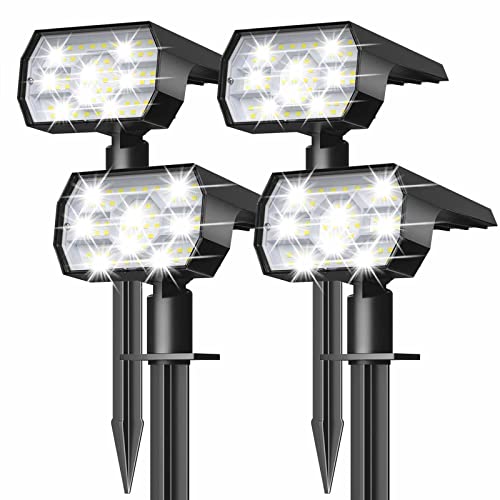
LITOM Solar Landscape Spotlights
A directional spotlight for washing light up a tree, house number or garden feature beside a path. Paired with low stake lights, it adds depth that path lights alone cannot create. Panel and head adjust separately, which helps when the best light angle and the best sun angle differ.
Pros
- Panel and head aim in different directions
- Adds visual depth alongside standard path lights
- Two mounting methods included in the package
Cons
- Not a path light in the usual sense
- Narrow beam requires careful aiming to work well
The lineup, side by side
| # | Model | Light colour | Best for | Score | Price |
|---|---|---|---|---|---|
| 1 | GIGALUMI Solar Pathway Lights | Warm white | Best overall | 9.4 | Check price |
| 2 | Beau Jardin Solar Path Lights | Warm white | Best value | 9.2 | Check price |
| 3 | SOLPEX Solar Garden Lights | Warm white | Best budget | 9.0 | Check price |
| 4 | Linkind Solar Pathway Lights | Warm white, higher output | Best for brightness | 8.8 | Check price |
| 5 | URPOWER Solar Lights 2-in-1 | Ground stake or wall mount | Best for flexible placement | 8.6 | Check price |
| 6 | TomCare Solar Lights Flickering Flame Torch | Flickering flame LEDs | Best decorative option | 8.3 | Check price |
| 7 | LITOM Solar Landscape Spotlights | Adjustable spotlight | Best for highlighting features | 8.0 | Check price |
What to look for
What to check before buying solar path lights Battery capacity matters more than the lumen number on the box. A high output LED paired with a small battery gives a bright evening and a dark early morning. Check for a stated milliamp hour rating and battery chemistry; lithium cells outperform older nickel metal hydride cells in cold weather. Sets that publish neither figure often hide a small cell inside. Replaceable batteries are worth seeking out, since the cell fails long before the LED does.
Does placement affect solar light performance more than price Placement decides output far more than brand does. A light shaded by a tree or fence rarely reaches full charge, no matter its rating. Solar panels need several hours of direct sun, and winter sun sits low enough to change shadow patterns across seasons. Walk the path at midday in winter, not summer, before choosing where each light goes. Keep panels clear of leaf litter and pollen for steady charging.
Which solar lights work for steps and slopes Marking a path differs from lighting it. Most solar path lights outline the edge of a walkway, which suits a level garden path well enough. Steps, slopes and uneven ground need real illumination, meaning a brighter fixture with a larger panel or a mains powered low voltage system. Deciding which job you need first avoids the common letdown of a pretty but still hard to navigate path.
How winter and rain affect solar path lights Rain and snow exposure calls for a stated ingress rating. Look for IP44 or better against rain, and IP65 where sprinklers hit the fixture directly. Cold weather reduces battery capacity, so runtime drops in winter even with a clean panel. In heavy snow regions, many owners lift the lights, wipe the panels and store them until spring, a habit that extends how many seasons a set lasts.
Questions worth asking
How long do solar path lights stay lit at night?
A well matched panel and battery typically runs six to eight hours in summer. That drops to three or four hours in midwinter, when charging hours are short and cold reduces capacity. Any listing claiming a full night of bright output year round is overstating it.
Do solar path lights work in winter?
They keep working, just for shorter stretches. Short days, a low sun angle and cold temperatures all cut into battery capacity. Wiping snow and leaves off the panel helps considerably, and lithium battery models handle cold better than older cell types.
Can you replace the batteries in solar path lights?
Many sets use a common rechargeable size sold in hardware stores, so yes. Swapping tired cells after two or three seasons restores most of the original runtime for very little cost. Sealed units without a battery door are effectively disposable once the cell wears out.
How far apart should solar path lights be spaced?
Six to eight feet apart is standard guidance for a marked path. Space them closer for overlapping pools of light, or wider only if some dark gaps are acceptable. On a curve, place one light at the apex so the path shape stays readable at night.
Why do solar lights stop working after a while?
A dirty panel, a shaded spot or an aging battery causes most failures. Wipe the panel with a damp cloth and confirm the switch is set to on. If the light still fails after a sunny day, the battery is the likely culprit, so check for water inside the head next.
Are solar lights bright enough to use on steps?
Standard path lights are not built for that job. Steps need a brighter, directed fixture, and a low voltage wired system remains the safer choice for a full staircase. If solar is the only option, pick a higher output model and place one light per two steps.
Do solar path lights need an electrician to install?
No, and that is the main appeal of the format. Stake models push into the ground with no wiring, no transformer and no trenching required. Wall mounted versions need only a couple of screws to fit.
Warm white or cool white for a garden path?
Warm white flatters planting and brickwork and reads as more welcoming in a garden. Cool white looks brighter for the same power draw and shows detail more clearly at night. Most gardens suit warm white, while cool white works better for security or step lighting.
Solar path lights vs low voltage wired lights, which is better?
Solar lights install without wiring and cost nothing to run, but output and runtime depend on sun exposure. Low voltage wired systems cost more upfront and need a transformer, yet deliver consistent brightness regardless of weather. Choose wired lighting for steps or safety critical paths, and solar for decorative garden borders.
What is the best solar path light for a long driveway?
A large multipack with sealed heads and a simple stake works best for long runs, since spacing many lights matters more than any single unit’s peak brightness. Beau Jardin Solar Path Lights and SOLPEX Solar Garden Lights both suit this job, trading top brightness for lower cost per light across a long distance.
Our take
GIGALUMI Solar Pathway Lights are the set to buy for a path that still looks lit late in the evening, not just after sunset. Larger gardens are better served by Beau Jardin Solar Path Lights, where cost per light drops without much sacrifice in coverage. For simply marking a long driveway edge cheaply, SOLPEX Solar Garden Lights get the job done.
Sierra Daniels
Sierra's background is in landscape design and nursery retail. She focuses on lawn and garden equipment, outdoor furniture and gear durability, weighing published specs against how materials actually hold up outside.