Picking the Right Clamps for a Woodworking Shop
The Bessey K Body REVO K2K gives the most even clamping pressure for panel glue-ups, with minimal marring on soft wood. The Jorgensen 2-Pack Bar Clamp covers everyday assembly at a lower cost. For one-handed jig work, the IRWIN QUICK-GRIP Mini Bar Clamp holds a part while your other hand runs a tool.
Frequent panel glue-ups call for the Bessey K Body REVO K2K parallel clamp, since its fixed jaws apply even pressure without denting soft wood. That precision costs more than a basic bar clamp, and the fixed-length body means buying separate sizes for different panel widths.
No single clamp fits every task, because jaw type, throat depth, and one-handed reach pull in different directions depending on the project. We compared published clamping force, throat depth, jaw pad material, and owner reports of marring or slippage across seven current models.
The top picks, ranked

Bessey K Body REVO K2K Parallel Clamp
Fixed parallel jaws stay flat against the workpiece under load, keeping panel glue-ups square. Cast iron jaws with replaceable pads spread pressure across wide boards, avoiding the twisting common on standard bar clamps. Lengths run from 12 to 50 inches to match different panel widths.
Pros
- Jaws stay parallel under full clamping load
- Replaceable pads reduce marring on softwood
- Handles wide panel glue-ups without racking
Cons
- Costs more per clamp than basic bar clamps
- Fixed length means buying multiple sizes for different jobs

Jorgensen 2-Pack Steel Bar Clamp and Spreader, 12-Inch
Reversing the head turns this 12-inch bar clamp into a spreader, useful for separating a stuck joint as well as gluing one. A steel bar and cast iron head keep it rigid under moderate pressure, and rubber pads protect finished surfaces. The 2-pack makes it affordable to own enough clamps for a typical glue-up.
Pros
- Works as both a clamp and a spreader
- Rubber pads limit marring on visible surfaces
- Reasonable cost per clamp for a 2-pack
Cons
- Shorter throat depth than dedicated panel clamps
- Steel bar can flex slightly under heavy pressure

IRWIN QUICK-GRIP One-Handed Mini Bar Clamp, 12-Inch
A trigger mechanism closes the clamp with one hand, leaving the other free to position a workpiece or run a tool. Rated around 150 pounds of force, it suits jigs, fences, and quick test fits rather than structural glue joints. Reversible jaws also let it act as a light-duty spreader.
Pros
- Frees one hand for a router, drill, or fence
- Quick to release and reposition compared to screw clamps
- Converts to a spreader for light tasks
Cons
- Lower clamping force than parallel-jaw or bar clamps
- Plastic trigger housing feels less durable long term
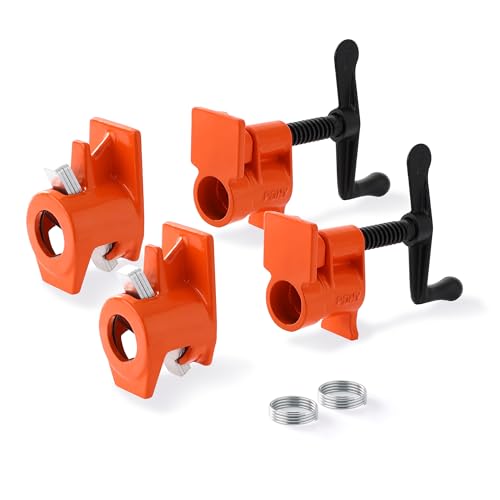
Pony Jorgensen 50 Series Pipe Clamp Fixture, 3/4-Inch
Threading onto standard 3/4-inch black pipe means the maximum length depends on the pipe bought separately, not a fixed bar. A head and tail stop fixture pair gives reach well beyond a bar clamp at a similar cost. Ductile iron construction holds up under repeated glue-ups.
Pros
- Cheapest way to reach long clamping lengths
- Ductile iron fixtures resist wear over time
- Length adjusts simply by swapping pipe sections
Cons
- Requires buying pipe separately from local hardware stock
- Round pipe can rotate slightly under uneven pressure

Stanley 4-Piece Spring Clamp Set
Four spring clamps in mixed sizes handle veneer edging, jigs, and small parts that do not need heavy pressure. Rubber-tipped jaws limit marring compared to bare metal tips. Spring action opens with one hand for near-instant placement.
Pros
- Fast to place with one hand
- Rubber tips reduce marring on soft wood
- Useful for veneer and small assembly tasks
Cons
- Clamping pressure too low for structural glue joints
- Smaller jaw opening limits material thickness

Jorgensen 10-Inch Wood Hand Screw Clamp
Two independently adjustable spindles tilt the hardwood jaws to match tapered, curved, or non-parallel stock, something flat-jaw clamps cannot do evenly. Wood jaws resist marring better than metal on delicate surfaces. It suits angled table legs and curved lamination more than flat panel glue-ups.
Pros
- Jaws adjust to angled and tapered workpieces
- Wood jaws mark delicate surfaces less than metal
- Wide, even contact area on irregular shapes
Cons
- Slower to adjust than a quick-release bar clamp
- Bulkier to store than flat bar clamps
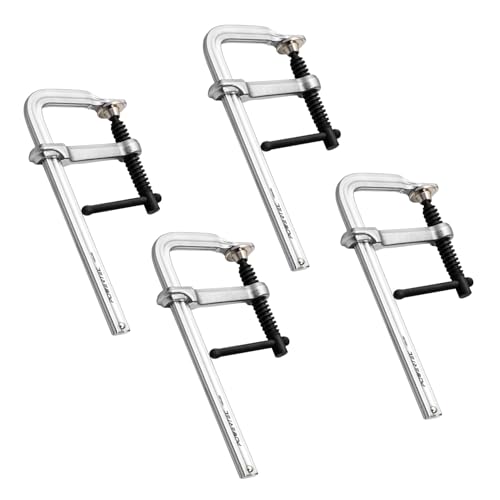
POWERTEC 4-Piece F-Clamp Set, 6-Inch
Small glue-ups, jig assembly, and general shop holding tasks are covered by this 4-pack of 6-inch F-clamps at a low cost per clamp. A steel bar and swivel pads keep the clamp stable on uneven surfaces. Compact size makes storage in a drawer or tool box easy.
Pros
- Low cost per clamp for a 4-pack
- Swivel pads adapt to angled surfaces
- Compact size stores easily
Cons
- Short 6-inch reach limits use to small parts
- Less rigid than heavier-duty bar clamps
How to choose
What types of clamps does a woodworking shop actually need Most shops need several clamp types rather than one universal clamp. Parallel-jaw clamps like the Bessey K Body REVO K2K hold panels flat during glue-ups because the jaws stay square to the bar. Bar clamps and F-clamps cover general assembly, holding cabinet parts or jigs at various angles. Pipe clamps extend cheaply for wide panels, since pipe length sets the reach. Spring clamps grip light parts fast, and hand-screw clamps like the Jorgensen wood clamp adjust to angled or tapered stock that flat jaws miss.
How much clamping pressure and throat depth do you need Clamping force ranges from about 150 pounds on a one-handed trigger clamp to over 1,000 pounds on a heavy parallel-jaw model. Wood glue joints need firm, even contact more than maximum crushing force, since overtightening can starve a joint of glue. Throat depth matters when reaching past an edge to a center joint; a 2-inch throat handles edge glue-ups, while wider panels call for 3.5 inches or more. Cast iron jaws with rubber or ABS pads spread pressure and reduce dents in softwoods like pine.
Which clamps fit glue-ups, assembly, and jig work Parallel-jaw or pipe clamps suit glue-ups best, since both apply pressure along a straight line without twisting the panel. Squaring a cabinet box often calls for bar clamps or F-clamps that reposition quickly at odd angles. Jig work and quick test fits benefit from one-handed trigger clamps, letting one hand hold a workpiece while the other runs a router or drill. Light tasks like holding veneer edging or a stop block suit spring clamps, where heavy pressure is not the goal.
When do you need one-handed or specialty clamps A project that needs a free hand for a router or screwdriver is where a one-handed clamp like the IRWIN QUICK-GRIP earns its place. Hand-screw clamps solve a narrower problem: holding tapered, curved, or angled workpieces where flat jaws would only touch at one point. Thin plywood during veneering or a featherboard held in place are the kind of small, low-pressure jobs spring clamps handle well. Most shops end up mixing two or three clamp types rather than relying on just one.
The lineup, side by side
| # | Model | Clamping force | Best for | Score | Price |
|---|---|---|---|---|---|
| 1 | Bessey K Body REVO K2K Parallel Clamp | Up to 1,700 lbs | Best overall | 9.4 | Check price |
| 2 | Jorgensen 2-Pack Steel Bar Clamp and Spreader, 12-Inch | 12 inches | Best value | 9.1 | Check price |
| 3 | IRWIN QUICK-GRIP One-Handed Mini Bar Clamp, 12-Inch | 150 lbs | Best for one-handed operation | 8.8 | Check price |
| 4 | Pony Jorgensen 50 Series Pipe Clamp Fixture, 3/4-Inch | 3/4 inch black pipe, sold separately | Best for wide panel glue-ups | 8.5 | Check price |
| 5 | Stanley 4-Piece Spring Clamp Set | 4 clamps, mixed sizes | Best for light-duty and small parts | 8.2 | Check price |
| 6 | Jorgensen 10-Inch Wood Hand Screw Clamp | Hardwood (maple) | Best for angled and irregular workpieces | 8.1 | Check price |
| 7 | POWERTEC 4-Piece F-Clamp Set, 6-Inch | 6 inches | Best budget | 8.0 | Check price |
Frequently asked questions
How many clamps do I need for woodworking?
Most furniture makers keep at least six to eight bar or parallel-jaw clamps for edge glue-ups, plus a few one-handed clamps for jigs. Larger panel glue-ups often need one clamp every 8 to 12 inches along the joint.
What is the difference between a bar clamp and a pipe clamp?
A bar clamp uses a fixed steel or aluminum bar with a set maximum length. A pipe clamp threads fixtures onto standard black pipe, so length changes by swapping pipe, which keeps cost down for long reaches.
Are parallel-jaw clamps worth the extra cost?
Parallel-jaw clamps like the Bessey K Body REVO K2K keep both jaw faces flat against the work, cutting down the twisting that can rack a glue-up. That even pressure matters most on wide panels and cabinet doors, less so on small jigs where a bar clamp works fine.
Can F-clamps be used for glue-ups?
Yes, F-clamps handle small to medium glue-ups, especially where a project needs pressure at an angle rather than straight across a panel. Wide panel glue-ups usually reach further with a longer bar or pipe clamp instead of stacking multiple F-clamps.
What clamping pressure is needed for wood glue joints?
Most wood glues bond well with light to moderate, even pressure, closer to 100 to 300 pounds than a clamp’s rated maximum. Overtightening squeezes out too much glue and can starve the joint, weakening it rather than strengthening it.
Is a one-handed clamp strong enough for woodworking?
One-handed trigger clamps rated around 150 pounds work well for holding jigs, fences, and quick test fits. They are not a substitute for a parallel-jaw or bar clamp on a structural glue joint that needs sustained, higher pressure.
Do spring clamps damage or dent wood?
Spring clamps with plastic or rubber-tipped jaws rarely mark hardwoods, but bare metal tips can dent soft species like pine or cedar. A scrap wood pad under the jaws avoids marring on any clamp type, not just spring clamps.
What is a hand-screw clamp used for?
A wood hand-screw clamp, like the Jorgensen model, adjusts each jaw independently, so it holds tapered, curved, or non-parallel workpieces evenly. Furniture makers use them for angled joinery and for clamping irregular shapes that flat-jaw clamps only touch at one point.
Which clamp works best for a small apartment workshop?
F-clamps and spring clamps take up the least storage space and cover most light assembly and jig tasks in a compact shop. A pipe clamp fixture is easy to add later since pipe sections store flat until a wider glue-up needs them.
Bar clamp vs pipe clamp for a first-time buyer, which should you choose?
A bar clamp is ready to use out of the box and suits most starter projects under 24 inches wide. A pipe clamp fixture costs less per inch of reach once you own pipe sections, making it the better choice for anyone planning wider panel glue-ups.
Our take
The Bessey K Body REVO K2K is the strongest overall choice for a shop building furniture with regular panel glue-ups, since its parallel jaws keep pressure even without racking the work. Woodworkers on a tighter budget or doing mostly small assembly should pick the Jorgensen 2-Pack Bar Clamp instead, since it costs less per clamp and still covers most everyday holding tasks.
Jake Monroe
Jake worked as a residential contractor for over a decade before shifting to full-time writing. He evaluates power tools, hand tools and workshop gear through the lens of someone who has actually used them on job sites, not just read the box.