Inline Water Filters for Cleaner RV Tap Water
Camco’s TastePURE inline filter leads this comparison for its widely available cartridges and solid sediment and chlorine reduction. Clearsource’s premium filter suits owners wanting the most thorough filtration stages. Culligan’s budget filter covers occasional campers needing basic taste improvement.
Camco’s TastePURE inline water filter is the strongest pick here because its carbon filtration reduces chlorine taste and odor while maintaining decent flow rate for filling a fresh tank, and its cartridges are stocked at most RV retailers for easy replacement. It filters less thoroughly than a multi-stage premium filter aimed at heavier sediment or mineral content.
Campground water quality varies enormously by location, from heavily chlorinated municipal supplies to well water with noticeable sediment, so a filter’s actual filtration stages matter more than general marketing claims. We compared each filter’s stated filtration method, cartridge replacement interval, and effect on water flow rate.
What to look for
Why campground water quality varies so much Some campgrounds draw from heavily chlorinated municipal systems, while others rely on well water with visible sediment or mineral content, and the right filter depends on which problem you are actually solving. A filter built for chlorine taste will not remove sediment, and vice versa.
Single-stage versus multi-stage filtration A single-stage carbon filter like Culligan’s or PurTrex’s handles chlorine taste and odor well but does little for sediment, while a multi-stage filter like Clearsource’s or Watts’ adds a dedicated sediment stage ahead of the carbon. Multi-stage filters cost more but address a wider range of water quality issues.
Cartridge life and replacement frequency Standard cartridges, used by most filters here, are typically rated for about one camping season of regular use, while a high-capacity cartridge like Camco’s EVO line extends that interval for full-time RVers filling tanks more often. Replacing a cartridge after its rated capacity keeps filtration effective.
Flow rate tradeoffs with thorough filtration More filtration stages can reduce flow rate compared to a simple single-stage filter, which matters if you are trying to fill a large fresh tank quickly. Clearsource’s multi-stage design maintains strong flow despite the added filtration, while some basic filters slow noticeably as the cartridge nears the end of its life.
The top picks, ranked

Camco TastePURE Inline Water Filter
Camco’s TastePURE filter uses a carbon filtration cartridge to reduce chlorine taste and odor from municipal water supplies common at campgrounds. The inline design screws directly between the spigot and your drinking water hose without extra plumbing.
Pros
- Reduces chlorine taste and odor effectively
- Cartridges are widely stocked at RV retailers
- Simple inline installation with no extra plumbing
Cons
- Does not address heavy sediment or mineral content
- Flow rate drops slightly as the cartridge nears end of life

Clearsource Premium RV Water Filter
Clearsource builds this filter with multiple filtration stages in one housing, addressing sediment, chlorine, and some mineral content in a single pass. The larger housing size trades some portability for more thorough filtration than a compact inline cartridge.
Pros
- Multi-stage filtration addresses more than taste and odor alone
- Maintains strong flow rate despite thorough filtration
- Longer cartridge life than compact single-stage filters
Cons
- Larger housing takes up more storage space
- Costs more than a basic single-stage inline filter

Hydro Life Inline RV Water Filter
Hydro Life focuses this filter specifically on taste and odor improvement using a granular carbon core, aimed at owners most bothered by a chlorine smell from campground water rather than sediment concerns. The compact housing stores easily in a hose storage bay.
Pros
- Granular carbon core targets taste and odor directly
- Compact housing fits easily in hose storage
- Reasonably priced for dedicated taste improvement
Cons
- Less effective against sediment than multi-stage filters
- Cartridge life matches basic filters, not extended-use designs
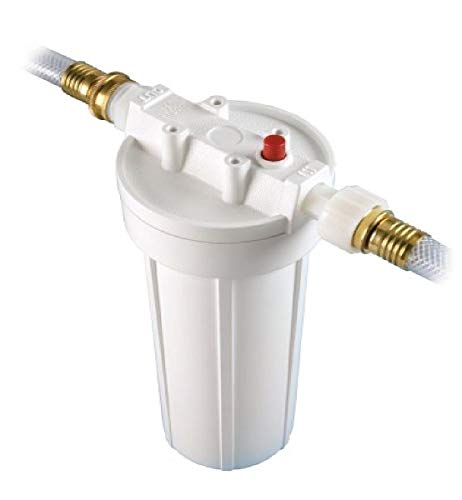
Culligan RV Inline Water Filter
Culligan keeps this filter simple and affordable, a single-stage carbon design aimed at an occasional camper who wants basic taste improvement without paying for multi-stage filtration. It still screws inline between the spigot and drinking water hose.
Pros
- Lowest price point among inline filters compared here
- Still provides basic chlorine taste and odor reduction
- Simple inline installation with no extra plumbing
Cons
- Single-stage filtration misses sediment and mineral content
- Less durable housing than premium multi-stage filters

Camco EVO Premium Water Filter
Camco’s EVO line uses a higher-capacity cartridge than the standard TastePURE filter, rated to filter more gallons before needing replacement. That suits full-time RVers filling their tank more frequently than occasional weekend campers.
Pros
- Higher-capacity cartridge lasts longer between replacements
- Suits full-time RVers filling tanks frequently
- Same reliable chlorine taste and odor reduction as TastePURE
Cons
- Costs more than Camco’s standard TastePURE filter
- Overkill for occasional weekend camping use
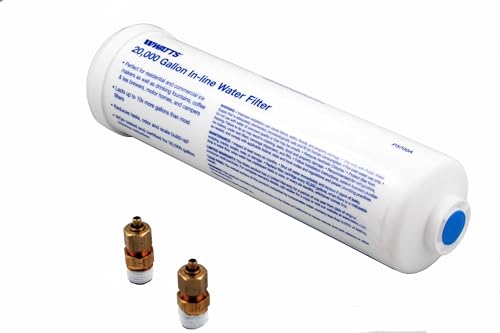
Watts Inline RV Water Filter
Watts adds a dedicated sediment pre-filter stage ahead of the carbon filtration, aimed at campgrounds or well water sources with visible particulate in the water. That pre-filter stage also helps extend the life of the carbon stage behind it.
Pros
- Dedicated sediment stage handles visible particulate well
- Pre-filter stage extends the life of the carbon stage
- Good fit for campgrounds with well water sources
Cons
- Two-stage design is bulkier than a single-stage filter
- Costs more than a basic carbon-only filter
PurTrex RV Inline Water Filter
PurTrex uses a standard-size replacement cartridge that matches common water filter dimensions sold at hardware and RV stores, making it easy to find a replacement on the road rather than ordering a specialty size. The housing itself is a basic single-stage inline design.
Pros
- Standard cartridge size is easy to find on the road
- Straightforward single-stage carbon filtration
- Reasonably priced for the replacement convenience
Cons
- Single-stage design does not address sediment specifically
- No extended-capacity option in this particular line
Side by side
| # | Model | Filtration Method | Best for | Score | Price |
|---|---|---|---|---|---|
| 1 | Camco TastePURE Inline Water Filter | Carbon filtration | Best Overall | 8.9 | Check price |
| 2 | Clearsource Premium RV Water Filter | Multi-stage sediment and carbon filtration | Best for Comprehensive Filtration | 9.1 | Check price |
| 3 | Hydro Life Inline RV Water Filter | Granular carbon filtration | Best for Taste and Odor | 8.6 | Check price |
| 4 | Culligan RV Inline Water Filter | Single-stage carbon filtration | Best Budget | 8.0 | Check price |
| 5 | Camco EVO Premium Water Filter | Carbon filtration, high-capacity cartridge | Best for Extended Capacity | 8.7 | Check price |
| 6 | Watts Inline RV Water Filter | Sediment pre-filter plus carbon filtration | Best for Sediment Removal | 8.4 | Check price |
| 7 | PurTrex RV Inline Water Filter | Carbon filtration, standard cartridge size | Best for Replacement Cartridge Availability | 8.2 | Check price |
Frequently asked questions
Do I need an inline water filter if I only camp occasionally?
Even occasional camping can expose your fresh tank to heavily chlorinated or sediment-containing water depending on the campground, so a basic filter like Culligan’s can still improve taste and water quality for infrequent trips.
How often should I replace my inline water filter cartridge?
Most cartridges are rated for about one camping season of regular use, though a high-capacity cartridge like Camco’s EVO line can last longer for full-time RVers. Replace sooner if you notice reduced flow or returning odor.
Will an inline filter remove all bacteria from campground water?
Standard carbon and sediment filters are not designed to remove bacteria or pathogens, so a separate sanitizing step is recommended if water safety is a specific concern.
Does an inline water filter slow down tank filling?
Filtration can reduce flow rate somewhat compared to an unfiltered hose, with multi-stage filters generally designed to minimize that slowdown better than basic single-stage filters nearing the end of their cartridge life.
What is the difference between a sediment filter and a carbon filter?
A sediment filter physically traps particulate matter like dirt or rust, while a carbon filter chemically reduces chlorine taste and odor. Many premium filters combine both stages for broader coverage.
Can I use a house water filter instead of an RV-specific inline filter?
RV-specific inline filters are designed to connect directly to a garden hose fitting and handle the flow rates typical of tank filling, while house filters are usually built for fixed plumbing installations.
Why does my filtered water still taste slightly different?
Mineral content and water source differences between campgrounds can still affect taste even after filtration, since most filters target chlorine, odor, and sediment rather than altering mineral composition.
Is a bigger filter housing always better filtration?
A larger multi-stage housing generally means more filtration stages, but a correctly matched single-stage filter can be perfectly adequate if your main concern is just chlorine taste rather than sediment or mineral content.
The verdict
Camco’s TastePURE inline filter is the best overall pick for most RV owners because it reliably reduces chlorine taste and odor with widely available replacement cartridges. Owners dealing with well water or visible sediment should pick Clearsource’s multi-stage filter instead, since its added sediment stage handles particulate that a single-stage filter misses. Full-time RVers filling tanks frequently get the most value from Camco’s higher-capacity EVO filter.
Tony Russo
Tony trained as an automotive technician and spent years in service and parts retail before moving into writing. He focuses on garage tools, car care products and accessories from a hands-on maintenance perspective.


