Blowers That Dry a Car Fast Without Water Spots
The MetroVac Air Force Master Blaster Revolution is the best car drying blower overall, with twin motors and a 30-foot hose that dry full-size vehicles fast. The Adam’s Polishes Air Cannon offers similar airflow for less, and the MetroVac Air Force Blaster Sidekick wins for lightweight portability.
The MetroVac Air Force Master Blaster Revolution is the best car drying blower for most owners, using twin 4.0 HP motors and a 30-foot hose to clear water from a full-size vehicle in minutes. It suits anyone drying multiple cars or trucks regularly, though its weight and noise exceed what a casual user needs.
Car drying blowers differ mainly in motor power, heat filtering and hose reach rather than styling, so we compared rated airflow in feet per minute, motor type and included accessories across each listing. We also weighed owner feedback on noise level and how the housing holds up to repeated outdoor use.
The top picks, ranked

MetroVac Air Force Master Blaster Revolution
Twin 4.0 HP motors push warm filtered air through a 30-foot hose, enough reach to dry a full-size truck from one outlet. Detailers favor this model because the warm air speeds drying without the heat levels that can mar fresh wax. The coiled hose stores compactly despite its length.
Pros
- Twin motors deliver enough airflow for full-size vehicles
- Warm air speeds drying without overheating fresh wax
Cons
- Heavier and louder than single-motor blowers
- Takes floor space a smaller blower would not
MetroVac Air Force Steel Commander
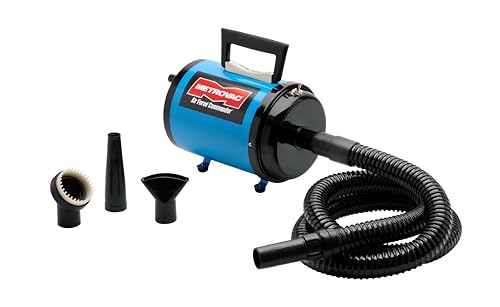
An all-steel housing holds up to the daily use a mobile detailing business puts it through, where plastic-bodied blowers crack sooner. The single 1.7 HP motor runs quieter than twin-motor models, useful when working near customers. Output is lower than the Master Blaster line but still clears water from panel gaps.
Pros
- Steel body withstands daily commercial transport and use
- Quieter operation than twin-motor blasters
Cons
- Less raw airflow than the twin-motor Master Blaster
- Heavier metal housing adds to overall weight

MetroVac Air Force Blaster Sidekick
At under 6 pounds, the Sidekick is light enough to hold through an entire drying session without arm fatigue. It plugs into a standard outlet, so no compressor or generator is required at a mobile job site. Output is lower than full-size blasters, which suits smaller cars better than trucks.
Pros
- Lightweight enough for one-handed extended use
- No compressor or special power setup required
Cons
- Less airflow than full-size twin-motor blowers
- Smaller nozzle means slower drying on large vehicles

Adam’s Polishes Air Cannon Car Dryer
Adam’s rates the Air Cannon at up to 73,000 feet per minute, competitive with pricier shop blowers, at a lower cost than the MetroVac twin-motor line. Multiple nozzle attachments adjust the airflow pattern for door jambs, mirrors and wheel wells. The 16-foot hose is shorter than MetroVac’s 30-foot option.
Pros
- High rated airflow for the price compared to twin-motor blasters
- Nozzle attachments adapt to tight panel gaps
Cons
- Shorter hose than the Master Blaster Revolution
- Less established commercial-use track record than MetroVac

XPower A-2S Airrow Pro Multi-Purpose Dryer
XPower markets the A-2S for pet grooming as much as car detailing, so a household with both needs gets one blower instead of two. Two speed settings let it run gentler for interior upholstery than for exterior panels. Output trails purpose-built car dryers but covers more household uses overall.
Pros
- Doubles as a pet dryer, not just a car blower
- Two speeds suit both interior and exterior use
Cons
- Lower airflow than dedicated car drying blasters
- Motor runs smaller than MetroVac or Adam’s units
XPower B-55 Mini Mighty Air Mover
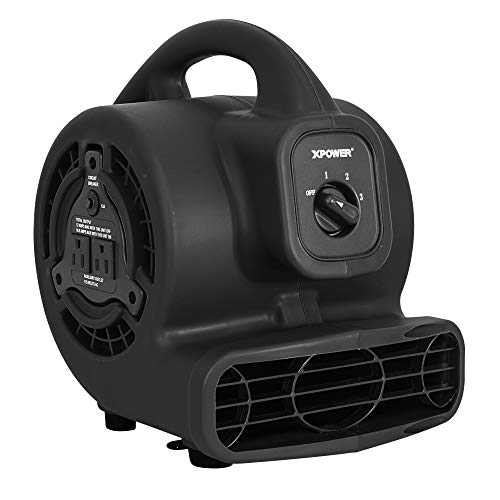
Built primarily as a carpet and floor air mover, the B-55 adapts to light car drying duty at a price well under purpose-built blowers. Its small size stacks easily in a trunk or garage shelf. It lacks the warm-air filtering that dedicated detailing blowers include.
Pros
- Lowest cost option that still moves meaningful air
- Compact and stackable for storage
Cons
- No warm-air filtering like dedicated car dryers
- Underpowered for drying full-size trucks or SUVs

MetroVac Air Force Off Road Dryer
MetroVac built this version with a rugged housing and extended hose reach aimed at trucks and SUVs that collect mud in wheel wells and underbody panels. It handles the taller ride height better than blowers designed around sedans. The rugged casing adds weight compared to the Sidekick.
Pros
- Extended reach suits taller trucks and SUVs
- Rugged housing tolerates mud and off-road grime
Cons
- Heavier than compact blowers meant for sedans
- Overkill for owners who only dry a small car
How they compare
| # | Model | Motor | Best for | Score | Price |
|---|---|---|---|---|---|
| 1 | MetroVac Air Force Master Blaster Revolution | Twin 4.0 HP motors | Best overall | 9.4 | Check price |
| 2 | MetroVac Air Force Steel Commander | All-steel construction | Best for professional detailers | 9.2 | Check price |
| 3 | MetroVac Air Force Blaster Sidekick | 1.3 peak HP | Best compact and portable | 8.8 | Check price |
| 4 | Adam’s Polishes Air Cannon Car Dryer | Up to 73,000 FPM | Best value | 8.9 | Check price |
| 5 | XPower A-2S Airrow Pro Multi-Purpose Dryer | 1/3 HP | Best dual-purpose for car and pet use | 8.6 | Check price |
| 6 | XPower B-55 Mini Mighty Air Mover | 1/5 HP | Best budget and lightweight | 8.3 | Check price |
| 7 | MetroVac Air Force Off Road Dryer | Heavy-duty single motor | Best for trucks and SUVs | 9.0 | Check price |
How to choose
What a purpose-built car dryer does differently A purpose-built blower filters incoming air and often warms it slightly, which standard shop blowers and leaf blowers do not do. That filtering matters because unfiltered air can blast grit straight into a fresh wash onto the paint. Motor type, whether single or twin, determines how much reach and coverage one pass gets across a vehicle.
Warm air versus cold air blowers Warm air speeds evaporation in door jambs, mirrors and wheel wells where a towel cannot easily reach. It stays well below temperatures that could damage wax or ceramic coatings when used at normal distance from the panel. Cold air options exist too, mainly on lighter-duty models like the XPower B-55, and still clear standing water even without the heat boost.
Picking power for sedans versus trucks and SUVs A compact sedan dries fine with a lighter unit like the Air Force Blaster Sidekick, since there is less surface area and fewer deep panel gaps. Trucks and SUVs benefit from the extended reach and higher airflow of something like the Air Force Off Road Dryer, especially around raised wheel wells and underbody trim. Buying more power than the vehicle needs mostly adds weight and noise without a real time saving.
When a dual-purpose blower makes more sense Anyone who also grooms a dog or inflates pool gear gets more total value from a multi-purpose option like the XPower A-2S than from a car-only blower. The tradeoff is lower peak airflow, so drying time on a full-size vehicle runs longer than with a dedicated unit. For a household with only cars to dry, a purpose-built blower like the Master Blaster Revolution still wins on raw speed.
Good to know
Is a car drying blower better than just using a towel?
Yes, for most owners. A blower reaches door jambs, badges and wheel wells a towel cannot easily clean, and it avoids the swirl marks a dragging towel can leave on paint.
Can a leaf blower work instead of a dedicated car dryer?
It can move some water, but leaf blowers lack the filtered air and heat control of purpose-built models, so they risk blasting yard debris onto a freshly washed car.
Does warm air damage a fresh wax or ceramic coating?
Not at normal use distance. These blowers run warm enough to speed drying but well below temperatures that would soften wax or harm a cured ceramic coating.
How much airflow does a car drying blower actually need?
Most full-size vehicles dry well with blowers rated in the 50,000 to 75,000 FPM range, like the Master Blaster Revolution or the Adam’s Air Cannon. Smaller cars can get by with less.
Are car drying blowers loud enough to need hearing protection?
Twin-motor models like the Master Blaster Revolution run loud enough that extended daily use benefits from hearing protection, similar to a shop vacuum.
Can the same blower dry a car and groom a dog?
Dual-purpose models like the XPower A-2S are built for exactly that, with speed settings suited to both uses, though output trails a dedicated car dryer.
Do these blowers need a water filter or compressor?
No. Standard models plug into a wall outlet and filter incoming air internally, unlike compressed-air setups that need a separate compressor.
What is the difference between FPM and horsepower on a blower?
FPM measures how fast air moves out of the nozzle, which affects drying speed. Horsepower describes motor size, which influences both FPM and how long the motor lasts under heavy use.
How long does it take to dry a full-size truck?
With a twin-motor blower like the Master Blaster Revolution, most full-size trucks dry in roughly 10 to 15 minutes, depending on how much standing water remains after the wash.
Our pick
For most owners the MetroVac Air Force Master Blaster Revolution is worth the investment, since its twin motors dry a full-size vehicle faster than any single-motor option here. Mobile detailers who need something lighter for daily transport should look at the Air Force Steel Commander instead. Anyone who only dries a car occasionally and also wants a pet dryer gets more use out of the XPower A-2S.
Tony Russo
Tony trained as an automotive technician and spent years in service and parts retail before moving into writing. He focuses on garage tools, car care products and accessories from a hands-on maintenance perspective.