Steel, acrylic and wood rulers worth keeping on a desk
Breman Precision’s 12 inch stainless ruler leads, with etched graduations down to 1/64 inch and cork strips that stop it sliding under a blade. Mr. Pen’s Metal Ruler 12 Inch handles the same desk jobs on a thinner blade. Drafters reading plans want the Staedtler Mars 987 18-31.
Breman Precision Stainless Steel Metal Ruler 12 Inch fits most desks and craft tables. Markings are stamped into the steel rather than printed, and cork strips underneath hold the edge still while you score. Its weak point is flex, since a thin blade can bow slightly under heavy hand pressure on a long cut.
Rulers look interchangeable until a specific job exposes the difference. Quilters need a 6 by 24 inch acrylic grid, drafters need eleven architectural ratios on three faces, and a classroom needs something that survives a backpack. We compared graduation fineness, edge material, marking method and backing grip, then read owner feedback on which rulers stay legible after a year of handling.
How to pick the right one
What to look for in a ruler Start with how the markings were applied. Etched or engraved lines on steel stay readable for years, while screen printed lines on plastic wear off exactly where your fingers sit. Check the finest increment next: 1/16 inch covers general work, but model makers and jewellers want 1/64. Then turn it over. Cork or rubber strips prevent the slide that ruins a scored line, and a hanging hole keeps the blade off a cluttered bench.
Steel, aluminium, acrylic or wood Material decides what a ruler can safely do. Steel and aluminium are the only options that guide a blade without being shaved into notches. Acrylic wins where you need to see through to the work underneath, which is why quilters reach for it. Hardwood with a brass edge feels good and stays put, though humid storage can cup it. Flexible polymer belongs in a school bag, where surviving the term matters more than a perfectly true edge.
Best ruler for cutting and scoring Two features matter for knife work: a metal edge and enough weight to stay planted. Alumicolor’s anodised straight edge takes the blade damage instead of your fingers on foam board and mat board. Breman’s stainless rule adds cork strips that stop creep on smooth vinyl, at the cost of a fraction of extra height. Avoid any ruler thin enough to let a blade ride up over the edge, and replace metal rules once the edge shows deep nicks.
Rulers for quilting, drafting and classrooms Specialist jobs need specialist tools. Fabric work wants the Fiskars 6 by 24 inch acrylic, wide enough to square a quarter yard and printed with bias angles. Plan reading needs ratios rather than inches, which is the Staedtler Mars 987 18-31 with eleven reductions across three faces. Classrooms do better with the Helix shatter resistant ruler, since a ruler that snaps gets replaced every term. Skip the wood ruler if it will live somewhere damp.
Our top picks

Breman Precision Stainless Steel Metal Ruler 12 Inch
Graduations are stamped into the steel, so they outlast the printed lines that rub off plastic. Cork strips on the underside grip paper, cardstock and vinyl while a blade travels along the edge. Four scales run across the two long edges, and the finest steps down to 1/64 inch.
Pros
- Etched markings survive years of handling
- Cork backing stops creep on paper and vinyl
- Four graduation scales across both edges
Cons
- Thin blade can bow under heavy hand pressure
- Cork lifts the ruler slightly off the page

Mr. Pen Metal Ruler 12 Inch
Nothing here is decorative: a flat stainless blade carries inches on one edge and centimetres on the other. A hanging hole at the top suits a pegboard hook above a bench. Owners report the finish holds up in a garage or basement where damp air rusts cheaper steel.
Pros
- Imperial and metric edges on one blade
- Flat profile sits close to the cut line
- Rust resistant in damp workspaces
Cons
- No cork or rubber backing
- Markings stop at 1/16 inch

Helix Shatter Resistant Ruler 12 Inch
Moulded from a flexible polymer, this one bends where a brittle plastic ruler would snap. Inches read along one edge and centimetres along the other. Punched holes let it sit in a ring binder beside worksheets instead of loose in a bag.
Pros
- Flexes instead of cracking in a school bag
- Fits a standard three ring binder
- Light enough for daily carry
Cons
- Printed markings fade with abrasion
- Too flexible to guide a craft knife

Staedtler Mars Triangular Scale Ruler 987 18-31
Eleven architectural ratios spread across three faces, running from 3/32 inch to 3 inches per foot. Colour coded grooves let you land on the right scale without hunting through numbers. Drafters use it to read plans and lay out elevations at a fixed reduction.
Pros
- Covers every common plan reduction in one tool
- Rigid body will not flex mid measurement
- Colour coding speeds up scale selection
Cons
- Triangular body cannot guide a blade
- Engineer decimal ratios need a separate scale
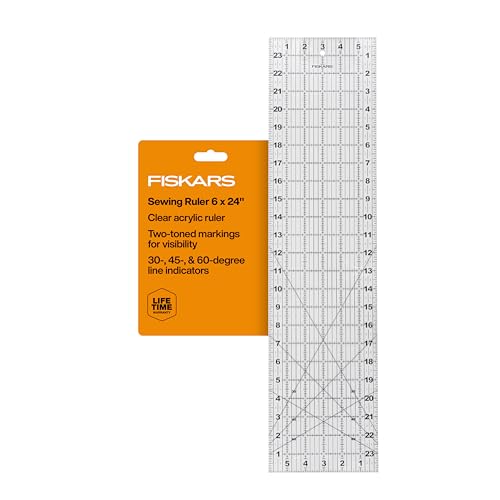
Fiskars 6 x 24 Inch Acrylic Ruler
Six inches of width squares a fat quarter in a single pass, with no repositioning to introduce error. Grid lines print at 1/8 inch intervals and 30, 45 and 60 degree guides handle bias strips. Clear acrylic keeps the fabric print visible underneath while you align.
Pros
- Wide enough to square quilting cottons in one cut
- Printed angle lines make bias strips repeatable
- Thick edge guides a rotary blade safely
Cons
- Bulky for general desk work
- Acrylic scratches if stored loose in a drawer

Alumicolor 12 Inch Aluminum Straight Edge Ruler
Anodised aluminium carries enough mass to sit still under a utility knife. Graduations run in 1/16 inch steps along both long edges. Craft users keep it for foam board and mat board, where a plastic ruler gets shaved into notches within a few cuts.
Pros
- Metal edge resists knife nicks
- Enough weight to stay planted mid cut
- Anodised finish does not transfer marks to paper
Cons
- Base version has no cork backing
- Aluminium dents if dropped on a hard floor

Westcott 12 Inch Wood Ruler
A brass strip takes the wear that would otherwise round off a bare wooden edge. Inches read on one face and centimetres on the reverse. Teachers buy these in multipacks because hardwood tolerates thirty pairs of hands better than moulded plastic.
Pros
- Brass edge stays true under repeated use
- Warm, grippy feel on a desk surface
- Large markings read from across a table
Cons
- Wood can cup in humid storage
- Snaps rather than bending when flexed
The lineup, side by side
| # | Model | Material | Best for | Score | Price |
|---|---|---|---|---|---|
| 1 | Breman Precision Stainless Steel Metal Ruler 12 Inch | Stainless steel | Best overall | 9.4 | Check price |
| 2 | Mr. Pen Metal Ruler 12 Inch | Stainless steel | Best value | 9.2 | Check price |
| 3 | Helix Shatter Resistant Ruler 12 Inch | Shatter resistant plastic | Best budget | 9.0 | Check price |
| 4 | Staedtler Mars Triangular Scale Ruler 987 18-31 | Triangular architect scale | Best for architectural drawing | 8.8 | Check price |
| 5 | Fiskars 6 x 24 Inch Acrylic Ruler | 6 x 24 inches | Best for quilting and fabric | 8.6 | Check price |
| 6 | Alumicolor 12 Inch Aluminum Straight Edge Ruler | Anodised aluminium | Best for craft cutting | 8.3 | Check price |
| 7 | Westcott 12 Inch Wood Ruler | Hardwood with brass edge | Best for classrooms | 8.0 | Check price |
Frequently asked questions
What is the best ruler for cutting with a craft knife?
Go metal. Alumicolor’s aluminium straight edge and the Breman stainless rule both take blade contact without notching. Plastic develops grooves after a handful of cuts, and those grooves steer the blade off the line.
Are metal rulers more accurate than plastic rulers?
Usually, for two reasons. Etched steel graduations do not smudge or wear away, and steel moves far less than plastic with temperature. Cheap moulded rulers can also come out of the tool slightly off scale.
Which ruler should I buy for quilting?
A 6 by 24 inch clear acrylic ruler with a 1/8 inch grid, such as the Fiskars. Width squares fabric in one cut, and the transparent body lets you line up against a printed pattern line underneath.
What is a triangular scale ruler used for?
Reading and drawing plans at a fixed reduction. Each face holds different ratios, so a wall drawn at 1/4 inch to the foot measures directly. Architects use an architect scale; civil drafters need a decimal engineer scale instead.
How long should a desk ruler be?
Twelve inches spans letter and A4 paper and fits a drawer. Move to 18 or 24 inches for poster board, fabric and picture framing, because repositioning a short rule introduces error at the join.
Do rulers need a cork or rubber backing?
For scoring and cutting, yes. Cork strips stop the ruler creeping as the blade pulls against it. Pencil layout work needs it less, and the backing raises the edge slightly above the paper, which some technical pen users dislike.
Is a stainless steel ruler worth it over a plastic one?
If you cut, score or measure most days, yes. Etched markings and a knife safe edge outlast several plastic rulers. Occasional homework measuring is fine with a shatter resistant plastic ruler.
Can a ruler measure fractions smaller than 1/16 inch?
Only when it is graduated that finely. Breman’s stainless rule steps down to 1/64 inch on its fine edge. Most school and office rulers stop at 1/16, so model and jewellery work needs a precision rule or callipers.
Which ruler holds up best in a school bag?
Helix’s shatter resistant ruler flexes instead of breaking and slots into a ring binder. Wooden rulers snap when bent and steel rules bend permanently, so neither suits daily carry by a student.
Final word
Buy the Breman Precision Stainless Steel Metal Ruler 12 Inch for a single rule that measures, scores and guides a blade without wearing out. Quilters should pass on it and take the Fiskars 6 by 24 inch acrylic, which does a job no steel rule can do in one pass. Anyone reading building plans needs the Staedtler Mars 987 18-31, because ratios cannot be worked out on an inch scale without arithmetic errors.
Marcus Chen
Marcus covered consumer electronics for enthusiast tech publications for six years before joining ChoiceCrest. He specializes in translating manufacturer spec sheets into plain-language buying advice, with a focus on audio, computing accessories and smart-home gear.