Indoor Putting Mats Compared for Realistic Green Speed
The PuttOUT Pro Putting Mat delivers the truest roll for serious practice, based on its two tone turf and weighted backing. Short putt accuracy improves fastest on the Perfect Practice Standard Edition, thanks to its narrowed target hole, while the SKLZ Accelerator Pro adds the easiest automatic ball return for quick sessions.
The PuttOUT Pro Putting Mat suits most golfers who want a practice stroke that transfers to the course. Alignment work favors the Perfect Practice Standard Edition, and the SKLZ Accelerator Pro speeds up short casual sessions with its automatic return.
A slow surface teaches a stroke that collapses on a real green, and a mat that curls at the edges ruins every read. We compared surface specifications, roll characteristics and what owners report about creasing, backing grip and long term flatness.
The shortlist, ranked

PuttOUT Pro Golf Putting Mat
Two turf zones recreate the transition from fairway to green, teaching pace judgment instead of a flat straight roll. Roll speed sits close to a real green rather than the slow carpet feel found on cheaper mats. Owners often pair it with the PuttOUT pressure trainer for added feedback.
Pros
- Realistic roll speed for stroke transfer
- Lies flat quickly after unrolling
- Alignment lines are easy to read
Cons
- No ball return included
- Higher cost than basic practice mats

Perfect Practice Putting Mat Standard Edition
A narrowed target hole sits behind a standard sized cup, so putts must thread a tighter gap to count. Crystal velvet surface reads true across the full mat length. Owners report the mat flattens within a day or two of unrolling.
Pros
- Two hole sizes sharpen accuracy
- Automatic return saves walking
- Long enough for real distance work
Cons
- Takes a day or two to lie fully flat
- Surface rolls slower than the PuttOUT Pro

SKLZ Accelerator Pro Indoor Putting Green
An angled ramp behind the cup sends made putts back toward your feet, keeping short sessions moving without a break. Ball position guide and pace ramp add structure beyond a plain green. Shorter overall length fits a hallway or office better than longer mats.
Pros
- Reliable automatic ball return
- Compact footprint for narrow rooms
- Built in pace control ramp
Cons
- Return only triggers on made putts
- Center line turf shows wear over time

Wellputt Start Mat 10ft
Printed zones mark out drills for face control, start line and distance, turning the mat into a coaching program rather than a plain green. Ten feet of length covers genuinely useful putt distances. Practice sessions follow a set structure instead of random rolling.
Pros
- Structured drills printed on the surface
- Long enough for real distance practice
- Packs down into a carry bag
Cons
- Busy graphics distract some players
- No cup or ball return included
GoSports Pure Putt Challenge Putting Green
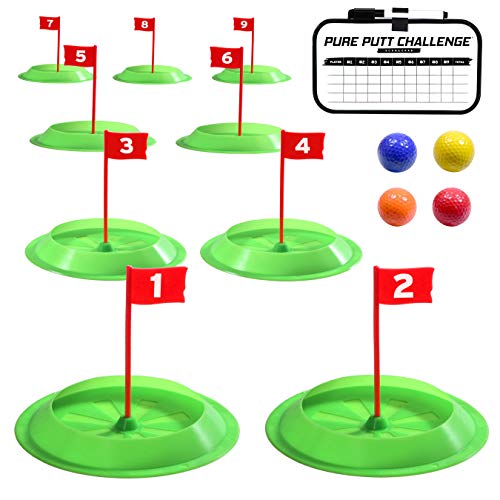
Multiple target holes and a scoring format turn practice into a game the whole household can join. Turf quality suits casual rounds more than dialed in stroke work. Setup and rollup each take under a minute.
Pros
- Fun format for mixed skill levels
- Several targets built into one mat
- Quick to set up and store
Cons
- Not built for precision stroke training
- Turf rolls slower than a real green

CHAMPKEY Premium Putting Green Mat
Extra width allows practice on breaking putts and varied approach angles instead of one repeated straight line. Dual turf sections mimic fringe grass transitioning into green. Heavier backing keeps the mat flat on hardwood and tile floors, according to owner reports.
Pros
- Room for angled and breaking putts
- Stays flat on hard flooring
- Two separate target positions
Cons
- Heavier to move and store
- Requires more floor space than narrow mats

Abco Tech Golf Putting Green Mat
An auto return ramp covers the basics of short putt repetition without a large outlay. Surface speed runs slower than premium turf, so it suits stroke repetition more than pace training. Rolled size fits into a closet or small cupboard.
Pros
- Low cost entry point
- Automatic ball return included
- Decent length for casual practice
Cons
- Slower surface speed than premium mats
- Creasing takes time to settle out
How they stack up
| # | Model | Length | Best for | Score | Price |
|---|---|---|---|---|---|
| 1 | PuttOUT Pro Golf Putting Mat | About 8 feet | Best overall | 9.4 | Check price |
| 2 | Perfect Practice Putting Mat Standard Edition | About 9.5 feet | Best for alignment work | 9.2 | Check price |
| 3 | SKLZ Accelerator Pro Indoor Putting Green | About 9 feet | Best ball return | 9.0 | Check price |
| 4 | Wellputt Start Mat 10ft | 10 feet | Best for structured drills | 8.8 | Check price |
| 5 | GoSports Pure Putt Challenge Putting Green | About 9 feet | Best for casual and family play | 8.6 | Check price |
| 6 | CHAMPKEY Premium Putting Green Mat | Wider than standard mats | Best wide surface for breaking putts | 8.3 | Check price |
| 7 | Abco Tech Golf Putting Green Mat | About 10 feet | Best budget pick | 8.0 | Check price |
How to choose
How surface speed shapes your stroke A slow mat forces a longer, firmer stroke, and that habit shows up as putts racing past the hole on a real green. Stimp readings between 10 and 11 match most everyday greens. Carpet like turf trains the wrong tempo, even if the mat looks realistic in photos.
Why mat length matters more than target count Most missed putts on course happen inside ten feet, so a mat between eight and ten feet covers the range where practice pays off. Four foot mats only groove a short tap in stroke. Measure the room first, including space to stand behind the ball before ordering.
How to get a rolled mat to lie flat Shipping creases arrive with every rolled mat, and thin backing can take weeks to settle or never flatten fully. Heavier rubber backing solves both the crease problem and sliding on hard floors. Reversing the roll direction for a day speeds up flattening considerably.
Is a ball return system worth having Return systems keep short sessions moving, which matters most for players practicing in ten minute bursts. Made putts trigger the return, but missed ones still need collecting by hand. Serious practice mats often skip the return in favor of a truer surface.
Good to know
Do putting mats actually improve your putting?
Mats improve stroke repeatability, start line and face control, the mechanical parts of putting. They cannot teach green reading or pace judgment on slopes, so pair mat work with time on a real practice green.
How long should a putting mat be?
Eight to ten feet suits most homes and covers the putt lengths that matter most. Longer mats support distance control practice but need a dedicated space to stay set up.
Why does my putting mat curl at the edges?
Thin backing and tight rolling during shipping cause most curling. Leaving the mat unrolled under weight for a few days, or briefly reversing the roll, usually resolves it.
Can you use a putting mat on carpet?
Yes, though soft carpet underneath can create subtle undulations that affect roll. A firm low pile carpet or hard floor gives more consistent results, and heavier backed mats help on either surface.
What is a realistic putting mat speed?
Real greens commonly run between 9 and 11 on the stimp scale. Quality mats target that range, while budget turf often rolls noticeably slower, changing the stroke length a putt needs.
Are alignment markings on a putting mat helpful?
Printed lines help most golfers hold a consistent start line, the leading cause of missed short putts. Golfers who find graphics distracting can choose a plain mat and use an alignment stick instead.
Is a ball return worth it on a putting mat?
Not for effective practice, but a return keeps sessions moving and raises how often the mat actually gets used. Players practicing in short ten minute bursts benefit most from one.
How do you clean a putting mat?
Vacuum lightly in the direction of the nap, then spot clean with mild soap and water. Avoid soaking the backing, and let the mat dry fully flat before rolling it away.
Putting mat vs real green, how different is the roll?
Premium mats like the PuttOUT Pro come close to real green speed, typically in the 10 to 11 stimp range. Budget turf mats roll noticeably slower, so putts need a firmer stroke than they would outdoors.
Are indoor putting mats worth buying?
For golfers working on stroke mechanics and start line, yes, based on what owners report about scoring improvements. Green reading and pace on slopes still require practice on an actual course.
The bottom line
Buy the PuttOUT Pro Putting Mat if the stroke needs to transfer straight to the course, since its roll speed and turf transition are the closest match to a real green here. Choose the Perfect Practice Standard Edition when short putt accuracy is the main weakness, and pick the SKLZ Accelerator Pro when a ball return keeps practice sessions actually happening.
Derek Holt
Derek has a background coaching recreational and amateur athletes and has worked the sales floor at specialty fitness retailers. He focuses on equipment durability, ergonomics and realistic use cases rather than marketing claims.