How to Choose a Professional Treadmill for Daily Use
The NordicTrack Commercial 1750 pairs a 3.75 CHP motor with a wide incline range and touchscreen coaching for most home gyms. Runners above 300 pounds fit better on the Sole F80’s 375 pound frame. Budget shoppers get a similar incline range from the Sunny SF-T7515 without a subscription.
Most home gyms do best with the NordicTrack Commercial 1750, which pairs a 3.75 CHP motor with a wide incline range for daily training. Its touchscreen locks its best features behind an iFit subscription. Heavier runners and small-space owners will find better-suited picks further down this list.
We compared listed motor horsepower, belt dimensions, incline range and weight capacity across current Amazon listings. Owner feedback on durability and noise also shaped the ranking. Models with vague or missing spec sheets were left out.
What we recommend

NordicTrack Commercial 1750
A 3.75 CHP motor drives a 60 by 22 inch belt on the Commercial 1750, giving stable strides at running speed. Incline shifts from a 3 percent decline to a 12 percent climb, matching real outdoor grade changes. A 10 inch HD touchscreen streams iFit workouts and adjusts speed and incline automatically during guided sessions.
Pros
- 3.75 CHP motor handles daily running
- Decline and incline range mirrors outdoor terrain
- Touchscreen adjusts pace during iFit workouts
Cons
- Full features require an iFit membership
- Large frame footprint suits bigger rooms only

Sole F80
Sole rates the F80 for runners up to 375 pounds, among the highest capacities in this class. A 3.5 CHP motor drives the same 22 by 60 inch belt found on gym-floor machines. Extra cushioning flexes at the heel strike zone to soften impact on long runs.
Pros
- 375 pound capacity suits larger runners
- Cushioned deck softens heel strike impact
- Folds for storage without losing frame rigidity
Cons
- Console skips a built-in touchscreen
- Speed sync needs a separate smartphone app

Horizon 7.8 AT
Horizon built the 7.8 AT around a 0 to 15 percent incline range, among the steepest at this size. Bluetooth speed and incline controls sync with apps like Zwift for virtual terrain. A 3.5 CHP motor and 22 by 60 inch belt support sustained uphill walking or running.
Pros
- Incline climbs to 15 percent for hill work
- Bluetooth syncs with third-party fitness apps
- Hydraulic assist folds the frame easily
Cons
- No built-in screen, needs a tablet holder
- Console response lags during app-controlled workouts

Bowflex Treadmill 22
A vertical fold cuts the Bowflex Treadmill 22’s floor footprint by roughly half. Its 22 inch HD touchscreen rotates to allow off-treadmill strength and yoga sessions. The motor still musters enough torque for interval runs despite the compact frame.
Pros
- Vertical fold saves floor space in tight rooms
- Rotating touchscreen doubles as an off-treadmill trainer
- 400 pound capacity beats most folding models
Cons
- Full workout library needs a JRNY membership
- Belt runs shorter than non-folding commercial decks

ProForm Pro 9000
A 3.6 CHP motor on the Pro 9000 is rated for continuous daily running, not occasional walking. Incline shifts from a 3 percent decline to a 15 percent climb without manual adjustment. A 10 inch touchscreen carries iFit’s coach-led training library.
Pros
- 3.6 CHP motor rated for continuous running
- Decline setting adds variety to incline training
- Large touchscreen simplifies trainer-led workouts
Cons
- iFit subscription adds to long-term cost
- Cable routing near the console feels crowded
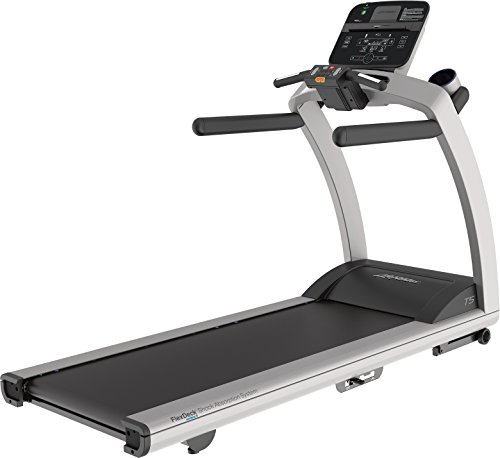
Life Fitness T5
Gyms and home buyers both run the Life Fitness T5, so parts and service follow commercial standards. A 3.0 CHP motor and steel frame handle multi-user, all-day operation. The Track Connect console pairs with a tablet for streaming workouts and metrics.
Pros
- Commercial parts and warranty support from a gym brand
- Steel frame handles frequent, multi-user operation
- Tablet holder keeps the console simple and durable
Cons
- Base console lacks a built-in screen
- Fewer preset workout programs than consumer brands

Sunny Health & Fitness SF-T7515
Sunny prices the SF-T7515 below most commercial-style rivals, yet still fits a 3.0 CHP motor. Incline still climbs to 15 percent, matching pricier competitors on that spec. Bluetooth speakers and a tablet holder cover the basics without a monthly subscription.
Pros
- 3.0 CHP motor and 15 percent incline rival pricier models
- No subscription required for basic use
- Bluetooth speakers stream audio without extra hardware
Cons
- Belt surface is narrower than premium commercial decks
- Console tracks fewer workout metrics
Side by side
| # | Model | Motor | Best for | Score | Price |
|---|---|---|---|---|---|
| 1 | NordicTrack Commercial 1750 | 3.75 CHP | Best overall | 9.4 | Check price |
| 2 | Sole F80 | 3.5 CHP | Best for heavy runners and high weight capacity | 9.2 | Check price |
| 3 | Horizon 7.8 AT | 3.5 CHP | Best incline range for hill training | 9.0 | Check price |
| 4 | Bowflex Treadmill 22 | 20 x 56 inches | Best for small spaces and folding storage | 8.8 | Check price |
| 5 | ProForm Pro 9000 | 3.6 CHP | Best motor for daily heavy use | 8.6 | Check price |
| 6 | Life Fitness T5 | 3.0 CHP | Best value for commercial-grade construction | 8.3 | Check price |
| 7 | Sunny Health & Fitness SF-T7515 | 3.0 CHP | Best budget option with commercial styling | 8.0 | Check price |
Before you buy
What makes a treadmill professional grade Commercial-style treadmills use motors built for continuous daily running, not occasional walks. Steel gauge and roller size hold up under frequent, heavier use. Cushioning systems in the deck reduce joint impact on long sessions. Motor and frame warranty length often signals build quality better than sticker cost.
Motor power and belt size for daily training A motor under 3.0 CHP can strain during sustained running at higher speeds. Look for 3.0 CHP or higher if the treadmill will see daily use. A belt of 20 by 60 inches or larger gives taller runners full stride room. Shorter or narrower belts suit walking more than running.
Weight capacity and incline range for serious runners Weight capacity above 300 pounds adds a safety margin even for lighter users, since it reflects motor and frame durability. Sole and Life Fitness both rate their decks near 375 to 400 pounds. Incline ranges of 12 to 15 percent let runners simulate hills indoors. Some models add a slight decline setting for downhill practice.
Fitting a commercial-style treadmill into a small space Folding frames like the Bowflex Treadmill 22 cut floor footprint by roughly half once stored upright. Hydraulic assist mechanisms make folding manageable for one person. Fixed-frame commercial units like the Life Fitness T5 skip folding for added stability. Apartment buyers should measure ceiling height, since folded units still stand several feet tall.
Good to know
What makes a treadmill professional grade?
Professional-grade treadmills run motors of 3.0 CHP or higher, use steel frames rated for continuous use, and size belts for full-stride running. Commercial parts support is an added marker.
How much horsepower do I need for daily running?
Daily runners should look for at least 3.0 CHP, with 3.5 to 3.75 CHP better suited to faster speeds or heavier users. Weaker motors can strain under sustained use.
Can a home treadmill handle gym-level use?
Models like the Life Fitness T5 and Sole F80 use motor and deck standards similar to gym floors. Lower-end home treadmills are not built for that frequency.
Is a higher weight capacity worth paying for?
A higher rating usually signals a sturdier frame and motor, which benefits any user regardless of body weight. It also tends to extend the treadmill’s usable lifespan.
Which treadmill has the best incline range for hill training?
The Horizon 7.8 AT and ProForm Pro 9000 both climb to a 15 percent incline, among the steepest ranges here. The ProForm adds a 3 percent decline option.
Do folding treadmills lose durability compared to fixed-frame models?
Quality folding treadmills like the Bowflex Treadmill 22 use hinges rated for the same weight capacity as the flat frame. Fixed-frame commercial units still edge out folding designs long-term.
How long does a commercial-style treadmill typically last?
Well-maintained units often run eight to ten years with regular belt lubrication and motor servicing. Frame and motor warranty length is a useful clue to expected lifespan.
Sole F80 vs NordicTrack Commercial 1750, which suits heavier runners?
The Sole F80 rates higher at 375 pounds against 300 for the NordicTrack, making it the safer pick for heavier runners. The NordicTrack instead offers a larger touchscreen and coached workouts.
Is a folding treadmill a good fit for small apartments?
Yes, if ceiling height and floor space are tight. The Bowflex Treadmill 22 halves its footprint when folded upright, though its belt runs shorter than fixed commercial decks.
What incline range should I look for on a daily-use treadmill?
A range of at least 10 to 12 percent covers most hill training. Models topping out near 15 percent, like the Horizon 7.8 AT, give the most room to progress.
The bottom line
The NordicTrack Commercial 1750 remains the strongest all-around pick, pairing a 3.75 CHP motor with a wide incline range and touchscreen coaching for daily training. Runners heavier than 300 pounds should choose the Sole F80 instead, since its 375 pound rating better fits sustained heavy use. Buyers short on space or budget get most of the same core specs from the Bowflex Treadmill 22 or Sunny Health & Fitness SF-T7515.
Derek Holt
Derek has a background coaching recreational and amateur athletes and has worked the sales floor at specialty fitness retailers. He focuses on equipment durability, ergonomics and realistic use cases rather than marketing claims.