Treadmill Desks Compared on Motor, Deck and Noise
LifeSpan’s TR1200-DT3 sets the bar for all-day desk walking, thanks to a 2.25 horsepower motor built for continuous hours. Apartments with no spare corner suit the WalkingPad C2, which folds at a hinge. Buyers wanting one machine for walking and running should take the UREVO 2 in 1.
LifeSpan’s TR1200-DT3 fits anyone planning several hours of walking each workday, because its motor carries a continuous duty rating rather than a peak one. Belt length also leaves room for a full stride at 6 feet tall. Storage is the catch, since the deck will not fold.
Walking pads look interchangeable in product photos. Put a 1.0 horsepower motor and a 2.25 horsepower motor through the same afternoon and the gap shows in heat and belt drift. Picks below draw on published motor ratings, deck dimensions, weight limits, speed ranges and owner reports about noise and long-session reliability.
What to look for
What to look for in an under-desk treadmill Motor rating predicts lifespan more than any other number. Continuous duty ratings near 2 horsepower absorb several hours a day, while peak-rated 1 horsepower units are built for short blocks. Belt length between 40 and 50 inches sets stride comfort, and anyone over 6 feet wants the upper end. Weight capacity ranges from 220 to 350 pounds across this group. Deck height then decides whether your existing desk works at all.
Pairing a walking pad with your desk Standing on a deck raises your working height by two to six inches, so desk range matters as much as the pad. Height adjustable frames such as the FLEXISPOT E7 absorb that easily. Fixed desks realistically need a low profile deck like the Egofit Walker Pro. Measure floor to elbow while standing on a book of similar thickness before ordering anything. Monitor height shifts too, and a low screen becomes a neck problem within a week.
Noise, flooring and apartment living Footfall, not motor hum, is what travels through a floor. Neighbours below hear impact, so a dense rubber mat helps more than hunting for a quieter motor. Carpet traps heat under the housing and shortens motor life. Hard floors plus a mat make the safer pairing. Renters on upper floors should also walk slower during evening hours, since cadence rises with speed.
Walking speed and getting real work done Typing accuracy falls off above roughly 2 miles per hour for most people. Calls, reading and email tolerate a faster pace than spreadsheets or design work. Two 45 minute blocks tend to beat one long push for both focus and legs. Jogging-capable decks like the UREVO let the same machine handle a workout after hours. Anyone who only ever walks should skip the handrail models and save the floor space.
The shortlist, ranked

LifeSpan TR1200-DT3 Under Desk Treadmill
Office duty shaped this design, pairing a 2.25 horsepower motor with a 20 by 50 inch belt. That extra deck length lets taller walkers keep a natural stride instead of clipping it. Speed stops at 4 miles per hour, which marks it as a walking tool rather than a running machine.
Pros
- 50 inch belt fits a full adult stride
- 350 pound capacity leads this group
- Motor rated for continuous daily hours
Cons
- Deck does not fold for storage
- Awkward to reposition without help

WalkingPad C2
KingSmith’s centre hinge folds this deck in half, so it slides under a sofa between sessions. Pace tops out near 3.7 miles per hour, which covers a brisk walk and nothing faster. Deck length falls short of office models, and walkers over about 6 feet notice within minutes.
Pros
- Folded footprint halves for storage
- Quiet enough for calls at walking pace
- Remote and phone app both set speed
Cons
- Short deck clips a long stride
- 220 pound limit rules out some users

UREVO 2 in 1 Under Desk Treadmill
Raising the folding handrail turns this deck into a light jogging treadmill once the workday ends. Dropped flat, it slides back under a desk. Top speed hits 7.6 miles per hour, well past what any flat walking pad offers.
Pros
- Covers desk walking and evening jogs
- Handrail folds flat for desk mode
- LED display tracks pace and distance
Cons
- Louder once speed passes a jog
- Heavier than a flat walking pad
Egofit Walker Pro
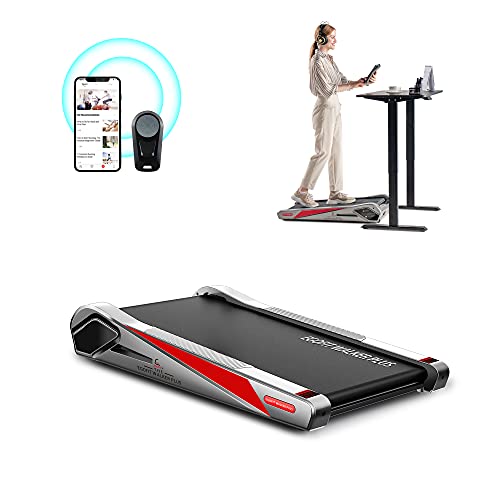
Deck height is the lowest here, which decides everything when a desk cannot rise. A built-in incline raises effort without asking for more speed. Its short deck suits shorter walkers and slower sessions.
Pros
- Slides under fixed-height desks
- Fixed incline adds effort at slow speeds
- Light enough to move every day
Cons
- Short deck limits stride length
- 3.1 mph ceiling rules out fast walking

GOPLUS 2 in 1 Folding Treadmill
Two people with different goals can share one machine here, with the rail up for running and down for desk walking. Bluetooth speakers and a remote come as standard. Assembled weight makes it a fixture in whichever room it lands.
Pros
- Serves a walker and a runner in one unit
- Remote control ships in the box
- Folds upright against a wall
Cons
- Too bulky for a studio apartment
- Console shows only basic metrics
Sunny Health & Fitness Walkstation Slim Treadmill
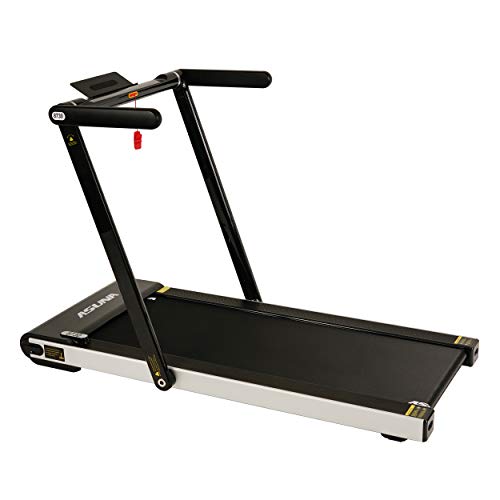
Owners return to the same point about this deck: motor hum stays under the threshold that shows up on a video call. Its slim frame slides beneath a standing desk and stores on end against a wall. Speed stops short of jogging, keeping the focus on desk work.
Pros
- Motor noise stays low during calls
- Stands upright in a closet between uses
- Controls work without pairing an app
Cons
- No incline setting
- Walking speeds only, no jogging mode
Sperax Walking Pad Treadmill
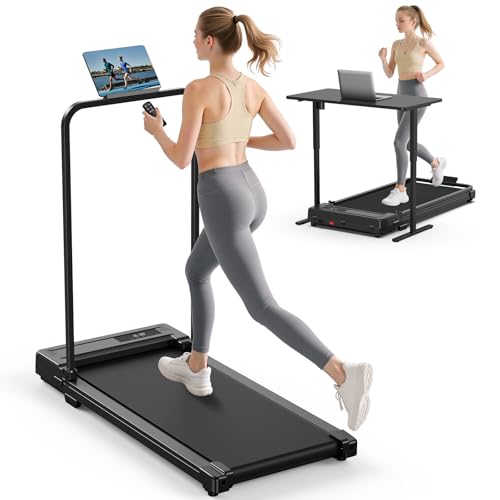
Sperax keeps the feature list short: a 2.25 horsepower peak motor, a remote and an LED readout. An hour of walking at a stretch is a fair expectation from a peak-rated motor. Belt width sits under the 20 inches office decks offer, so foot placement needs more attention.
Pros
- Simple enough for a first walking pad
- Light enough to carry between rooms
- Remote keeps the control set minimal
Cons
- Narrow belt leaves less margin for error
- Peak motor rating suits shorter sessions
Side by side
| # | Model | Motor | Best for | Score | Price |
|---|---|---|---|---|---|
| 1 | LifeSpan TR1200-DT3 Under Desk Treadmill | 2.25 horsepower | Best overall | 9.4 | Check price |
| 2 | WalkingPad C2 | 1.0 horsepower | Best for small apartments | 9.2 | Check price |
| 3 | UREVO 2 in 1 Under Desk Treadmill | 2.5 horsepower peak | Best value | 9.0 | Check price |
| 4 | Egofit Walker Pro | Low deck height for fixed desks | Best for low fixed desks | 8.8 | Check price |
| 5 | GOPLUS 2 in 1 Folding Treadmill | 2.25 horsepower | Best for shared households | 8.6 | Check price |
| 6 | Sunny Health & Fitness Walkstation Slim Treadmill | About 3.75 mph | Best for quiet operation | 8.3 | Check price |
| 7 | Sperax Walking Pad Treadmill | 2.25 horsepower peak | Best budget | 8.0 | Check price |
Frequently asked questions
Can you really work while walking on a treadmill desk?
Reading, calls and email hold up well at 1.5 to 2 miles per hour. Detailed typing and precise mouse work get harder above that. Most owners alternate walking blocks with sitting blocks.
Do I need a standing desk for a walking pad?
Almost always, since the deck adds two to six inches of height. Height adjustable desks solve it cleanly. Low profile pads are the only realistic route with a fixed desk.
How loud is an under-desk treadmill?
Motors stay quiet at walking pace, and footsteps dominate the sound. Neighbours below hear impact through the floor structure. A dense rubber mat cuts both noise and vibration.
What speed should I walk at while working?
Between 1 and 2 miles per hour suits desk work. Calls and reading tolerate a faster setting. Build up over a couple of weeks rather than starting with a full day.
Are walking pads safe to use on carpet?
Short pile carpet is usable but traps heat under the motor housing. Thick carpet is best avoided altogether. A hard board or mat underneath improves airflow and stability.
Which treadmill desk is best for tall users?
Look for a belt near 50 inches long, as on the LifeSpan TR1200-DT3. Shorter decks force a clipped stride that gets uncomfortable fast. Belt width around 20 inches helps too.
How many calories does desk walking burn?
Energy use scales with speed, body weight and hours walked rather than any fixed figure. Walking still beats sitting across a full workday. Treat console estimates as a rough guide.
Is a 2 in 1 treadmill better than a plain walking pad?
It is when one machine must cover both walking and running. Handrail models weigh more and sit less discreetly under a desk. Pure desk walkers rarely miss the extra speed.
What is the difference between peak and continuous horsepower?
Peak ratings describe a short burst, while continuous ratings describe sustained output. A 2.25 horsepower continuous motor handles hours; the same peak figure may not. Listings that only quote peak numbers point toward lighter duty.
How long does an under-desk treadmill last?
Motor duty rating and daily hours drive that answer more than brand. Belt tension checks and keeping the deck off carpet extend service life. Occasional users report years from entry level pads that heavy walkers wear out in months.
The verdict
Buy the LifeSpan TR1200-DT3 if desk walking is going to be a daily habit, because its continuous-duty motor and 50 inch belt are sized for hours instead of minutes. Renters short on floor space get more from the WalkingPad C2 and its folding hinge. When one machine has to cover both walking and running, the UREVO 2 in 1 makes better sense, and anyone with a fixed-height desk should start with the low profile Egofit Walker Pro.
Derek Holt
Derek has a background coaching recreational and amateur athletes and has worked the sales floor at specialty fitness retailers. He focuses on equipment durability, ergonomics and realistic use cases rather than marketing claims.