How to Pick a Treadmill for Walking or Serious Running
NordicTrack Commercial 1750 leads for motor power, deck size and incline range. Sole F80 Folding Treadmill suits dedicated runners who want a plain, sturdy frame. Horizon Fitness T101 delivers the strongest value for walkers and mixed household use.
Serious running and daily walking need different machines, and NordicTrack Commercial 1750 handles both without compromise. Sole F80 Folding Treadmill suits runners who want a plain, solid frame over screen features. Horizon Fitness T101 wins on value for walking and light jogging.
Treadmill shopping goes wrong because walkers and runners need genuinely different machines, yet listings blur that line. A short deck and small motor suit walking fine and fail completely under a 180 pound runner doing intervals. We compared continuous duty motor ratings, deck dimensions, cushioning systems, incline ranges and folded footprints, then weighed what owners report about noise, belt tracking and long term motor reliability.
What we recommend

NordicTrack Commercial 1750 Treadmill
This machine pairs a strong continuous duty motor with a full length running deck and an incline range that dips below level, unusual and genuinely useful for downhill training. A large touchscreen runs guided sessions with a subscription, though it works fine without one. Owners credit the deck cushioning for letting them run daily without the joint complaints a cheaper deck causes.
Pros
- Motor and deck suit real running
- Decline setting is rare at this level
- Effective deck cushioning
Cons
- Heavy and hard to move once assembled
- Best console features assume a subscription

Sole F80 Folding Treadmill
Sole builds the F80 around mechanicals rather than the screen, with a heavy frame, long deck and cushioning aimed at reducing impact over long runs. A hydraulic folding deck lowers itself gently instead of dropping. Frame weight, per its published specs, is a large part of why it stays planted during faster running.
Pros
- Very stable at running speeds
- Wide belt suits taller runners
- Hydraulic fold is safe to operate alone
Cons
- Console is basic next to touchscreen rivals
- Very heavy to position initially
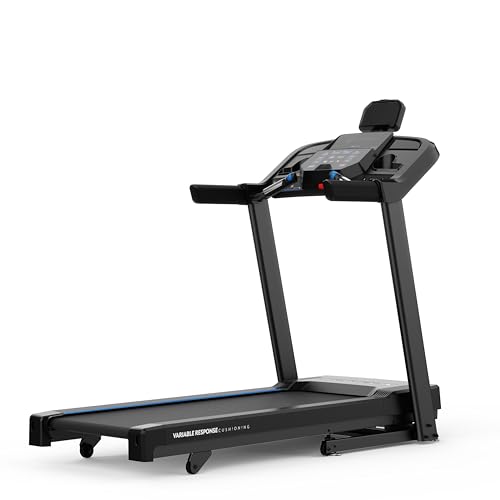
Horizon Fitness T101 Folding Treadmill
T101 sits at the point where a treadmill turns solid enough for jogging without the cost of a dedicated running machine, which covers what most households actually need. A hydraulic fold and transport wheels make it practical in a shared room. Owners report the quick dial speed and incline controls see the most use during intervals.
Pros
- Strong value for walking and jogging
- Quick dials speed up interval sessions
- Folds and moves easily
Cons
- Deck is short for tall runners
- Motor is not sized for daily long runs

XTERRA Fitness TR150 Folding Treadmill
XTERRA aims this squarely at walkers and occasional joggers, keeping the motor modest and the price low. Manual incline positions keep the mechanism simple and reliable. A small folded footprint, per its published specs, stores against a wall in a spare room.
Pros
- Lowest cost route to home walking
- Simple manual incline is reliable
- Compact folded footprint
Cons
- Narrow belt limits running comfort
- Manual incline means stopping to change it

ProForm Carbon T7 Treadmill
ProForm builds this around guided sessions on a tilting touchscreen, letting a trainer adjust speed and incline automatically mid class. That automation is the real appeal for anyone who struggles to structure their own sessions. Owners report the machine works fully in manual mode without a subscription, though the screen adds less value then.
Pros
- Guided classes adjust the machine automatically
- Tilting screen suits floor exercises too
- Solid mid range motor
Cons
- Screen value depends on a subscription
- Deck length is short for tall runners

Sunny Health & Fitness SF-T4400 Folding Treadmill
This ranks among the smallest conventional treadmills that still include a handrail and console, workable in an apartment where a full size machine is out of the question. Nine preset programs cover basic structure. A soft drop folding system and transport wheels, per its published specs, round out the compact design.
Pros
- Fits rooms that cannot take a full machine
- Light enough to move alone
- Inexpensive for a folding design
Cons
- Narrow, short belt suits walking only
- Noticeably louder than heavier machines

WalkingPad C2 Folding Walking Treadmill
This drops the handrail entirely and folds in half, sliding under a desk or sofa once you finish. It targets slow walking during work rather than exercise sessions, and its speed range reflects that. Owners find it works best with a standing desk, since typing while seated and walking rarely mix.
Pros
- Stores in genuinely small spaces
- Turns desk time into walking time
- Quiet enough for a shared office
Cons
- No handrail rules out fast walking or running
- Needs a standing desk to be useful
How they stack up
| # | Model | Motor | Best for | Score | Price |
|---|---|---|---|---|---|
| 1 | NordicTrack Commercial 1750 Treadmill | 3.5 CHP continuous duty | Best overall | 9.4 | Check price |
| 2 | Sole F80 Folding Treadmill | 3.5 CHP continuous duty | Best for runners | 9.2 | Check price |
| 3 | Horizon Fitness T101 Folding Treadmill | 2.5 CHP continuous duty | Best value | 9.0 | Check price |
| 4 | XTERRA Fitness TR150 Folding Treadmill | 2.25 HP | Best budget | 8.7 | Check price |
| 5 | ProForm Carbon T7 Treadmill | 2.6 CHP | Best for guided workouts | 8.5 | Check price |
| 6 | Sunny Health & Fitness SF-T4400 Folding Treadmill | 2.2 HP peak | Best for small apartments | 8.2 | Check price |
| 7 | WalkingPad C2 Folding Walking Treadmill | Handrail free walking pad | Best for under a desk | 8.0 | Check price |
What to look for
Match the motor to how you will use it Continuous horsepower, listed as CHP, is the figure that matters, not peak horsepower. Around 2.0 CHP suits walking, 2.5 CHP suits regular jogging, and 3.0 CHP or more covers someone running most days. A motor working near its limit runs hot, and heat is what kills treadmill motors early.
Deck length follows your stride Running lengthens stride considerably, so a belt that feels roomy at walking pace turns cramped at speed. Walkers do fine with a 50 to 55 inch belt. Runners should look for 60 inches, and anyone over six feet should treat that as a minimum, not a luxury.
Folding, footprint and where it will live Folding treadmills save space, yet they remain large, heavy machines that still need a wall to lean against. Check folded depth and machine weight before assuming you will move it often. Hydraulic assisted folding is worth having, since it lets one person lower the deck safely.
Consoles, subscriptions and what manual mode still offers Several manufacturers now build the experience around guided classes, and the screen looks sparse without a subscription. Every machine in this list still runs in manual mode with speed and incline control. Skip guided sessions and put that budget toward motor and deck quality for a better machine overall.
Good to know
How much motor power do I need for a treadmill?
Walking needs around 2.0 continuous horsepower. Regular jogging wants 2.5 CHP, and daily running is better served by 3.0 CHP or more. Ignore peak horsepower figures, since they describe a brief burst rather than sustained output.
What deck length works best for a runner?
Aim for a 60 inch running surface. Shorter decks force a shortened stride at speed, which changes gait and makes fast running feel cramped, especially for anyone over six feet tall.
Are folding treadmills less stable than fixed frames?
The folding mechanism itself is not the issue. Frame weight and deck support drive stability, so a heavy folding machine can beat a light rigid one. Check the machine weight and the stated user weight limit.
Do I need a subscription to use a smart treadmill?
No. Every treadmill in this list runs in manual mode with full speed and incline control. Subscriptions add guided classes and, on some models, automatic adjustment of speed and incline during a session.
How noisy is a treadmill in an apartment?
Impact noise through the floor usually matters more than motor noise. A rubber treadmill mat helps considerably, and heavier machines with better cushioning transmit less impact than light budget models.
What maintenance does a treadmill need?
Keep the belt centred, check tension periodically, and lubricate the deck on the manufacturer’s schedule if the model calls for it. Vacuuming dust from underneath a few times a year also keeps the motor cool.
Is incline worth paying extra for?
Yes, for walkers especially. Incline raises effort without raising speed, which matters for anyone managing joint impact. Powered incline you can adjust mid session beats manual pins by a wide margin.
Can a walking pad replace a full treadmill?
Only if the goal is daily step count rather than cardio training. Walking pads skip the handrail and cap the speed range, so they suit desk walking but cannot support jogging or interval work.
Treadmill vs walking pad: which suits daily steps?
A walking pad wins for slipping under a desk and logging steady steps during work. A full treadmill wins once running, intervals or incline training enter the picture.
Best treadmill for a small apartment or shared room?
Sunny Health & Fitness SF-T4400 and the WalkingPad C2 both fold into a small footprint, with the WalkingPad sliding fully under furniture when it is not in use.
Final word
NordicTrack Commercial 1750 covers running, walking and incline training for a whole household in one machine. Runners who care more about frame than screen should look at the Sole F80, and Horizon Fitness T101 remains the smarter value pick for walking and light jogging.
Derek Holt
Derek has a background coaching recreational and amateur athletes and has worked the sales floor at specialty fitness retailers. He focuses on equipment durability, ergonomics and realistic use cases rather than marketing claims.
