Which Professional Kite Suits Your Wind and Field
Prism Quantum 2.0 is the strongest all round pick, tracking cleanly from light breeze to brisk coastal wind. Tricks come faster on the Prism Nexus 2.0, which stalls slowly and forgives late inputs. For pull rather than figures, HQ Kites Symphony Beach III 1.3 is the gentlest starting point.
Prism Quantum 2.0 earns its place for anyone with a clear field and changeable wind, since it holds a line from roughly 5 to 25 mph. Corners stop where you release them, which is what makes geometric figures possible. Wingspan near 7 ft 8 in is the catch, because launching wants open ground and a helper on gusty days.
Serious kites split into three families that share little beyond a line set. We compared published wind ranges, frame materials, sail fabrics, supplied line lengths and packed dimensions. Owner accounts of snapped spreaders, sail stretch after a season of sun and how quickly each kite teaches a trick set the order.
What matters most
The three families of professional kites Single line kites fly themselves. Stake the line and a delta such as the Prism Zenith 5 holds position for an hour. Dual line kites add steering, so a pilot draws figures and eventually lands tricks. Power foils belong to a different sport: no frame, plenty of pull, and traction rather than precision as the goal. Choose the family before the model, because a trick kite and a traction foil answer opposite questions. Mixing them up is the most common reason a first serious kite disappoints.
How much wind each kite type needs Wind range decides whether a kite leaves the ground at all. Inland parks often sit between 4 and 10 mph, which favours light framed trick kites like the Prism Nexus 2.0 and large light wind deltas. Coastal sites regularly run 12 to 25 mph, where a foil holds shape and a light trick kite turns nervous. Flown above its range, a framed kite risks a snapped spar. Flown below it, the sail simply sinks. Check a forecast in mph before you choose a model, not after the box arrives.
Frames, sails and what breaks first Spars absorb the damage in every crash. Wrapped carbon on the Prism Quantum 2.0 flexes and springs back, while plain fiberglass on the HQ Salsa III weighs more but costs little to replace. Ripstop nylon resists tear spread better than lighter polyester, which stretches over seasons of sun. Foils avoid the problem entirely, since nothing rigid can snap. Keep spare spars and a roll of sail tape in the bag. A broken lower spreader ends a session that sail tape alone could have saved.
Flying space, safety and packing for travel Dual line kites want clear ground about as wide as the line set, commonly 80 to 100 feet in every direction. Power foils need more room plus firm footing, because a gust can drag a flyer several steps. Stay away from power lines, roads and crowded beaches, and keep the downwind area empty of people. Travelling flyers should look at foils first: the Prism Snapshot 1.9 packs into a stuff sack with no tube to check in. Framed kites need a padded sleeve, and baggage handling causes more broken spars than flying does.
The top picks, ranked

Prism Quantum 2.0
Tracking is the design goal here, so straight lines stay straight and turns finish where you stop pulling. Wrapped carbon and fiberglass spars flex through nose-in landings that snap solid glass. Padded wrist straps and pre-sleeved flying lines ship in the box, so a first flight needs nothing extra.
Pros
- Holds a track tight enough for geometric figures
- Flies across roughly 5 to 25 mph
- Line set and padded straps arrive included
Cons
- Wingspan near 7 ft 8 in demands a large field
- Pull near the 25 mph ceiling tires new pilots
Prism Nexus 2.0
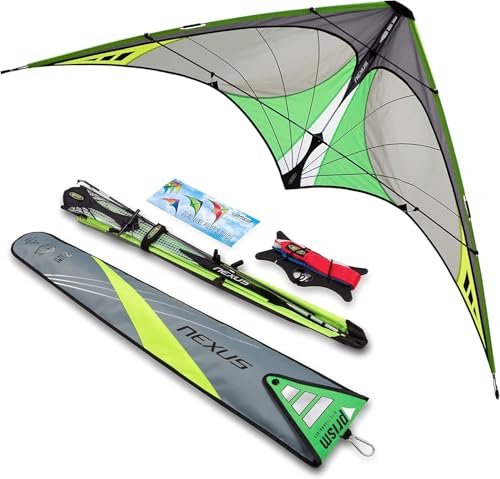
Smaller sail area and light carbon spars slow the Nexus enough to park it in a stall. Axels and fades begin from that pause, which is why owners land a first trick on this kite. Inland parks suit it well, since a 4 mph bottom end keeps it airborne on quiet evenings.
Pros
- Slow flight speed makes trick timing readable
- Light carbon frame lifts in about 4 mph
- Roughly 6 ft span fits a neighbourhood park
Cons
- Twitchy and overpowered in strong coastal wind
- Carbon spar replacements cost more than fiberglass

HQ Kites Symphony Beach III 1.3
Nothing rigid means nothing to break, so a bad landing on sand costs no inspection time. Span measures 1.3 m, enough pull to feel through the straps without dragging an adult across the beach. Cells need roughly 8 mph to inflate and hold their shape.
Pros
- Frameless build shrugs off crashes into sand
- Stuffs down to about the bulk of a jacket
- Delivers real traction pull for a first foil
Cons
- Stalls and trick moves are off the menu
- Will not hold shape below roughly 8 mph

Prism Zenith 5
One line and a delta profile make this a kite you stake out and watch. A long line on the supplied winder lifts the sail above ground turbulence, where wind runs steadier. Assembly finishes in under a minute, which matters when a child is waiting.
Pros
- Sits in the sky once staked or lightly held
- Sleeved spars assemble in under a minute
- Stays settled in gusty inland conditions
Cons
- No steering, so flying stays passive
- Strong gusts call for tail adjustment

HQ Kites Salsa III
Fiberglass spars and ripstop polyester keep this one cheap to put back together after a hard nose-in. Handling feels direct rather than delicate, rewarding big sweeping figures over subtle trick input. Lending it to friends costs nothing but a spar, which is the real argument for a second kite.
Pros
- Fiberglass spars are inexpensive to replace
- Direct handling suits new dual line pilots
- Flies through a broad 6 to 25 mph window
Cons
- Heavier frame dulls trick response
- Polyester sail stretches sooner than ripstop nylon
Prism Snapshot 1.9
Roll the sail, pocket the handles, and a 1.9 m foil disappears into a carry-on. Larger area means stronger pull than the Symphony Beach III, so planting your feet matters on gusty days. Zero spars removes the case, the assembly time and the usual travel breakage.
Pros
- Packs smaller than any framed kite listed
- 1.9 m area generates pull in moderate wind
- Nothing to assemble once you reach the beach
Cons
- Pull can overwhelm lighter flyers in gusts
- Lines tangle badly if the foil is stuffed away wet

Premier Kites Ghost Delta
Large sail area on light fiberglass spars lifts in breezes that leave smaller kites sitting. Translucent panels stay readable against bright sky from a long way off. Control runs through one line only, so expect graceful drift instead of figures.
Pros
- Launches in genuinely light wind near 5 mph
- Ripstop nylon sail resists tear spread
- Two spar assembly with nothing fiddly
Cons
- Big sail turns awkward above roughly 18 mph
- Supplied line and winder are basic for the size
The lineup, side by side
| # | Model | Type | Best for | Score | Price |
|---|---|---|---|---|---|
| 1 | Prism Quantum 2.0 | Dual line stunt kite | Best overall | 9.4 | Check price |
| 2 | Prism Nexus 2.0 | Dual line trick kite | Best for learning tricks | 9.2 | Check price |
| 3 | HQ Kites Symphony Beach III 1.3 | Dual line power foil | Best power foil | 9.0 | Check price |
| 4 | Prism Zenith 5 | Single line delta | Best single line | 8.8 | Check price |
| 5 | HQ Kites Salsa III | Dual line sport kite | Best value dual line | 8.5 | Check price |
| 6 | Prism Snapshot 1.9 | Dual line power foil | Best for travel | 8.2 | Check price |
| 7 | Premier Kites Ghost Delta | Single line delta | Best for light wind | 8.0 | Check price |
Questions worth asking
What is the best professional kite for a first stunt kite?
Prism Quantum 2.0 if open space is available, since it tracks predictably and includes the line set. Prism Nexus 2.0 works better on smaller fields and in lighter wind.
Which kite is best for learning tricks like the axel?
Prism Nexus 2.0. Slow flight speed and light carbon spars let it hold a stall long enough for trick inputs to register.
What is the difference between a stunt kite and a power kite?
Stunt kites carry a frame and are built for precision figures. Power foils have no frame, generate real pull, and get used for traction instead of tricks.
How much wind do professional kites need?
Dual line framed kites here start near 4 to 6 mph. Foils want roughly 8 mph or more before their cells inflate and the sail holds shape.
Prism Quantum 2.0 vs Prism Nexus 2.0: which should you buy?
Quantum for a wide wind range and precise tracking on open ground. Nexus for slow, forgiving flight that teaches tricks in lighter breeze.
Are foil kites better than framed kites for travel?
Yes. A foil such as the Prism Snapshot 1.9 rolls into a small sack with nothing rigid to break, while framed kites need a padded tube in the hold.
How much space does a dual line kite need?
Allow clear ground at least as wide as the line length, commonly 80 to 100 feet each way, with no power lines or roads downwind.
Can a broken kite spar be repaired?
Usually. Fiberglass spars on the HQ Salsa III are easy to source, and most makers sell matched carbon spars for their own frames.
Is a professional kite too much for a child to fly?
A power foil is, since the pull can drag a light flyer. Hand a child the Prism Zenith 5 on a single line, then move up to a dual line kite once steering interests them.
What is the best kite for light wind days?
Premier Kites Ghost Delta lifts in breezes near 5 mph thanks to a big sail on light spars. Prism Nexus 2.0 is the light wind answer for anyone who wants steering.
The bottom line
Prism Quantum 2.0 is the one to buy if your local field is large and the wind changes week to week, because tracking stays precise across roughly 5 to 25 mph. Pilots stuck with a small park or gentle evening breeze should take the Prism Nexus 2.0 instead and learn tricks sooner. When pull is the point rather than figures, HQ Kites Symphony Beach III 1.3 introduces traction without hauling anyone off their feet.
Rachel Simmons
Rachel previously worked in child-product retail and brings a practical, detail-first eye to gear reviews, focusing on safety standards, ease of use and the fine print that matters most for new caregivers.
You might also need

EVERYDAY KIDS Roarin’ Dinos Nap Mat: A Real Comforter or Just a Thin Blanket?
Why Does a High Chair’s Tray Shape Affect How Much Mess Gets Made?
Why Does a Baby Swing’s Motion Pattern Matter for Soothing?
