Why Does a Baby Swing’s Motion Pattern Matter for Soothing?
Different motion patterns stimulate a baby’s vestibular system, the inner ear balance mechanism, in different ways, and some babies settle more easily with one pattern than another, which is why a swing that soothes one baby to sleep might barely register with a different baby. There is no single best pattern, but the variety matters because it lets caregivers find what a specific baby actually responds to.
The vestibular connection
Rhythmic motion stimulates the vestibular system in the inner ear, which plays a role in regulating a sense of calm and balance from very early infancy. This is part of why the natural rocking motion of being carried or gently bounced has long been an effective soothing technique even before mechanical swings existed.
Side-to-side versus front-to-back motion
Side-to-side swinging motion is often compared to the gentle sway of being carried while walking, while front-to-back, or head-to-toe, motion is closer to the sensation of being rocked in arms facing the caregiver. Babies can show a clear preference for one direction over the other, and it is not always predictable which one a specific baby will prefer.
Why some swings combine multiple motion patterns
Higher-end swings that combine side-to-side sway with a gentle bounce, or offer several distinct motion settings, exist specifically because no single pattern works universally, giving caregivers more options to try before settling on what actually calms a particular baby.
Speed and consistency matter alongside direction
Beyond the direction of motion, the speed and smoothness of the swing also affect its soothing power. An erratic or jerky motion, even in an otherwise soothing direction, can be more agitating than calming, while a slow, smooth, consistent rhythm tends to be more universally settling regardless of direction.
Why motion alone does not always work
A swing’s motion pattern is only one factor in soothing a baby, and hunger, discomfort, overtiredness, or overstimulation can all override even a well-matched motion pattern’s calming effect. Motion works best as part of an overall calm, consistent environment rather than as a standalone fix for every instance of fussiness.
Safe use limits on swing motion
Pediatric guidance generally recommends limiting continuous swing use to shorter stretches rather than extended periods, both to avoid excessive time in a reclined position and to encourage other forms of movement and interaction, regardless of how effective the specific motion pattern seems to be.
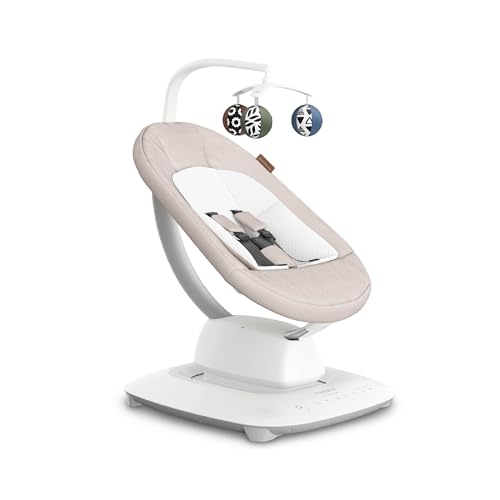
4moms mamaRoo Baby Swing
A widely used swing offering multiple distinct motion patterns, including a bouncing and a side-to-side style, designed to let caregivers match the motion to what a specific baby responds to.
Fisher-Price Sweet Snugapuppy Dreams Swing
A traditional pendulum-style swing offering a classic side-to-side swinging motion at adjustable speeds, a common entry-level option in many nurseries.
Questions worth asking
Why do some babies prefer side-to-side swinging over front-to-back motion?
This likely relates to individual differences in how each baby’s vestibular system responds, and preference is not consistently predictable from one baby to another, which is why trying different motions is common.
Can the wrong swing motion actually upset a baby more than help?
Yes, a motion pattern or speed that does not match what a specific baby finds soothing can increase fussiness rather than calm it, which is why switching settings or styles is a reasonable troubleshooting step.
Is a multi-motion swing worth the extra cost over a simple single-motion swing?
For a baby who does not settle well with one pattern, a multi-motion swing’s flexibility can be worth it, though many babies do fine with a simple, single consistent motion pattern as well.
How long is it safe to leave a baby in a swing at one time?
General guidance suggests limiting continuous swing time to shorter stretches rather than extended periods throughout the day, to encourage varied positioning and avoid excessive time reclined.
Does swing speed matter as much as the direction of motion?
Yes, an inconsistent or overly fast motion can be agitating even in a direction a baby typically likes, while a smooth, slow, steady rhythm tends to be more reliably calming.
Can a baby’s motion preference change as they get older?
Yes, what soothes a very young newborn may not have the same effect a few months later, as babies’ sensory responses and overall temperament continue to develop over time.
Do battery-powered and plug-in swings differ in motion quality?
Battery-powered swings can sometimes slow down as batteries drain, producing a less consistent motion, while plug-in swings generally maintain steadier power and motion throughout use.
Is there a connection between swing motion and car ride soothing?
Many parents notice babies who settle well in a moving car also respond well to certain swing motions, since both involve a rhythmic, somewhat similar vestibular stimulation.
Can overusing a swing’s motion create a sleep association that is hard to break later?
It is possible for a baby to form a strong association with swing motion for sleep, similar to other sleep associations, though most children transition away from needing it as they grow.
Does swing motion help with colic or excessive crying?
Many parents report some relief using gentle, consistent swing motion during fussy periods, though it is not a guaranteed fix for colic, which has multiple possible underlying causes.
Why do some swings offer a separate bouncing motion instead of only a swinging motion?
A gentle bouncing motion mimics being held and bounced in arms, which some babies find more calming than a purely lateral swinging motion, hence the inclusion of both options in multi-motion swings.
Can twins have different motion preferences in the same model of swing?
Yes, since motion preference is highly individual, it is entirely possible for two babies, even twins, to respond differently to the exact same swing and motion setting.
Is it normal for a baby to resist a swing entirely regardless of motion pattern?
Yes, some babies simply do not take to swings at all, and in those cases other soothing methods like rocking in arms, a carrier, or a different type of motion altogether may work better.
Does the recline angle of a swing affect how its motion feels to a baby?
Yes, a more upright or more reclined angle changes how motion is experienced by the baby’s body and head position, which can influence comfort alongside the swing pattern itself.
Should swing motion settings be adjusted gradually or tried at full range right away?
Starting with a gentler, slower setting and adjusting based on the baby’s reaction is generally a more cautious approach than immediately testing the most intense available motion setting.
Can a baby outgrow a particular swing motion pattern they used to love?
Yes, preferences can shift over the first several months as a baby’s sensory responses mature, so a motion that worked well early on may need to be swapped for a different setting later.
Does the sound a swing makes while moving affect how well the motion soothes a baby?
A noisy, mechanical motor sound can sometimes compete with or distract from the calming effect of the motion itself, so quieter swing mechanisms are often preferred for consistent soothing.
Is it worth trying a swing at a friend’s or relative’s house before buying one?
Yes, since motion preference is so individual, testing a swing a baby has not used before can help avoid purchasing a model whose specific motion pattern the baby simply does not respond to.
Can combining a swing’s motion with other soothing tools, like white noise, improve results?
Many parents find combining gentle motion with steady background sound more effective than either alone, since the two address different senses that can both contribute to a calm state.
Final word
The motion pattern matters because babies are not interchangeable in how their vestibular system responds to rhythm and direction. A swing with more motion options simply gives a better chance of finding what actually works for a specific baby, rather than guaranteeing success on the first try.
Rachel Simmons
Rachel previously worked in child-product retail and brings a practical, detail-first eye to gear reviews, focusing on safety standards, ease of use and the fine print that matters most for new caregivers.


