Classroom Grade Geography Toys for Ages 3 to 12
PlayShifu Orboot Earth Explorer leads for ages four to ten, layering animals, landmarks and culture onto an unlabelled globe through a tablet app. LeapFrog Magic Adventures Globe suits homes with no spare device, playing BBC video on a built in screen. Preschoolers do better with the Educational Insights GeoSafari Jr. Talking Globe.
PlayShifu Orboot Earth Explorer is the pick for primary age children. Scanning the 10 inch ball with a tablet unlocks animals, monuments and culture cards tied to each region. No country names are printed, so children read shapes and position instead of labels. A device is mandatory, which rules the globe out for screen free households.
Classroom grade toys differ from novelty ones on three counts: they survive daily handling, they correct a wrong answer, and they carry real content. We compared age ranges, teaching formats, materials and app requirements across seven options. Reports from parents and teachers about battery drain, lost pieces and fading interest shaped the ranking.
The top picks, ranked

PlayShifu Orboot Earth Explorer AR Globe
Blank coastlines do the teaching here, because no country names appear on the sphere. Pointing a tablet at a region reveals animals, monuments, inventions and cultural facts through the Orboot app. Constellation mode reuses the same ball as a night sky reference, which stretches interest well past week one.
Pros
- Unlabelled map builds genuine country recall
- Quests and quizzes reward a correct answer
- Constellation mode adds a second subject
Cons
- Nothing happens without a phone or tablet
- Four and five year olds need help starting quests
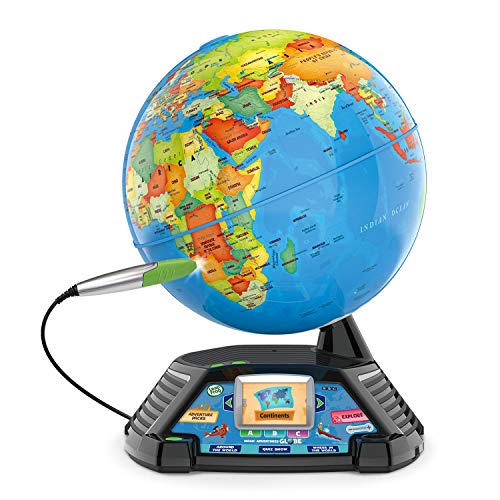
LeapFrog Magic Adventures Globe
Touching a place with the stylus plays BBC footage on a 2.8 inch colour screen set into the base. Over five hours of video cover habitats, wildlife, landmarks and daily life across the continents. Parents choose it over an augmented reality globe for one reason: no tablet leaves the drawer.
Pros
- Runs on its own with no second device
- Real footage holds attention better than animation
- Stylus control works before reading does
Cons
- Screen size suits one viewer at a time
- Video library cannot be added to later
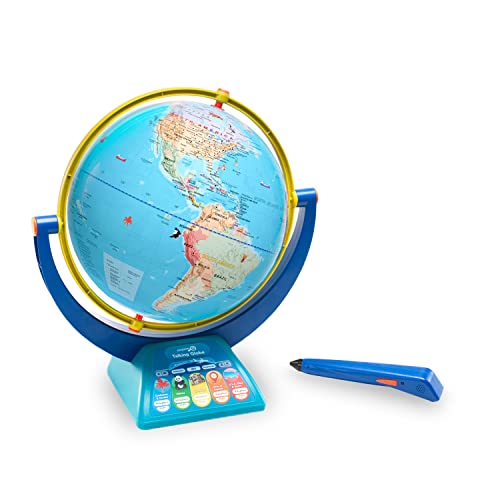
Educational Insights GeoSafari Jr. Talking Globe
Tapping a country, capital or landmark with the pen returns a spoken fact, so pre readers get information directly. Quiz modes turn that into a game with right and wrong feedback for one or two players. Chunky mouldings and a wide base tolerate being swept off a table.
Pros
- Speaks facts aloud for children who cannot read
- Quiz mode corrects a mistake on the spot
- Sturdy enough for a nursery shelf
Cons
- Audio lines start repeating after heavy use
- Batteries drain fast under daily play

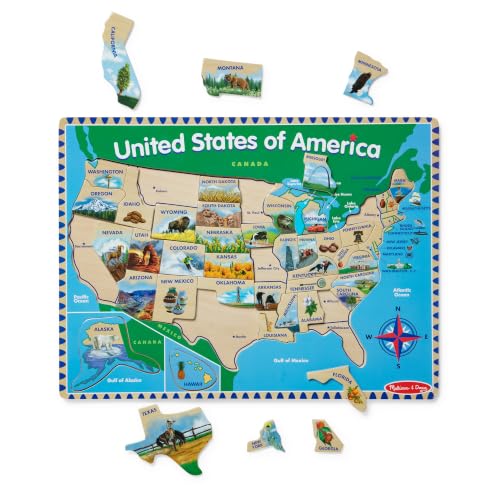
Melissa & Doug USA Map Floor Puzzle
Fifty one thick pieces build a map around two feet by three feet, wide enough for two children side by side. Every state carries its capital plus a small illustration, anchoring a name to a picture. Board stock takes a knee or a shoe without creasing, unlike thin jigsaw card.
Pros
- Floor scale suits two or more builders
- Capitals and icons print on each state
- Pieces stay flat through repeat use
Cons
- Coverage stops at the United States
- Wants clear floor about two by three feet

GeoToys GeoPuzzle World
Each piece is cut to a real country outline, so a child learns Chile or Italy by handling it. Fitting neighbours together teaches which nations border which, the part a wall poster never conveys. Chunky pieces work for four year olds, while the full world count keeps older builders busy.
Pros
- Borders and neighbours get learned by touch
- No app, screen or batteries involved
- Several children can build it at once
Cons
- Small island nations go missing easily
- Interest fades once it has been built repeatedly

Professor Noggin’s World Geography Trivia Card Game
Every card carries an easy and a hard version of the same question, so a child and an adult compete fairly. Topics span continents, capitals, landmarks and physical features such as rivers and deserts. Deck plus die fits a coat pocket, making this the option that travels to restaurants and long drives.
Pros
- Two difficulty levels keep mixed ages even
- Packs small enough for a glovebox
- Covers physical and human geography
Cons
- An adult or older reader must run each round
- Answers get memorised after several plays
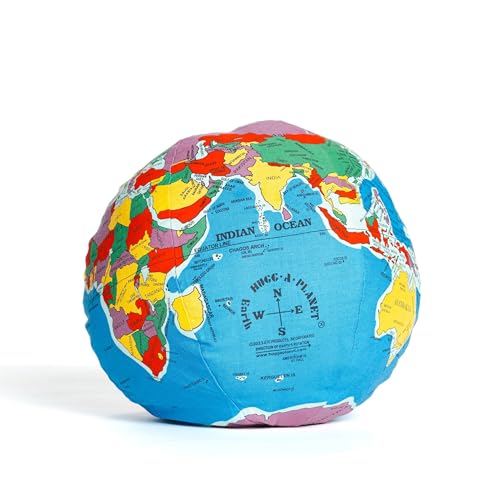
Hugg-A-Planet Classic Political Earth
Fabric and soft fill let a baby throw, squash and sleep on the world with no damage either way. Hundreds of place names print across the surface, so the map stays accurate rather than cartoon decoration. Machine washing returns it to service after the spills this age group guarantees.
Pros
- Safe from birth with no hard edges
- Prints a real political map, not a picture
- Goes through the washing machine
Cons
- Offers no interactive content at all
- Printing fades after repeated washes
How they stack up
| # | Model | Age range | Best for | Score | Price |
|---|---|---|---|---|---|
| 1 | PlayShifu Orboot Earth Explorer AR Globe | 4 to 10 years | Best overall | 9.4 | Check price |
| 2 | LeapFrog Magic Adventures Globe | 5 to 10 years | Best for independent learning | 9.2 | Check price |
| 3 | Educational Insights GeoSafari Jr. Talking Globe | 4 years and up | Best for preschoolers | 9.0 | Check price |
| 4 | Melissa & Doug USA Map Floor Puzzle | 51 | Best for learning US states | 8.8 | Check price |
| 5 | GeoToys GeoPuzzle World | Country shaped pieces | Best for world map recall | 8.6 | Check price |
| 6 | Professor Noggin’s World Geography Trivia Card Game | Trivia card deck with die | Best for family game night | 8.3 | Check price |
| 7 | Hugg-A-Planet Classic Political Earth | 12 in diameter | Best for toddlers | 8.0 | Check price |
Before you buy
What makes a geography toy worth buying Feedback comes first. A toy that flags a wrong answer and supplies the right one teaches faster than anything that only displays facts. Accuracy is the second filter, since plenty of children’s globes still print outdated capitals or borders. Durability is what most buyers mean by professional: thick board, sturdy mouldings and a base that survives a fall from a table. Content depth decides how long the toy lasts, because a fixed set of facts runs dry within a fortnight. Check whether that content can grow through app updates or extra card packs.
Globes, puzzles and card games compared Formats teach different skills. Interactive globes deliver content, so facts about wildlife, food and landmarks land first. Puzzles build spatial memory, which is where borders and neighbouring countries stick; GeoToys GeoPuzzle World does that better than any poster. Card decks such as Professor Noggin’s test recall under light pressure and scale across mixed ages. One of each covers far more ground than three globes would. Screen free homes can skip the augmented reality category entirely without losing much.
Best geography toys by age, from toddler to ten Under three, familiarity beats facts, so a soft globe like Hugg-A-Planet earns its place. Four to six needs audio, because pre readers cannot use printed labels; GeoSafari Jr. Talking Globe fits that window exactly. Seven and up opens trivia decks, detailed puzzles and quiz modes where reading and competition both work. Orboot Earth Explorer spans the widest range, since app quests get harder as a child progresses. Nine and ten year olds usually want real footage or a real challenge rather than cartoon characters.
What holds up in a classroom or homeschool group Group settings punish anything fragile or single player. Floor puzzles let four children work at once and store flat on a shelf between lessons. Battery powered globes need a replacement plan, because a dead globe teaches nothing on a Monday morning. Tablet based toys turn awkward past two children, so keep augmented reality for home. For a class, a floor puzzle plus a card deck reaches more children at once than any single globe can.
Questions worth asking
What age should a child start learning geography?
Around three, children can name continents and recognise a globe as the world. Formal map skills arrive closer to six or seven. Early exposure through a soft globe or a floor puzzle builds the familiarity later lessons lean on.
Are interactive globes worth buying?
They earn their place when a child engages with content instead of just pressing buttons. LeapFrog Magic Adventures Globe uses real BBC footage, which holds attention longer than generic narration. Households limiting screens should take a talking globe or a puzzle instead.
Which geography toy is best for a five year old?
GeoSafari Jr. Talking Globe fits that age, since it speaks facts aloud for pre readers and includes quiz modes. Orboot Earth Explorer also works at five with an adult nearby. Pair either with a floor puzzle for physical play away from a screen.
Do AR globes need a tablet?
Yes. Orboot Earth Explorer shows no content at all without a phone or tablet running its app. Where no device is free, a self contained globe with a built in screen is the safer format.
How do map puzzles help children learn countries?
Handling a country shaped piece links an outline to a name in a way a poster cannot. Slotting it between neighbours teaches relative position and border shape together. That pairing is why GeoPuzzle World keeps working through repeat classroom use.
Are children’s globes accurate?
Established brands refresh borders and capitals between print runs. Second hand globes often lag, so check recently renamed capitals before buying used. Political maps date faster than physical ones showing rivers and mountains.
What geography game can the whole family play?
Professor Noggin’s World Geography deck is built for mixed ages, with an easy and a hard question on each card. It runs from two to eight players and needs no setup. Floor puzzles work as a shared activity for children too young to read.
Do geography toys need batteries?
Talking and video globes do, including GeoSafari Jr. and the LeapFrog globe. Puzzles, card decks and fabric globes need none. Battery free options save a recurring headache in a classroom cupboard.
Talking globe vs AR globe: which teaches more?
Talking globes give instant audio feedback, which suits children under six. AR globes carry deeper content and quest structure that scales up to about ten. Budget and device availability usually settle it before teaching style does.
Can geography toys be used in a classroom?
Floor puzzles, country shaped puzzles and card decks handle group use best. Pick items with thick board and no charging requirement for daily lessons. Keep one interactive globe on a table for small group rotation rather than whole class work.
The bottom line
Pick PlayShifu Orboot Earth Explorer if a spare tablet exists and the child is four to ten, because an unlabelled globe forces real map reading rather than label spotting. Screen free households should start with GeoSafari Jr. Talking Globe and add GeoPuzzle World as reading develops. Teachers buying for a group get more from the Melissa & Doug floor puzzle, since four children can build it together and nothing needs charging.
Rachel Simmons
Rachel previously worked in child-product retail and brings a practical, detail-first eye to gear reviews, focusing on safety standards, ease of use and the fine print that matters most for new caregivers.