Premium Geography Toys That Hold a Child’s Interest
PlayShifu Orboot Earth leads because its unlabeled globe makes a child search for every answer. LeapFrog Magic Adventures Globe suits pre-readers, since video clips and a stylus replace reading. Past age eight, Ticket to Ride teaches city locations through rail routes instead.
Buy PlayShifu Orboot Earth for a tablet owning household with a child between four and ten. Nothing is printed on the sphere, so uncovering animals, monuments and dishes happens through the app. Without a tablet in the house, that same globe does almost nothing.
Box age labels rarely match how these toys actually get used. We compared stated age ranges, screen requirements, how deep each content library goes and how the materials hold up. Owner feedback about app crashes, battery drain and how quickly novelty faded shaped the order below.
What matters most
What to look for in a premium geography toy Depth is the first test: ask what the toy does on its tenth use that it did not do on its first. Layered content, quiz progression and physical assembly all pass, while a printed map alone does not. Materials decide the second half, since weighted bases and thick cardboard outlast thin molded plastic. Check the screen requirement last, because an app dependency decides whether the toy travels.
Globes compared: printed, talking and augmented reality Printed globes such as the Waypoint World Explorer reward a child who already reads and wants to browse. Talking models remove that reading barrier, which is why GeoSafari Jr. works at four. Augmented reality goes deepest on wildlife and culture, yet Orboot Earth is inert without a tablet. Households capping screen time should treat that dependency as the deciding factor, not a footnote.
Puzzles and maps for hands-on learners Some children map space with their hands before their eyes. Floor puzzles work at that scale, and the Melissa & Doug USA map gives a preschooler something to physically arrange. Learning Resources Puzzle Globe adds curvature, the quickest way to show why flat maps stretch the poles. Neither needs power, pairing or a charging cable.
Which toys still get used after age eight Globe interest usually fades around nine, and that is where games take over. Ticket to Ride keeps city positions relevant because recall wins routes. Board games also pull adults to the table, which is what actually keeps a purchase in rotation. A child bored of a talking globe will still play a strategy game three years later.
The best picks, ranked

PlayShifu Orboot Earth AR Globe
No country names appear on the sphere, which is deliberate. Aim a tablet camera at a region and the app layers in animals, monuments, inventions and cuisines. Six themed areas plus a sticker passport give a child reasons to return next week.
Pros
- Blank sphere rewards searching over label reading
- Covers culture and food, not only borders
- Sticker passport stretches play across weeks
Cons
- Does nothing without a tablet or phone
- Content runs thin for children past nine
LeapFrog Magic Adventures Globe
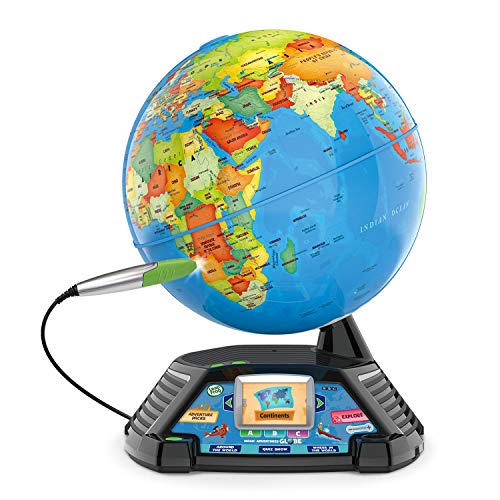
A video display sits in the base, so no second device is needed. Touch a country with the attached stylus and short BBC Earth clips play. Quiz and challenge modes take over once free browsing loses its pull.
Pros
- Self contained, with nothing to pair or download
- Footage holds a five year old’s attention
- Quiz modes add replay value after browsing
Cons
- Base screen is small for detailed footage
- Heavy use drains batteries quickly

Waypoint Geographic World Explorer Illuminated Globe
Twelve inches of printed political map sit on a weighted, tilted stand. Internal lighting makes island nations and small type legible after dusk. Nothing talks or responds here, which suits a reader who prefers looking things up alone.
Pros
- No app, pairing or screen involved
- Lit map makes tiny labels readable
- Serves as a bedroom night light
Cons
- Printed borders date as countries change
- Offers no quizzes or guided content
Educational Insights GeoSafari Jr. Talking Globe
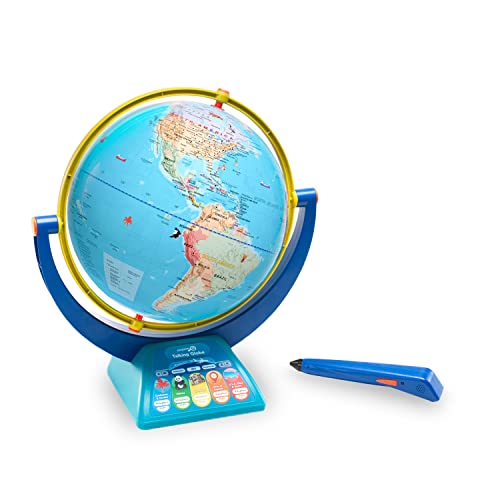
Audio carries everything, so a four year old plays without an adult reading aloud. Touch the pen to a continent and it names what sits there. Levels step up from continents to countries and capitals as recall improves.
Pros
- Usable well before a child can read
- Difficulty levels grow with the child
- Keeps the learning off a screen
Cons
- Audio clips repeat after several weeks
- Pen is the part most likely to break

Days of Wonder Ticket to Ride
Claiming rail routes between real cities means everyone studies the map for 45 minutes. City positions stick because knowing them wins the round. Two to five players work, and eight year olds follow the rules after one explanation.
Pros
- Turns city locations into useful information
- Adults stay engaged, so it gets played
- Rules teach in under ten minutes
Cons
- Covers rail routes, not physical geography
- Needs a second player to start

Learning Resources Puzzle Globe
Fourteen curved segments snap into a freestanding sphere. Assembly forces a child to handle which continents border which oceans, rather than just read it. After the build it stands on a desk as an ordinary labeled globe.
Pros
- Building it aids spatial memory
- Survives many rebuild cycles
- Doubles as a desk globe afterwards
Cons
- Fourteen pieces limit the challenge
- Labels are sparser than a printed globe

Melissa & Doug USA Map Floor Puzzle
Fifty one thick cardboard pieces spread into a map roughly 2 ft by 3 ft. Every state carries an illustration of what it is known for, tying a name to a picture. Shapes and neighbors land first, long before capitals do.
Pros
- Floor scale suits three year olds
- Extra thick pieces resist bending
- Illustrations anchor states to landmarks
Cons
- United States only, no world coverage
- Outgrown once reading comes easily
The lineup, side by side
| # | Model | Age range | Best for | Score | Price |
|---|---|---|---|---|---|
| 1 | PlayShifu Orboot Earth AR Globe | About 4 to 10 years | Best overall | 9.4 | Check price |
| 2 | LeapFrog Magic Adventures Globe | About 5 to 10 years | Best for young readers | 9.2 | Check price |
| 3 | Waypoint Geographic World Explorer Illuminated Globe | 12 in | Best desk globe | 9.0 | Check price |
| 4 | Educational Insights GeoSafari Jr. Talking Globe | About 4 to 8 years | Best for preschoolers | 8.8 | Check price |
| 5 | Days of Wonder Ticket to Ride | 2 to 5 | Best for family game nights | 8.6 | Check price |
| 6 | Learning Resources Puzzle Globe | 14 curved puzzle segments | Best 3D puzzle to build | 8.3 | Check price |
| 7 | Melissa & Doug USA Map Floor Puzzle | 51 extra thick cardboard pieces | Best for US geography basics | 8.0 | Check price |
Common questions
What is the best geography toy for a 5 year old?
GeoSafari Jr. Talking Globe or the LeapFrog Magic Adventures Globe. Both deliver content through audio and touch, so reading ability is not the limit.
Does Orboot Earth work without a tablet?
Barely. With no printed country names on the sphere, the globe reads as a blank ball once the app is unavailable.
Are interactive globes better than printed globes?
Under age eight, usually yes, because audio and video carry the content. Confident readers often prefer a detailed printed globe they can browse at their own pace.
Which geography toys involve no screen time?
Waypoint World Explorer, GeoSafari Jr. Talking Globe, Learning Resources Puzzle Globe, the Melissa & Doug floor puzzle and Ticket to Ride all run screen free.
How do you teach a child world capitals?
Quiz progression beats browsing for recall. GeoSafari Jr. separates continents, countries and capitals into distinct difficulty levels so capitals arrive last.
Is Ticket to Ride actually educational?
It fixes where North American cities sit and how they connect. Winning depends on reading the map, which motivates recall more than a quiz does.
What age should a child get their first globe?
Around four suits talking and augmented reality models. Printed political globes make sense once a child reads fluently, usually near seven.
Do illuminated globes stay plugged in all the time?
Only when you want the light. Waypoint World Explorer reads as a normal globe unlit and switches on for evening use.
Which geography toy suits a classroom or homeschool group?
The Melissa & Doug floor puzzle and Ticket to Ride handle groups best. One spreads out for several children at once, the other seats up to five players.
Can one geography toy work for siblings of different ages?
Ticket to Ride stretches furthest, since an eight year old and an adult play the same game. Age locked globes rarely span more than about four years.
Our pick
Get PlayShifu Orboot Earth if a tablet is already in the house and your child is four to ten, because the missing labels turn learning into a hunt. Screen free families should take GeoSafari Jr. Talking Globe for pre-readers and the Waypoint World Explorer for fluent ones. Skip globes entirely past age eight and buy Ticket to Ride, which keeps getting played long after a talking globe goes quiet.
Rachel Simmons
Rachel previously worked in child-product retail and brings a practical, detail-first eye to gear reviews, focusing on safety standards, ease of use and the fine print that matters most for new caregivers.