Road Trip Jump Starters and Battery Chargers Compared
NOCO Boost Plus GB40 earns the trunk slot, pushing 1000 peak amps from a 2.4 pound pack. At home, NOCO GENIUS10 rebuilds a weak battery overnight at 10 amps with AGM and lithium profiles. Diesel pickups need the 2000 amp HULKMAN Alpha85 instead.
NOCO Boost Plus GB40 is the pack most road trippers should carry. Its 1000 peak amps crank gas engines up to roughly 6 liters, and a 2.4 pound body survives months in a glovebox between uses. Large diesel pickups fall outside that rating, which is where HULKMAN Alpha85 belongs.
Two separate problems get sold as one product. Jump starters deliver a brief burst of cranking current on a dark forecourt, while smart chargers rebuild a weak battery over hours in a driveway. Chemistry splits things further, since AGM and lithium packs want voltage profiles a plain trickle charger never produces. We compared peak current claims, rated engine ranges, supported chemistries and published cold weather limits, then read owner reports on clamp bite and case durability.
How to pick the right one
What to pack for a long drive Carry current you will actually use, not a spec sheet trophy. A lithium pack near 1000 peak amps starts the overwhelming majority of gas engines and hides in a glovebox. Gloves and a headlamp belong beside it, since roadside work tends to happen after dark. Charge the pack before departure, because lithium cells self discharge slowly even sitting untouched. Drivers towing a trailer or running a diesel should size up before leaving.
Jump starter vs charger vs maintainer Three tools, three jobs, and buyers routinely pick the wrong one. Jump starters supply a brief cranking burst and leave the battery as flat as they found it, so drive twenty minutes afterwards. Smart chargers such as NOCO GENIUS10 rebuild charge over hours and can reverse light sulfation. Maintainers like Battery Tender Plus hold an already healthy battery topped off and will rescue nothing that is dead. Store a car over winter and you need the third type, not the first.
Matching amps to your engine and climate Engine displacement and fuel type set the number to look for. Gas engines up to roughly 6 liters sit inside GB40 range, while a diesel pickup draws far more at the starter and calls for Alpha85 territory. Cold compounds everything, because a chilled battery surrenders much of its cranking capability while thick oil resists turning. Snow belt drivers should buy one tier above their engine size rather than exactly at it. Glow plugs add their own draw before a diesel even cranks.
Storing a jump pack safely Summer trunk temperatures shorten lithium pack life faster than use does. Keep the pack in the cabin where climate control reaches it, and off the dashboard in direct sun. Connect red to the positive post first, then black to bare metal away from the battery, keeping any spark clear of vented hydrogen. Reverse polarity protection is a safety net, not a reason to skip checking the terminals. Top the pack up every three months and it will be ready when a morning goes wrong.
The best picks, ranked
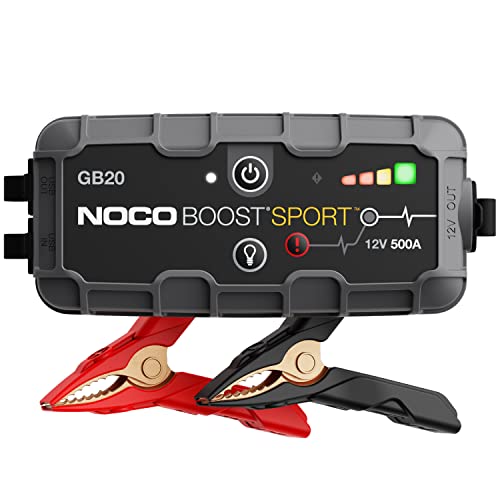
NOCO Boost Plus GB40
Rated at 1000 peak amps, this pack cranks gas engines to about 6 liters and diesels to roughly 3 liters. Spark proof clamps and reverse polarity protection make it safe for someone jumping a car for the first time. At about 2.4 pounds it doubles as a USB power bank and a 100 lumen work light.
Pros
- Fits a glovebox or door pocket at 2.4 pounds
- Spark proof clamps forgive a reversed connection
- USB output charges phones on long drives
Cons
- Sits outside its rating for large diesel trucks
- Wants a top up charge every few months

NOCO GENIUS10
Ten amps of charge current refills a drained battery overnight rather than across a weekend. Dedicated AGM and lithium modes cover start stop cars and motorcycle packs alike, on 6 volt and 12 volt systems. A repair mode targets sulfated batteries that simpler chargers read as unchargeable.
Pros
- Recovers a flat battery in a single night
- Correct voltage profiles for AGM and lithium
- Safe to leave connected through long storage
Cons
- Mains powered, so it stays in the driveway
- Mode selection trips up first time users

HULKMAN Alpha85
Two thousand peak amps turn over full size diesel pickups and V8 trucks that stall smaller packs. A backlit screen reports pack charge and clamp connection, removing guesswork in an unlit parking lot. Self heating circuitry keeps output usable once temperatures drop below freezing.
Pros
- Current headroom for diesel and V8 starters
- Screen shows charge level and connection state
- USB C input recharges it from a laptop adapter
Cons
- Bulkier than a pocket sized lithium pack
- More capacity than a commuter car needs

Schumacher SC1281
Three jobs live in one case: 30 amp boost charging, a slow maintenance rate, and 100 amp start assist. Automatic voltage detection switches between 6 and 12 volt batteries, handy in a garage with a classic car or a tractor. Long clamp leads reach a bumper from a workbench without rolling the vehicle.
Pros
- Charges and starts from a single unit
- Detects 6 V and 12 V batteries automatically
- Cables reach awkward battery locations
Cons
- Needs mains power, so no roadside use
- Too heavy to carry as trip equipment

CTEK MXS 5.0
Eight programmed stages include desulfation and a reconditioning pass for deeply drained batteries. Output stays at 4.3 amps, a deliberately gentle rate aimed at service life rather than speed. An IP65 sealed housing lets it hang in a carport or unheated garage through winter.
Pros
- Gentle rate favors long battery service life
- Reconditioning stage revives deeply drained cells
- Sealed body tolerates a damp garage
Cons
- Slow to refill a fully flat battery
- Provides no jump starting at all

DEWALT DXAEJ14 Jump Starter
An onboard compressor rated to 120 PSI covers the other common roadside failure, a soft tire on a gravel shoulder. Peak output of 1400 amps starts most gas engines and mid size trucks. Sealed lead acid cells make it heavier than lithium rivals, so it rides in the trunk rather than a door pocket.
Pros
- Reinflates tires as well as jump starting
- 1400 amp peak suits mid size trucks
- Rugged case survives riding in a truck bed
Cons
- Heavy next to a lithium jump pack
- Lead acid cells need regular recharging

Battery Tender Plus 021-0128
One and a quarter amps is a maintenance rate, sized to hold a parked vehicle at full charge for months. Four stage charging drops to float on its own, so it can stay plugged in all winter. Ring terminal and alligator leads both ship in the box, letting a pigtail stay bolted to a motorcycle.
Pros
- Built for seasonal cars, boats and bikes
- Quick connect pigtail avoids removing panels
- Designed for months of continuous connection
Cons
- Far too slow to revive a flat battery
- 12 V only, with no lithium profile
How they compare
| # | Model | Peak current | Best for | Score | Price |
|---|---|---|---|---|---|
| 1 | NOCO Boost Plus GB40 | 1000 A | Best overall | 9.4 | Check price |
| 2 | NOCO GENIUS10 | 10 A | Best smart charger | 9.2 | Check price |
| 3 | HULKMAN Alpha85 | 2000 A | Best for large and diesel engines | 9.0 | Check price |
| 4 | Schumacher SC1281 | Up to 30 A boost | Best for home garage use | 8.8 | Check price |
| 5 | CTEK MXS 5.0 | 4.3 A | Best for AGM and stored vehicles | 8.5 | Check price |
| 6 | DEWALT DXAEJ14 Jump Starter | 1400 A | Best for tire and battery emergencies | 8.3 | Check price |
| 7 | Battery Tender Plus 021-0128 | 1.25 A | Best budget maintainer | 8.0 | Check price |
Good to know
How many amps do I need in a jump starter?
Roughly 1000 peak amps covers gas engines up to about 6 liters. Large diesel pickups want 2000 amps or more. Cold climates justify one size up, since a chilled battery and thick oil both raise cranking demand.
What is the difference between a battery charger and a jump starter?
Jump starters supply a short high current burst to crank the engine, leaving the battery still discharged. Chargers refill that battery over hours on a controlled profile. Carry the first in the car, keep the second in the garage.
Can a jump starter charge a dead battery?
No. Packs deliver starting current only, so the alternator handles recharging once the engine runs. Drive at least twenty minutes afterwards, or put the car on a proper charger when you arrive.
Do AGM batteries need a special charger?
Yes. AGM chemistry wants a different voltage profile than flooded lead acid. NOCO GENIUS10 and CTEK MXS 5.0 both include an AGM mode, and a plain trickle charger shortens AGM service life.
Is it safe to leave a battery maintainer connected all winter?
Four stage maintainers switch to float and are designed for months of connection. Battery Tender Plus exists for exactly that job. Check the terminals occasionally for corrosion and keep the unit clear of standing water.
Will a jump starter work in freezing weather?
Lithium output sags in the cold, which is why HULKMAN Alpha85 adds self heating. Store any pack in the cabin rather than the trunk on winter trips. Warming a cold pack in your hands for a minute helps before you clamp on.
Which jump starter is best for a diesel truck?
HULKMAN Alpha85 and its 2000 amp peak is the pick. Diesel starters pull heavily, especially with glow plugs drawing first. A 1000 amp compact pack often cranks slowly or gives up entirely on a large diesel.
Can one unit charge and jump start?
Schumacher SC1281 does both, pairing a 30 amp boost charge with 100 amp start assist. That combination needs mains power, so it works in a garage and not on a shoulder. Road trips still call for a separate lithium pack.
Do I need a jump starter if I have roadside assistance?
A pack turns a two hour wait into a five minute fix, which matters most on rural routes with patchy cell coverage. Assistance still wins when the fault is a failed alternator or starter. Both belong in the plan for long drives.
How often should I recharge a jump pack in storage?
Top it up every three months, and always before a long trip. Most packs show remaining charge on a display or an LED row. A pack left flat for a year may refuse to accept charge at all.
The bottom line
NOCO Boost Plus GB40 wins the trunk slot, since 1000 peak amps in a 2.4 pound body answers almost every road trip failure. Keep a NOCO GENIUS10 at home so a tired battery gets rebuilt instead of jumped again next week. Diesel owners should skip the compact pack entirely and buy HULKMAN Alpha85 from the start.
Tony Russo
Tony trained as an automotive technician and spent years in service and parts retail before moving into writing. He focuses on garage tools, car care products and accessories from a hands-on maintenance perspective.


