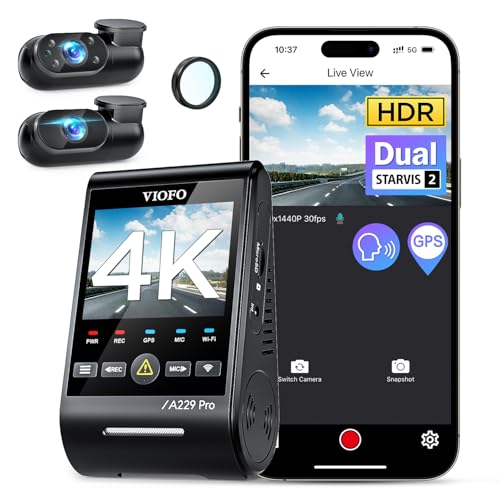
Top Dual Channel Dash Cams for Epic Road Trips
For most road trippers, the VIOFO A229 Plus is the top pick. It records sharp 2K front and rear video, has a supercapacitor for heat resistance, and offers reliable buffered parking mode. Its main drawback is the lack of built-in Wi-Fi on the base model, which some users find inconvenient for quick phone transfers. But if you want a dependable camera that won’t let you down on a long journey, this is it.
Road trips are about the journey, not just the destination. A dual channel dash cam captures both the front and rear views, giving you complete protection and evidence in case of an incident. It also lets you record the scenic landscapes behind you, adding a new dimension to your travel memories.
Choosing the right dual channel dash cam can be overwhelming with so many options. We compared seven popular models to see which ones offer the best video quality, reliability, and features for long drives. Whether you prioritize crystal-clear night vision, parking surveillance, or seamless smartphone integration, this guide will help you pick the perfect travel companion.
Our top picks

VIOFO A229 Plus 2CH
The VIOFO A229 Plus records sharp 2K video from both front and rear cameras. It uses a Sony STARVIS 2 sensor for excellent low-light performance. The camera has a supercapacitor, making it more heat resistant than models with lithium batteries. It offers reliable buffered parking mode and supports up to 512GB storage. Owners appreciate the clear footage and sturdy build, though some find the menu system a bit complex.
Pros
- Excellent video quality in all conditions
- Heat resistant supercapacitor design
- Reliable parking mode with buffering
Cons
- Menu navigation can be confusing
- No built-in display

Thinkware Q1000
The Thinkware Q1000 is a premium 2-channel dash cam with 4K front and 2K rear recording. It features built-in ADAS (Advanced Driver Assistance Systems) with lane departure and forward collision warnings. The camera has a 2.7 inch LCD touchscreen for easy setup and playback. It offers cloud connectivity via Wi-Fi and LTE (optional) for remote viewing. Owners report that the safety alerts are helpful but sometimes overly sensitive.
Pros
- 4K front camera captures incredible detail
- Advanced driver assistance alerts
- Intuitive touchscreen interface
Cons
- Pricey compared to other models
- ADAS alerts can be distracting

Garmin Dash Cam 67W
The Garmin Dash Cam 67W is a compact single-channel camera, but it can be paired with a rear camera for dual coverage. It features voice control, allowing you to save clips or take photos hands-free. The 180 degree field of view captures more of the road. It has built-in Wi-Fi and Bluetooth for easy app connectivity. Owners like the small size and clear 1440p footage. Some wish the rear camera was included in the box.
Pros
- Voice control for hands-free operation
- Ultra-wide 180 degree front view
- Compact and discreet design
Cons
- Rear camera not included
- No parking mode without additional hardwire kit
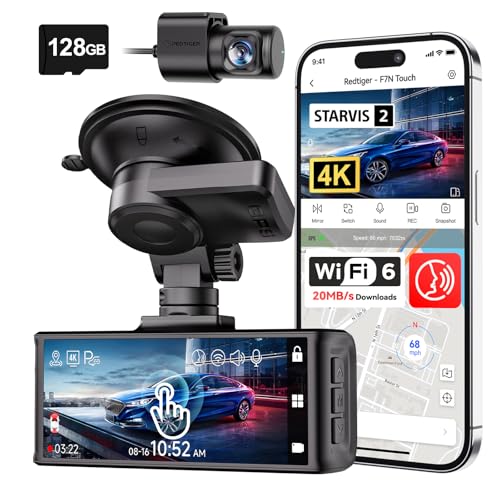
REDTIGER F7N Dual Lens Dash Cam
The REDTIGER F7N is a budget-friendly dual dash cam that records in 4K front and 1080p rear. It includes a 3 inch IPS screen for easy viewing and playback. The camera has a supercapacitor, which is a plus for heat resistance. It offers loop recording and G-sensor detection. Owners appreciate the clear video and easy setup, though the app could be more polished.
Pros
- Great value for 4K front video
- Built-in screen for easy setup
- Supercapacitor for durability
Cons
- Rear camera quality lower than front
- Mobile app can be finicky
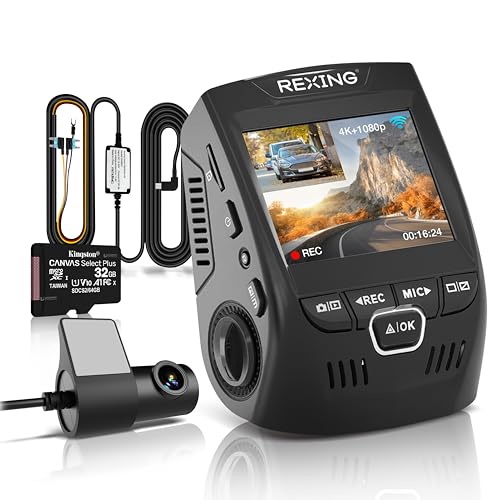
Rexing V1P Pro 2K
The Rexing V1P Pro 2K is a straightforward dual dash cam with 2K front and 1080p rear recording. It features a Sony sensor for improved low-light performance. The camera has a 3 inch LCD screen and supports up to 256GB microSD. It includes a GPS logger for tracking your route. Owners report that it is easy to install and provides good video quality for the price.
Pros
- Good low-light performance
- Built-in GPS for speed tracking
- Easy to install and use
Cons
- No Wi-Fi connectivity
- Bulky design
COXPAL A8T
The COXPAL A8T is a dual dash cam with a 3 inch IPS display and a unique design. It records 4K front and 1080p rear. The camera includes a 64GB memory card and a suction mount. It offers loop recording, G-sensor, and parking mode with hardwire kit (sold separately). Owners like the sharp video and user-friendly menu. Some report that the mount can be a bit loose.
Pros
- Sharp 4K front video
- Comes with memory card
- Compact and easy to mount
Cons
- Mount may loosen over time
- No GPS or Wi-Fi

Vantrue N4 Pro
The Vantrue N4 Pro is a triple lens dash cam that records 4K front, 1080p rear, and 1080p interior. It uses Sony STARVIS sensors for excellent night vision. The camera has a 2.45 inch screen and supports up to 512GB storage. It features voice control and a supercapacitor. Owners appreciate the comprehensive coverage, but some find the camera bulky and the menu complex.
Pros
- Triple lens coverage for full protection
- Excellent night vision with Sony sensors
- Voice control for hands-free operation
Cons
- Larger and heavier than dual cams
- Higher price point
How they compare
| # | Model | Front Resolution | Best for | Score | Price |
|---|---|---|---|---|---|
| 1 | VIOFO A229 Plus 2CH | 2K QHD (2560×1440) | Overall best for road trips | 9.4 | Check price |
| 2 | Thinkware Q1000 | 4K UHD (3840×2160) | Advanced safety features | 9.1 | Check price |
| 3 | Garmin Dash Cam 67W | 1440p (2560×1440) | Easiest to use with voice control | 8.9 | Check price |
| 4 | REDTIGER F7N Dual Lens Dash Cam | 4K UHD (3840×2160) | Value for money | 8.7 | Check price |
| 5 | Rexing V1P Pro 2K | 2K QHD (2560×1440) | Simple dual cam with good night vision | 8.5 | Check price |
| 6 | COXPAL A8T | 4K UHD (3840×2160) | Large screen and mirrorless design | 8.3 | Check price |
| 7 | Vantrue N4 Pro | 4K UHD (3840×2160) | Triple camera coverage | 8.0 | Check price |
How to choose
Questions worth asking
What does dual channel mean in a dash cam?
A dual channel dash cam has two cameras: one facing the front windshield and one facing the rear window. This provides simultaneous recording of both the road ahead and behind you, offering comprehensive coverage in case of accidents or incidents.
Do I need a rear camera for road trips?
Yes, a rear camera is beneficial for road trips because it captures what happens behind you, such as tailgating or rear-end collisions. It also records the scenery and can be useful for documenting any incidents that occur from behind.
Can I leave my dash cam recording while parked?
Yes, if your dash cam has a parking mode feature. Parking mode uses motion detection or impact sensors to record events when your car is parked. However, it may require a hardwire kit to the car’s fuse box to avoid draining the battery. Some models have a low voltage cutoff to protect the battery.
How do I install a dual dash cam?
Installation is typically straightforward. Mount the front camera on the windshield using adhesive or a suction mount. Route the cable along the headliner and down to the rear window, then mount the rear camera. Plug the power adapter into the cigarette lighter or hardwire it. Most cameras come with a trim tool to hide the cables.
What is the best resolution for a dash cam?
For clear license plate capture, a resolution of at least 2K (2560×1440) is recommended. 4K (3840×2160) provides even more detail, but produces larger files and may require a high-end memory card. 1080p is acceptable for basic use, but may miss fine details in low light.
Do dash cams work at night?
Yes, most modern dash cams have enhanced night vision using sensors like Sony STARVIS. They can record clear footage in low light, but performance varies by model. Look for a camera with good low-light ratings and a wide aperture for better night recording.
Can I use a dash cam in extreme temperatures?
Dash cams with supercapacitors are more heat tolerant than those with lithium batteries. Supercapacitors are less likely to swell or fail in high temperatures. For cold weather, most dash cams operate well, but extreme cold can affect battery life if the camera has a battery. A supercapacitor design is recommended for climates with wide temperature swings.
How much storage do I need for a road trip?
For a multi-day road trip, a 128GB microSD card is usually sufficient. At 2K resolution, you can record about 10-12 hours before the card fills up, but loop recording will overwrite old footage when full. If you want to keep specific clips, you can manually save them or use a camera with cloud storage.
What is buffered parking mode?
Buffered parking mode continuously records a few seconds before an event is detected, like a bump or motion. This ensures you capture the moments leading up to an incident, which is crucial for evidence. It uses a small buffer in the camera’s memory to store pre-event footage.
Are dash cams legal?
Dash cams are legal in most places, but there are restrictions in some jurisdictions regarding placement and recording. For example, in some countries, it’s illegal to obstruct the driver’s view, so you must mount the camera behind the rearview mirror. Always check local laws before using a dash cam.
Our take
For most road trippers, the VIOFO A229 Plus is the best choice because it delivers excellent 2K video from both cameras, has a durable supercapacitor, and offers reliable parking mode. It provides a great balance of performance and value. If you want the absolute best in safety features and are willing to spend more, the Thinkware Q1000 is a top-tier option with 4K front video and ADAS alerts. Budget-conscious travelers will appreciate the REDTIGER F7N for its 4K front camera at an affordable price. Choose the VIOFO A229 Plus for a dependable road trip companion.
Tony Russo
Tony trained as an automotive technician and spent years in service and parts retail before moving into writing. He focuses on garage tools, car care products and accessories from a hands-on maintenance perspective.