Which Heavy Duty Tire Inflator Suits Long Road Trips?
VIAIR’s 400P leads here, pushing 2.30 CFM at up to 150 PSI through clamps that skip the 15 amp socket fuse. Overlanders on 35 inch tires get tougher sealing from the ARB CKMP12. Cordless convenience belongs to the DEWALT DCC020IB, which also runs from a household outlet.
VIAIR’s 400P is the one to carry on a long trip. Sustained 2.30 CFM and direct battery clamps refill a full set of light truck tires without a cooling stop. Bulk is the trade, since it travels in its own bag. Drivers who only correct a few PSI in a parking lot are buying far more pump than they need.
Listings bury the number that decides everything, which is duty cycle at working pressure. A pump badged 150 PSI may run ten minutes before thermal protection trips, and that falls short of four tires from 15 PSI after airing down. We compared rated pressure, air delivery in CFM, duty cycle, power source and hose reach. Owner reports on overheating, clamp quality and cold starts settled the close calls.
The top picks, ranked

VIAIR 400P Portable Air Compressor
Rated output reaches 2.30 CFM against a 150 PSI ceiling, enough to bring light truck tires up to 35 inches back to back. Alligator clamps feed it straight from the battery posts, so a 15 amp socket fuse never caps the current. A 25 foot coiled hose turns one parking position into access for all four wheels.
Pros
- Sustained 2.30 CFM covers a full set in one session
- Battery clamps bypass fuse limited 12V sockets
- 25 foot hose reaches every corner from one spot
Cons
- Bulky enough to claim its own trunk bag
- Hood has to come open for every use

ARB CKMP12 Portable Air Compressor
Sealed motor housing carries over from ARB’s underhood systems, keeping dust and moisture out on gravel and desert runs. Pressure tops out at 150 PSI, which covers standard light truck sizes. Braided hose stays flexible once the temperature drops, and the hard case absorbs whatever else rolls around a load bed.
Pros
- Sealed motor shrugs off fine dust and sand
- Braided hose resists kinking below freezing
- Hard case survives loose gear in a load bed
Cons
- Heavier than most single motor portables
- Slower than twin motor units on 35 inch tires

Smittybilt 2781 Universal Air Compressor
Free flow output of 5.65 CFM makes this the quickest refill in the group after airing down on sand or rock. Clamps are mandatory, since the current draw sits well past any socket fuse. Smittybilt supplies 24 feet of hose, long enough to serve dual rear wheels without repositioning the truck.
Pros
- Highest free flow rating of any pump here
- 24 foot hose covers dual rear wheels
- Copes with 35 inch and larger tires
Cons
- Amp draw demands a running engine
- Loud enough to wake a quiet campsite

DEWALT DCC020IB 20V MAX Inflator
Three inputs cover most road trip situations: a 20V MAX battery, a 12V socket, or a household outlet at the motel. High pressure mode climbs to 160 PSI for tires, while a second high volume hose fills air mattresses and pool floats. Set a target on the digital preset and the motor stops itself.
Pros
- Tool batteries leave the vehicle battery untouched
- High volume hose handles camping gear
- Preset cut off prevents overinflation
Cons
- Bare tool listing arrives without a battery
- Slower than clamp fed pumps on truck tires

AstroAI Portable Air Compressor Tire Inflator
Everyday top ups on cars and small SUVs are the job here, handled from a 12V socket with a 100 PSI ceiling. Punch the target pressure into the digital gauge and the motor cuts out on its own. Roughly 10 feet of cord reaches all four tires on a sedan from the dash.
Pros
- Plugs into the dash socket with no hood access
- Auto shut off lands close to the set figure
- Small enough to live in a door pocket
Cons
- 100 PSI ceiling rules out heavy truck tires
- Wants a cooling pause between tires
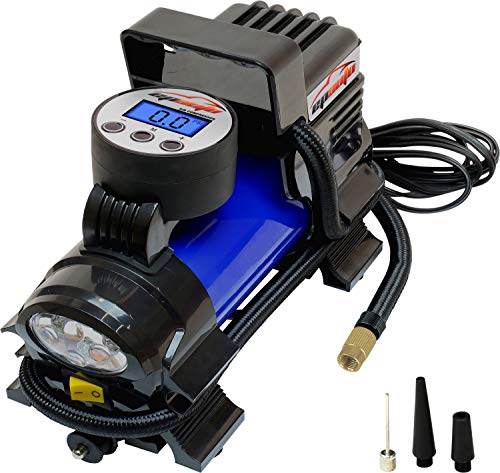
EPAuto 12V DC Portable Air Compressor Pump
Simplicity drives this one: socket power, a digital readout, and three nozzle adapters for bikes and sports balls. Treat it as a correction tool for a few PSI before a long drive rather than a recovery pump. Draw sits near 10 amps, and continuous running should stop around the ten minute mark.
Pros
- Cheapest route to accurate pressure control
- Coils down small enough for a glovebox
- Adapters cover bikes, balls and inflatables
Cons
- Short duty cycle forces frequent cooling breaks
- Not rated for light truck or off road tires

Fanttik X8 Apex Cordless Tire Inflator
An internal lithium battery means no cable, no clamps and no ignition on. Pressure climbs to 150 PSI, and a preset cut off ends the fill without anyone watching the gauge. A built in LED puts light on the valve stem during a dark roadside stop.
Pros
- Nothing to plug in or clip on before inflating
- Stores in a door bin or a daypack
- LED light handles night time repairs
Cons
- Charge limits it to a couple of tires per session
- Body warms up during long fills
How to choose
What makes a tire inflator heavy duty Maximum pressure gets top billing on every listing, yet nearly every unit here claims 100 PSI or more. Air delivery in CFM and duty cycle carry the real weight. CFM sets fill speed. Duty cycle sets how long the motor runs before thermal protection trips. Ten minutes of continuous operation will not carry four light truck tires up from 15 PSI, whatever the pressure ceiling promises.
How the power connection limits fill speed Cigarette sockets sit behind a fuse rated near 15 amps, and that caps current for anything plugged into them. Clamps on the battery posts dodge the limit entirely, which is why high output compressors ship with them. Socket units therefore hover near 1 CFM while clamp fed pumps clear 2 CFM and beyond. Cordless models skip the question altogether, trading runtime for freedom from cables.
Which inflator fits your tire size Passenger car tires at 32 to 36 PSI ask very little, so the AstroAI or EPAuto is enough. Loaded SUVs and half ton trucks hold more air at higher pressure, which points toward the VIAIR 400P. Anything 33 inches and up, especially after airing down on rock, wants the 5.65 CFM of the Smittybilt 2781 or the sealed build of the ARB CKMP12. Buying past your tire size mostly costs trunk space.
Hose reach, cold mornings and what to pack Hose length shapes the job more than most buyers expect. 25 feet means one parking position instead of four separate stops. Cold stiffens cheap PVC into a coil that refuses to lie flat, so braided hose earns its keep on winter routes. Carry a separate stick or digital gauge, because built in readouts drift over time. Keep one cordless unit inside the cabin as well, since a flat vehicle battery still leaves you able to chase a slow leak.
Compared at a glance
| # | Model | Max pressure | Best for | Score | Price |
|---|---|---|---|---|---|
| 1 | VIAIR 400P Portable Air Compressor | 150 PSI | Best overall | 9.4 | Check price |
| 2 | ARB CKMP12 Portable Air Compressor | 150 PSI | Best for off road travel | 9.2 | Check price |
| 3 | Smittybilt 2781 Universal Air Compressor | 150 PSI | Best high output | 9.0 | Check price |
| 4 | DEWALT DCC020IB 20V MAX Inflator | 160 PSI | Best cordless | 8.7 | Check price |
| 5 | AstroAI Portable Air Compressor Tire Inflator | 100 PSI | Best value | 8.5 | Check price |
| 6 | EPAuto 12V DC Portable Air Compressor Pump | 100 PSI | Best budget | 8.2 | Check price |
| 7 | Fanttik X8 Apex Cordless Tire Inflator | 150 PSI | Best compact cordless | 8.0 | Check price |
Frequently asked questions
What size tire inflator do I need for a road trip?
Cars are covered by a 100 PSI socket powered pump. SUVs, trucks and loaded campers call for a clamp fed compressor rated near 150 PSI with at least 2 CFM of delivery.
How long does it take to inflate a tire?
Adding 5 PSI to a car tire runs about two minutes on most pumps. Bringing a 35 inch tire from 15 PSI back to road pressure can pass five minutes even on a high output compressor.
Is a cordless tire inflator powerful enough for truck tires?
For top ups, yes. Both the DEWALT DCC020IB and the Fanttik X8 Apex reach truck pressures, but a charge runs out before a full set of large tires is finished.
What does duty cycle mean on an air compressor?
It states the share of time the motor may run before cooling. A 33 percent duty cycle at 100 PSI works out to roughly one minute of running for every two minutes resting.
Can I run a tire inflator with the engine off?
Small socket pumps manage a few minutes safely. High draw compressors flatten a battery quickly, so keep the engine running whenever clamps are on the posts.
VIAIR 400P vs Smittybilt 2781: which is better for airing up?
Smittybilt moves more air at 5.65 CFM and wins on refill speed after airing down. VIAIR packs smaller, runs quieter and stores more easily, which suits mixed highway and trail driving.
Do tire inflators work for air mattresses and pool toys?
Only with a high volume mode. DEWALT’s DCC020IB includes a separate high volume hose, while pure high pressure pumps move too little air to fill bulky inflatables.
Are built in pressure gauges accurate?
Accurate enough for a top up, though most drift a couple of PSI as they age. Keep a stick or digital gauge in the glovebox and cross check the readout now and then.
Which tire inflator is best for a small car?
AstroAI’s socket unit fits that job well, since 100 PSI covers every passenger tire and the cord reaches all four corners. EPAuto does the same work in a smaller package.
Is a heavy duty inflator worth it if I only drive highways?
Rarely. Highway driving means occasional top ups, and a socket pump handles those. Spend on sustained CFM when you tow, run light truck tires, or air down off pavement.
Final word
Buy the VIAIR 400P for trips involving a loaded SUV, a truck or a trailer, since 2.30 CFM through 25 feet of hose covers a full set without stopping to cool. Regular airing down justifies stepping up to the Smittybilt 2781 and its 5.65 CFM free flow. Families driving a sedan should skip both and plug in the AstroAI, which handles a monthly top up from the dash socket and stows in a door pocket.
Tony Russo
Tony trained as an automotive technician and spent years in service and parts retail before moving into writing. He focuses on garage tools, car care products and accessories from a hands-on maintenance perspective.


