Children’s Puzzles That Survive a Hundred Builds
Ravensburger 100 Piece XXL jigsaws cut the cleanest, so pieces stay locked when a child lifts the finished picture. Melissa & Doug chunky wooden trays fit toddlers still gripping with a whole hand. ThinkFun Rush Hour Junior takes over once jigsaws stop being a challenge.
A Ravensburger 100 Piece XXL jigsaw is the safe buy for a child around six. Extra-large pieces match small hands, and the linen-finish board resists glare and fingerprints. Younger children scatter 100 pieces rather than sort them. Toddlers need chunky wooden shapes that drop into a tray instead.
Professional in this category means board density, cut accuracy and print quality, not difficulty. We compared cardboard thickness, die-cut reputation and how closely published age ranges match real piece counts. Owner feedback covered pieces separating at the joint, box lids tearing and how each design holds up after twenty rebuilds.
The top picks, ranked

Ravensburger 100 Piece XXL Children’s Jigsaw Puzzle
Tight die cutting is what Ravensburger sells, and it shows when a finished picture lifts off the table in one sheet. XXL pieces suit hands around age six, which cuts the fumbling that ends a session early. Linen texture on the board scatters ceiling glare and wipes clean after snacks.
Pros
- Assembled picture holds together when it is lifted
- XXL cut matches hand size at around six years
- Linen finish kills glare under overhead lights
Cons
- One hundred pieces overwhelms most under-fives
- Licensed designs sell through and go out of print

Melissa & Doug Farm Wooden Chunky Puzzle
Pieces stand upright on a table, so they double as farm animal figures between builds. Each shape drops into a matching recess with the same picture printed underneath as a hint. Naming the animals turns a short tray puzzle into a vocabulary activity.
Pros
- Thickness suits a toddler whole-hand grip
- Recess and under-print guide placement without adult help
- Shapes stand up for pretend play after the build
Cons
- Eight pieces get outgrown inside about a year
- Painted wood chips where a teething child chews

Crocodile Creek 36 Piece Floor Puzzle
Thirty six oversized pieces build a picture roughly two feet across, wide enough for two children to work opposite sides. Heavy board resists the bending that happens when a piece gets pressed into place on carpet. Storage is a round tin, which outlives the cardboard lids used elsewhere.
Pros
- Two foot format lets siblings build side by side
- Thick stock stays flat when pressed on carpet
- Metal tin survives years of being dropped
Cons
- Requires a clear floor area to lay out fully
- Thirty six pieces goes quickly for a confident seven year old

Mudpuppy 100 Piece Jigsaw Puzzle
Mudpuppy commissions illustrators instead of licensing screen characters, so a finished build earns wall space. Board is recycled and printed with soy-based inks, which matters to parents checking materials. Pieces run smaller than the Ravensburger XXL cut, making this a genuine step up in difficulty.
Pros
- Original illustration rather than licensed characters
- Recycled board and plant-based inks throughout
- Rigid lidded box holds up to repeated storage
Cons
- Standard-size pieces challenge younger builders
- Dense artwork slows the sorting stage

ThinkFun Rush Hour Junior Logic Game
Cars block an exit on a grid, and the child slides them clear in as few moves as possible. Forty challenge cards run from beginner to expert, so the difficulty ladder lasts years rather than an afternoon. Every car and card stores inside the grid tray.
Pros
- Teaches planning several moves ahead
- Four difficulty tiers keep it useful past age eight
- Single player format works in a car seat
Cons
- Not a picture puzzle, so jigsaw fans need convincing
- Challenge cards go missing once they leave the tray

Educational Insights Kanoodle Puzzle Game
Coloured pieces drop into a flat grid or stack into a 3D pyramid, guided by a booklet of graded puzzles. Case snaps shut with every piece and the booklet inside, so nothing escapes into a bag. Adults keep solving it, which is rare for a toy bought at seven.
Pros
- Case holds every piece plus the booklet for travel
- Graded booklet runs from simple flat grids to 3D builds
- Holds attention well past the stated age range
Cons
- Small pieces rule it out for under fives
- Printed solutions tempt children to skip ahead
Coogam Wooden Tangram Jigsaw Puzzle
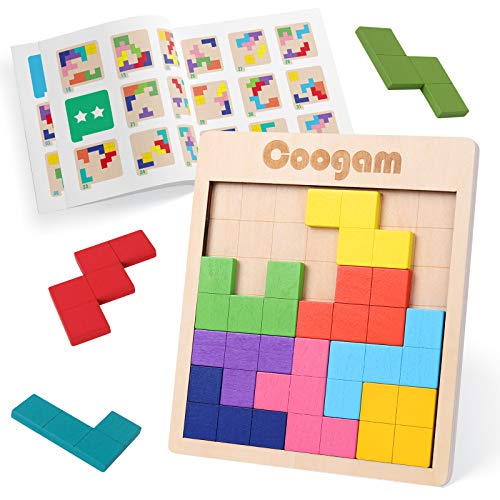
Wooden geometric tiles rearrange into hundreds of pattern cards, covering animals, figures and letters. Because one set makes many pictures, it never reaches the finished-once state a jigsaw does. Sanding quality lags behind Melissa & Doug, and edges often benefit from a pass with fine paper.
Pros
- One tile set generates hundreds of different builds
- Pattern cards teach shape and spatial relationships early
- Lowest outlay of the seven picks here
Cons
- Edges can arrive rough and need sanding
- Small tiles need supervision around toddlers
How they stack up
| # | Model | Pieces | Best for | Score | Price |
|---|---|---|---|---|---|
| 1 | Ravensburger 100 Piece XXL Children’s Jigsaw Puzzle | 100 XXL pieces | Best overall | 9.4 | Check price |
| 2 | Melissa & Doug Farm Wooden Chunky Puzzle | Solid wood pieces and tray | Best for toddlers | 9.2 | Check price |
| 3 | Crocodile Creek 36 Piece Floor Puzzle | 36 large floor pieces | Best floor puzzle | 9.0 | Check price |
| 4 | Mudpuppy 100 Piece Jigsaw Puzzle | 100 standard pieces | Best artwork | 8.8 | Check price |
| 5 | ThinkFun Rush Hour Junior Logic Game | Sliding block logic game | Best logic puzzle | 8.6 | Check price |
| 6 | Educational Insights Kanoodle Puzzle Game | 2D and 3D combination puzzles | Best for travel | 8.3 | Check price |
| 7 | Coogam Wooden Tangram Jigsaw Puzzle | Wooden tangram tiles | Best budget | 8.0 | Check price |
What to look for
What makes a children’s puzzle last Board density and cut accuracy separate a keeper from a frustration. Thin stock delaminates at the joints after a few builds, and the picture never lies flat again. A precise die cut, which is Ravensburger’s calling card, lets a finished puzzle be lifted in one piece. Check the packaging as well, since tins and rigid lidded boxes outlive the flimsy lids on cheaper sets.
Matching piece count to your child’s age Two and three year olds do best with chunky wooden trays of six to twelve pieces. Four and five year olds manage 24 to 48 piece floor puzzles comfortably. Around six, extra-large 100 piece jigsaws become realistic, which is exactly why the Ravensburger XXL cut exists. Skipping a stage usually ends with a child walking away, so aim low and let a finished puzzle drive the next step up.
When to move beyond jigsaws to logic puzzles Once 100 pieces come together without help, bigger jigsaws add time rather than challenge. Rush Hour Junior asks for move planning, while Kanoodle trains spatial fitting in two and three dimensions. Tangram tiles sit between the two, open ended and workable from around three with supervision. All three travel well, since none of them need a table-sized flat surface.
Storage, lost pieces and puzzles for two children One missing piece retires a jigsaw permanently, so favour sets that store their own contents. Tins and snap cases beat card boxes on this by a wide margin. Floor puzzles suit siblings building together, whereas a 100 piece jigsaw is really a solo or one-to-one activity. Counting pieces back in at the end of each session sounds fussy and prevents most losses.
Questions worth asking
How many puzzle pieces are right for my child’s age?
Roughly 6 to 12 chunky pieces at age two, 24 to 48 around four, and 100 larger pieces at about six. Published age guidance on the box tracks real ability reasonably well. Drop a stage if your child is new to jigsaws entirely.
What makes a children’s puzzle professional grade?
Dense board, an accurate die cut and print that resists fading or glare. Those three decide whether pieces interlock cleanly and survive repeat builds. Brand reputation for cut precision, Ravensburger being the obvious example, is the practical shortcut when you cannot handle the box first.
Are wooden puzzles better than cardboard for toddlers?
Under three, yes. Wooden pieces resist chewing and bending, and their thickness suits a whole-hand grip. Cardboard becomes the better format once a child can manage finer interlocking pieces, usually around four.
Which children’s puzzles help develop problem solving skills?
Logic formats do it most directly. Rush Hour Junior requires planning several moves ahead before touching a car. Kanoodle trains spatial fitting, while traditional jigsaws build pattern recognition and persistence instead.
Can two children work on the same puzzle?
Floor puzzles are designed for exactly that, since a two foot picture gives both children their own edge to work. The Crocodile Creek 36 piece set handles this well. A standard 100 piece jigsaw on a table gets cramped with two pairs of hands.
How do I stop losing puzzle pieces?
Pick sets with real storage, such as a tin or a snap-shut case. Count pieces back in before packing away. Building on a tray rather than carpet also stops pieces migrating under furniture.
Is a floor puzzle or a table jigsaw better for a five year old?
Floor puzzles suit five year olds because larger pieces match their hand size and the activity is social. Table jigsaws work better once fine motor control sharpens, often around six. Plenty of families keep one of each in rotation.
Which children’s puzzle is best for travel?
Kanoodle, since every piece and the booklet live inside a case that snaps shut. Rush Hour Junior is a close second because its cars store in the grid. Loose jigsaw pieces and a moving vehicle never end well.
Are 100 piece puzzles too hard for a five year old?
Usually, unless the pieces are the XXL size. A five year old typically manages 24 to 48 standard pieces without frustration. Start with a large-format floor puzzle and move up when it gets finished without prompting.
Our pick
Pick the Ravensburger 100 Piece XXL for a school-age child. Cut precision is what keeps a puzzle usable after twenty rebuilds, and the XXL size removes the fumbling that ends sessions early. Parents shopping for a two or three year old should buy the Melissa & Doug chunky wooden tray and step up in stages. Once 100 pieces stop being a challenge, Rush Hour Junior is the natural next purchase.
Rachel Simmons
Rachel previously worked in child-product retail and brings a practical, detail-first eye to gear reviews, focusing on safety standards, ease of use and the fine print that matters most for new caregivers.