Brain Teaser Puzzles That Sharpen Logic and Memory
ThinkFun’s Rush Hour ranks first for forty graded challenges that keep producing new problems for years. ThinkFun Gravity Maze suits younger players building spatial reasoning through marble runs. Hanayama’s Cast Vortex is the pick for adults who want a puzzle that resists brute-force guessing.
ThinkFun’s Rush Hour delivers the strongest replay value here, with forty challenge cards spanning beginner to expert. Younger players building spatial reasoning get more from Gravity Maze and its marble runs. Adults who want a puzzle immune to guessing should look at the Hanayama Cast Vortex instead.
Brain teasers are tricky to shop for, since the puzzles that photograph best are often solved in an evening and never touched again. We compared challenge counts, difficulty progression, materials and the age ranges each publisher specifies, plus what owners report about long-term use. Ranking here favors how much thinking a puzzle delivers per purchase over how clever it looks on a shelf.
What to look for
What makes a brain teaser worth buying Replay value separates a good puzzle from an expensive ornament sitting on a shelf. Single-solution puzzles, like trick locks and disentanglement pieces, deliver one intense hour and then stop delivering anything new. Challenge-card systems such as Rush Hour, Gravity Maze and IQ Fit keep producing distinct problems for years instead. Knowing which type is being bought prevents disappointment down the line.
How to match puzzle difficulty to the person Publishers print broad age ranges that assume an interested child with an adult nearby to help. A puzzle pitched slightly below someone’s ceiling gets solved and genuinely enjoyed. One pitched well above it usually ends up abandoned in a drawer. Graded challenge cards let a single puzzle grow with a child instead of being outgrown or too hard on day one.
Build quality and storage: what survives daily handling Cheap twisty puzzles with peeling stickers and thin plastic frames tend to get thrown out quickly. Cast metal puzzles, precisely cut jigsaws and molded plastic challenge games hold up for years of handling instead. Storage matters just as much as material. A game whose pieces live inside its own board gets played far more often than one needing a bag of loose parts hunted down first.
Solo puzzle or group activity: which do you actually want? Most brain teasers are built for a single player, which suits quiet time but falls flat at a group gathering. Trick locks and disentanglement puzzles pass around a table well, since watching someone struggle is part of the entertainment. Jigsaws work best as a shared, low-pressure project for several people at once. Deciding which mode is wanted changes the right purchase completely.
Our top picks

ThinkFun Rush Hour Traffic Jam Brain Game
Forty challenge cards climb from beginner to expert, so the same small board keeps producing new problems for years. Children grasp the sliding-car mechanic in minutes, yet the hardest cards still stump adults. Every piece stores inside the game grid, which is why it survives in family cupboards rather than getting lost.
Pros
- Genuine difficulty range across the card set
- Rules understood within a minute
- Compact, self-contained storage
Cons
- Card set can eventually be memorized
- Plastic cars scratch with heavy use

ThinkFun Gravity Maze Marble Run Logic Game
A marble drop rewards every correct solution, which keeps younger players engaged longer than an abstract puzzle would. Sixty graded challenges build from simple setups to genuinely difficult three-dimensional problems. More components mean more pieces to track than a card-based puzzle needs.
Pros
- Physical marble drop keeps children engaged
- Sixty challenges provide real longevity
- Builds three-dimensional planning skills
Cons
- More components to lose than card puzzles
- Marbles roll away on uneven surfaces

Hanayama Cast Puzzle Cast Vortex
Cast metal construction feels substantial and shrugs off years of handling without wear, the standard reference point for adult disentanglement puzzles. Vortex sits in the harder tier of Hanayama’s own difficulty scale. Reassembly often proves harder than the original solve, effectively doubling the challenge for anyone who skips a photo of the starting position.
Pros
- Substantial tactile build quality
- Difficulty that resists guessing
- Reassembly extends the challenge further
Cons
- Replay value drops sharply once solved
- Too difficult for most children

Rubik’s Cube 3×3 Classic Puzzle
Speed becomes the real challenge once the cube is first solved, which sustains interest for years at a low purchase price. Learning the layer method takes about an evening with a guide. Modern versions turn far more smoothly than the stiff cubes many adults remember from childhood.
Pros
- Very low cost for the hours it delivers
- Progression continues well past the first solve
- Extensive free learning resources online
Cons
- Stickers peel on cheaper versions
- Learning curve frustrates some beginners

SmartGames IQ Fit
A clip-shut travel case holds colored pieces and a booklet of one hundred twenty graded challenges, built for waiting rooms and flights. Three-dimensional placement puzzles turn genuinely difficult toward the back of the booklet. Pieces stay contained rather than scattering across a car seat or tray table.
Pros
- Excellent travel format
- Very large challenge count
- Difficulty scales from child to adult
Cons
- Small pieces are easy to lose
- Booklet can go missing without its case
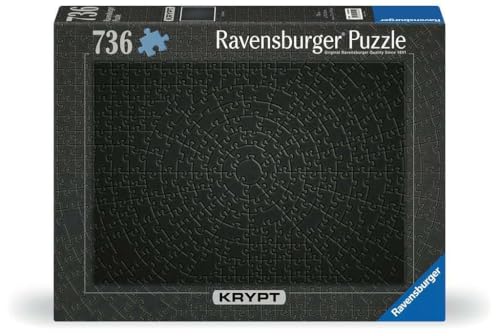
Ravensburger Krypt Black Puzzle
Every piece carries the same blank finish, so shape and subtle gradient alone guide placement instead of an image. Finishing this jigsaw is a multi-day project rather than an evening activity. Precise piece cutting from Ravensburger is what makes the puzzle solvable at all, since sloppy cuts would defeat it.
Pros
- Unusually difficult for a jigsaw
- Excellent piece-cutting precision
- Rewarding as a long-form project
Cons
- Frustrating for anyone wanting quick wins
- Needs a large dedicated surface

Project Genius Trick Lock 1
A working padlock hides its opening sequence inside a solid metal body, doubling as a small practical joke for guests. Mechanism quality holds up well for the price point. Like most single-solution puzzles, its challenge ends the moment someone works out the trick, so passing it around a group gets the most use from it.
Pros
- Fun puzzle to hand to visitors
- Solid metal construction
- Works well as a small gift
Cons
- Single solution ends replay value
- Easily spoiled if someone reveals it
Compared at a glance
| # | Model | Challenges | Best for | Score | Price |
|---|---|---|---|---|---|
| 1 | ThinkFun Rush Hour Traffic Jam Brain Game | 40 cards, beginner to expert | Best overall | 9.4 | Check price |
| 2 | ThinkFun Gravity Maze Marble Run Logic Game | 60 graded challenges | Best for kids | 9.2 | Check price |
| 3 | Hanayama Cast Puzzle Cast Vortex | Cast metal disentanglement | Best for adults | 9.0 | Check price |
| 4 | Rubik’s Cube 3×3 Classic Puzzle | 3×3 twisty puzzle | Best value | 8.8 | Check price |
| 5 | SmartGames IQ Fit | 120 graded levels | Best for travel | 8.6 | Check price |
| 6 | Ravensburger Krypt Black Puzzle | Several hundred, blank finish | Best jigsaw challenge | 8.3 | Check price |
| 7 | Project Genius Trick Lock 1 | Mechanical trick lock | Best novelty puzzle | 8.0 | Check price |
Good to know
What is the best brain teaser for an adult beginner?
Rush Hour and the Rubik’s Cube both make good entry points, since the rules take seconds to learn and the difficulty lives entirely in the thinking. Cast metal disentanglement puzzles reward patience more but can discourage a first-time buyer.
Do brain teasers actually improve thinking skills?
They reliably build the specific skills they exercise, such as spatial reasoning, sequencing and pattern recognition. Claims about broader intelligence gains carry much weaker evidence, so treat them as enjoyable practice rather than a training program.
What age is right for logic puzzles?
Simple shape-fitting puzzles work from around four or five years old. Graded logic games such as Gravity Maze and Rush Hour typically start around age eight, while cast metal puzzles and blank jigsaws sit firmly in adult territory.
Which puzzle has the most replay value?
Multi-challenge systems win by a wide margin. IQ Fit offers one hundred twenty levels, Gravity Maze sixty, and Rush Hour forty. A Rubik’s Cube may beat all three anyway, since speed practice never really runs out.
Are expensive brain teasers worth the extra cost?
Sometimes. Cutting precision on jigsaws and mechanism quality on metal puzzles both affect the experience directly. For challenge-card games, price differences mostly track challenge count rather than build quality.
What is a good brain teaser for a group?
Trick locks and disentanglement puzzles pass around well for a group. A large jigsaw suits people who want a shared, low-pressure activity together. Most logic games are built as solo challenges and stall once several people crowd one board.
How do you stop losing small puzzle pieces?
Choose puzzles that store components inside the board or in a clipped case, as IQ Fit and Rush Hour both do. For puzzles with loose parts, a labeled zip bag kept inside the box saves frustration later.
What brain teaser should I buy as a gift if I do not know their skill level?
A graded challenge game is the safest gift, since easy cards give an immediate win and hard cards leave room to grow. Rush Hour and IQ Fit both work reliably for this reason.
Rush Hour vs Rubik’s Cube: which lasts longer?
Rush Hour offers forty distinct challenges before repetition sets in, while a Rubik’s Cube has effectively unlimited replay through speed practice. Rush Hour suits people who want variety, and the cube suits people chasing a personal best.
Final word
ThinkFun’s Rush Hour is the brain teaser most households should own, since forty graded challenges in a self-storing board keep it in use long after novelty puzzles get forgotten. Gravity Maze is the better buy for younger players who need a physical payoff. Give the Hanayama Cast Vortex to an adult who insists puzzles are easy, and prioritize challenge count over cleverness for the best return on the purchase.
Rachel Simmons
Rachel previously worked in child-product retail and brings a practical, detail-first eye to gear reviews, focusing on safety standards, ease of use and the fine print that matters most for new caregivers.

