How to Pick a Portable Solar Panel for Camping Power
The Jackery SolarSaga 100W folds flat with a built in kickstand, making it the easiest panel to live with for most campers. The EcoFlow 110W delivers stronger real world output for those who already own an EcoFlow station. Hikers should look at the ultralight BigBlue SolarPowa 28 for phone and light charging.
For camping and van trips, the Jackery SolarSaga 100W is the portable solar panel most people should buy. Owners already running an EcoFlow power station get a worthwhile step up from the EcoFlow 110W. Every gram counts while backpacking, which is where the BigBlue SolarPowa 28 earns its spot.
Rated wattage comes from laboratory conditions that no campsite ever reproduces, which is what makes portable solar confusing to shop for. Panel angle, temperature, haze and cable losses routinely cut real output to sixty or seventy percent of the number printed on the box. We compared cell efficiency, folded size, connector standards and owner reports of output on ordinary sunny days rather than perfect ones.
The shortlist, ranked
Jackery SolarSaga 100W
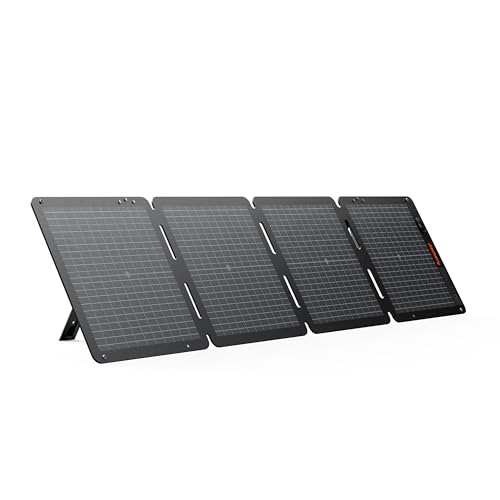
Folding into a briefcase shape with a handle, this panel deploys on integrated kickstands within seconds. USB outputs sit alongside the DC connector, letting it charge a phone directly even when the power station is elsewhere. Owners report consistent output in the seventy to eighty watt range under good midday sun.
Pros
- Fast setup with built in kickstands
- USB outputs work without a power station nearby
- Compact folded profile with a carry handle
Cons
- Kickstand angle is not adjustable
- Not rated for sustained rain exposure

EcoFlow 110W Portable Solar Panel
High efficiency cells pair with a case that doubles as an adjustable stand, letting owners set a proper angle to the sun instead of accepting a fixed lean. Correct angle is the single biggest factor in daily yield, so that adjustability adds up over a full day. An IP68 rating makes an unexpected shower far less stressful.
Pros
- Adjustable angle improves daily energy yield
- High IP68 weather resistance rating
- Efficient cells for the panel’s size
Cons
- Case stand takes practice to set correctly
- Heavier than the equivalent Jackery panel

Renogy 100W 12V Monocrystalline Foldable Suitcase
Charging a lead acid or lithium battery bank directly, rather than feeding a branded power station, is where this panel fits best. A charge controller and alligator clips ship in the box, so it works immediately on a trailer or boat battery. Aluminium framed panels stay rigid and heavy, trading portability for durability and a solid stand.
Pros
- Charge controller included for direct battery use
- Rigid frame holds up to repeated travel
- Strong, stable deployment stand
Cons
- Considerably heavier than folding fabric panels
- Bulky to store in a small vehicle

BLUETTI PV200
Panel area becomes the only real answer once you need to refill a large battery in a single day. A long four fold design uses ETFE coated cells that resist scratching and yellowing better than plain plastic laminates. Based on specifications, it pairs well with most large power stations through a standard MC4 connection.
Pros
- Enough output to refill a large station in a day
- Durable ETFE coated surface
- Standard MC4 connector fits many brands
Cons
- Long footprint once fully unfolded
- Heavy to reposition through the day

Goal Zero Nomad 50
Years in the field have exposed few weaknesses in the Nomad 50’s design. Reinforced corners, a protected junction box and fabric backing that tolerates folding while wet all point to a panel built for repeated use rather than a single season. Output stays modest, so treat it as a steady trickle instead of a fast refill.
Pros
- Built to survive repeated field use
- Chainable to add output later
- Folds compactly relative to its output
Cons
- Lower output than 100 watt rivals here
- Higher cost per watt than larger panels

Anker 625 Solar Panel
USB C and USB A outputs let the Anker 625 charge devices directly without assuming ownership of a power station, which suits car campers and festival trips. A sundial style alignment guide on the back helps with aiming, and that small feature does more for output than most people expect. Cell efficiency stays competitive for the class.
Pros
- Charges devices directly over USB C
- Alignment guide improves aiming accuracy
- Adjustable kickstands set panel angle
Cons
- USB output caps below the panel’s full potential
- Fabric backing shows wear over time

BigBlue SolarPowa 28
At 28 watts, this panel charges devices rather than refilling battery banks, and judged on that basis it excels. Folding to roughly tablet size, it clips to a pack and keeps phones, headlamps and a small power bank topped up across multi day trips. Owners report it needs direct sun and correct aiming to reach useful charging speeds.
Pros
- Light enough to carry comfortably all day
- Clips to a backpack while walking
- Handles phones and headlamps with ease
Cons
- Too small to charge power stations
- Output drops sharply under cloud cover
How to pick the right one
Why does a portable solar panel underperform its rated watts? Panel ratings come from standard test conditions with perfect light, a set temperature and a perpendicular angle to the sun. Real camping conditions typically deliver sixty to eighty percent of that rating during peak hours, and far less in morning or evening light. Sizing a setup around the number on the box is the most common mistake buyers make. Plan on a 100 watt panel producing around 300 to 400 watt hours across a good summer day instead.
How do you match a solar panel’s connector to your power station? Most power stations use a barrel style DC input, an MC4 pair or a proprietary plug, and a mismatch turns a good panel into an expensive mat. Panels built by your power station’s own brand are guaranteed to fit, while third party panels usually need an adapter cable. Checking the input voltage window matters too, since a panel outside that range simply will not charge the battery.
Does panel angle matter more than wattage? A 100 watt panel aimed correctly outperforms a 200 watt panel lying flat on the ground. Setting the panel perpendicular to the sun, and repositioning it two or three times through the day, makes a real difference. Panels with adjustable stands or long kickstand legs make that repositioning practical, while fixed lean designs force a compromise paid for in charging time.
How should you store and protect a panel in bad weather? Solar cells lose efficiency as they heat up, so a panel resting on hot ground produces less than the same panel with air moving behind it. Propping it up instead of laying it flat on gravel helps noticeably. Few folding panels are fully waterproof, and the junction box is the most vulnerable part, so bringing panels in during heavy rain and storing them dry protects them longest.
How they compare
| # | Model | Rated output | Best for | Score | Price |
|---|---|---|---|---|---|
| 1 | Jackery SolarSaga 100W | 100 watts | Best overall | 9.4 | Check price |
| 2 | EcoFlow 110W Portable Solar Panel | 110 watts | Best real world output | 9.2 | Check price |
| 3 | Renogy 100W 12V Monocrystalline Foldable Suitcase | 100 watts | Best for 12V battery charging | 9.0 | Check price |
| 4 | BLUETTI PV200 | 200 watts | Best for larger power stations | 8.8 | Check price |
| 5 | Goal Zero Nomad 50 | 50 watts | Best for durability | 8.6 | Check price |
| 6 | Anker 625 Solar Panel | 100 watts | Best for phones and small devices | 8.3 | Check price |
| 7 | BigBlue SolarPowa 28 | 28 watts | Best for backpacking | 8.0 | Check price |
Frequently asked questions
How much solar power do you need for camping?
Phones, lights and a fan need only 50 to 100 watts. Running a portable fridge or refilling a large power station daily calls for 200 watts or more of panel area.
Can you connect two portable solar panels together?
Often yes, provided both panels share the same rating and the power station supports the combined voltage or current. Series wiring raises voltage while parallel wiring raises current, so check input limits before combining panels.
Do portable solar panels still work in cloudy weather?
They keep producing, just far less. Thick cloud cuts output to roughly ten to twenty five percent of the rated figure, enough to trickle a phone but not to refill a battery station.
Are folding solar panels waterproof?
Most are water resistant rather than fully waterproof, and the junction box is the weak point. A few, like the EcoFlow panel here, carry a high IP rating and tolerate rain far better.
Do you need a separate charge controller for solar charging?
Only when charging a bare battery directly. Power stations already have controllers built in, so a panel plugged into one needs nothing beyond the correct cable.
Why is my solar panel producing less power than expected?
Usually angle, shade or heat is the cause. Even a small shadow across one cell can cut output sharply, and a panel lying flat on hot ground loses efficiency on both counts.
How long do portable solar panels typically last?
Cells commonly stay productive for a decade or more. Cables, connectors and folding hinges tend to fail first, so handling those gently and storing the panel dry extends its life.
Is it safe to leave a solar panel outside unattended all day?
In stable weather, yes, though output suffers since nobody repositions it to track the sun. Securing it against wind matters, since a folding panel acts like a sail and hinges break when it tumbles.
Our pick
The Jackery SolarSaga 100W suits the widest range of trips, thanks to quick setup and USB outputs that work independently of any power station. Choose the EcoFlow 110W for stronger real world output and better weather sealing, or the Renogy suitcase for charging a twelve volt battery bank directly. Backpackers are better served by the far lighter BigBlue SolarPowa 28.
Sierra Daniels
Sierra's background is in landscape design and nursery retail. She focuses on lawn and garden equipment, outdoor furniture and gear durability, weighing published specs against how materials actually hold up outside.