7 Paint Edgers That Skip the Taping Step Entirely
The Shur-Line 2006561 Paint Edger Pro is the most reliable choice for ceilings and trim thanks to its adjustable guide wheels. The Accubrush MX Jumbo Kit is faster over long runs, and the HomeRight Quick Painter C800952 loads its own paint so you skip the tray.
Buy the Shur-Line 2006561 Paint Edger Pro for most rooms. Step up to the Accubrush MX Jumbo Kit if you are edging a whole house, and pick the HomeRight Quick Painter C800952 if carrying a tray up a ladder sounds like a bad idea.
Paint edgers frustrate people because a badly loaded pad bleeds under the guide and leaves a worse line than a steady hand would. We compared pad width and stiffness, guide wheel adjustment, how each tool loads paint, refill pad availability, and behavior on textured walls, then weighed what owners report about the learning curve on the first few meters.
What to look for
How to load a paint edger correctly Overloading the pad is the single biggest mistake, since excess paint squeezes past the guide and bleeds onto the ceiling. Dip only the pad face, never the wheels or backing plate, and scrape the excess against the tray ridge. Owners report that reloading twice as often produces a far cleaner line than stretching one heavy load across a whole wall.
Keeping the guide wheels clean while you work Guide wheels run directly against the surface you are trying to keep clean, so any paint that reaches them transfers straight onto the ceiling. Keep a damp cloth in your free hand and wipe the wheels every few meters. This single habit separates an edger that looks like a miracle from one abandoned after half a wall.
Which edger works best on textured surfaces Pad edgers assume a flat surface and struggle where a textured ceiling meets the wall, since paint skips the low points while the guide rides the high ones. Roller and brush-based tools such as the Accubrush MX Jumbo and Wagner SMART Edge Roller cope far better with texture. Heavily textured ceilings may still need a flexible caulk line or careful brushwork regardless of the tool.
How to extend the life of an edger pad A pad that has dried out or gone stiff will never cut a clean line again, no matter how carefully you work. Replace pads once the edge frays or the nap flattens, wash thoroughly with water immediately after latex paint use, and buy refills alongside the tool so a job never stalls mid-room. Budget one or two pads per room as a working estimate.
The best picks, ranked

Shur-Line 2006561 Paint Edger Pro
Guide wheels adjust independently on the Pro version, the feature that separates a clean line from a smeared one when a ceiling runs slightly out of true. The replaceable pad stays stiff enough to hold its edge while covering a useful band in one pass. Refill pads are widely stocked, which matters since a worn pad is the usual reason an edger stops performing.
Pros
- Adjustable wheels handle out of true ceilings
- Stiff pad holds a crisp edge
- Refill pads easy to find
Cons
- Wheels pick up paint and need wiping between passes
- Needs a tray, so a ladder means carrying both

Accubrush MX Jumbo Paint Edger Kit
A small roller feeds a brush behind a guide wheel here, so the tool lays down and cuts in the line in one motion instead of dragging a loaded pad. That speed difference matters on long walls and stairwells. The kit includes an extension pole adapter, a mini roller, and replacement brushes, and it handles textured surfaces better than any pad-based edger in this comparison.
Pros
- Fastest tool here over long straight runs
- Handles textured walls better than pads
- Pole adapter keeps you off the ladder
Cons
- More parts to clean after each session
- Real learning curve for the first wall

HomeRight Quick Painter Pad Edge Painter C800952
This edger draws paint into its own barrel like a large syringe, then feeds the pad as the trigger pulls, so no tray needs balancing on a ladder step. That setup helps with high work and quick touch-ups on a single doorway. Its pad runs narrower than the Shur-Line’s, so it suits trim and window frames better than long ceiling lines.
Pros
- No tray needed, ideal on ladders
- Feeds paint evenly as you work
- Good for quick touch ups without setup
Cons
- Barrel takes time to clean thoroughly
- Narrow pad is slow on long ceiling runs
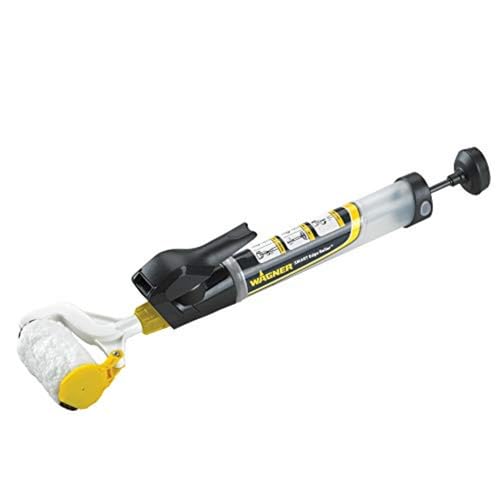
Wagner Spraytech SMART Edge Roller
Instead of a pad, a small roller with a rigid shield along one side and an internal reservoir feeds paint out to the nap. Rolling rather than dragging leaves a texture matching the rest of the wall, avoiding the usual giveaway of pad edgers. The reservoir holds enough for a decent run before refilling.
Pros
- Texture matches the rolled wall surface
- Reservoir cuts down on refill trips
- Shield keeps ceiling lines clean
Cons
- Reservoir is fiddly to clean out fully
- Shield needs wiping often to avoid transfer

Shur-Line 03500C Paint Edger with Swivel Handle
A swivel handle lets the pad stay flat against the wall while your wrist stays in a comfortable position, which matters most above shoulder height. It threads onto a standard extension pole, so a whole room perimeter can be worked from the floor. The pad uses the same proven Shur-Line design, so refills are easy to source.
Pros
- Swivel head reduces wrist strain overhead
- Pole compatible for whole room perimeters
- Uses common Shur-Line refill pads
Cons
- Swivel adds slop that takes practice to control
- Fixed wheels do not adjust for uneven ceilings

Bates Paint Edger with Replacement Pads
Spare pads ship in the box alongside the edger, which makes sense since a saturated pad is the main cause of a ragged line. The handle feels comfortable, and the guide wheels stay fixed but true. This is a straightforward tool for a single room repaint rather than a piece to build a decorating kit around.
Pros
- Spare pads included in the box
- Comfortable grip for long sessions
- Low outlay for a one room job
Cons
- Wheels are not adjustable
- Pad backing is less rigid than premium rivals
Shur-Line 1000C Paint Edger
This original basic Shur-Line edger is just a pad, a backing plate, and two wheels, with nothing else to clean or go wrong. It handles a single accent wall or a small bathroom fine at very low cost. Expect slower work and more frequent pad changes than the Pro version delivers, since the backing flexes under pressure.
Pros
- Lowest outlay of any pick
- Almost nothing to clean or maintain
- Uses the same widely stocked refill pads
Cons
- Flexible backing lets paint bleed if pressed hard
- Slowest option over a whole house
Side by side
| # | Model | Pad width | Best for | Score | Price |
|---|---|---|---|---|---|
| 1 | Shur-Line 2006561 Paint Edger Pro | Approximately 4.5 inches | Best overall | 9.4 | Check price |
| 2 | Accubrush MX Jumbo Paint Edger Kit | Mini roller feeding an angled brush | Best for long runs | 9.2 | Check price |
| 3 | HomeRight Quick Painter Pad Edge Painter C800952 | Approximately 3 inches | Best all in one | 9.0 | Check price |
| 4 | Wagner Spraytech SMART Edge Roller | Fed mini roller with rigid shield | Best roller style edger | 8.8 | Check price |
| 5 | Shur-Line 03500C Paint Edger with Swivel Handle | Approximately 4 inches | Best for ceilings | 8.6 | Check price |
| 6 | Bates Paint Edger with Replacement Pads | Approximately 4 inches | Best value multipack | 8.3 | Check price |
| 7 | Shur-Line 1000C Paint Edger | Approximately 4 inches | Best budget | 8.0 | Check price |
Common questions
Do paint edgers actually work better than tape?
They are much faster, and with a clean pad and wiped wheels the line compares well for most rooms. Tape still wins for absolute precision on high-contrast color changes and on textured or uneven surfaces. Many decorators use an edger for ceilings and tape only around door and window trim.
Can I use a paint edger on a textured ceiling?
Pad edgers struggle here because the guide rides the high points while paint skips the low ones. Brush and roller-based tools such as the Accubrush MX Jumbo Paint Edger Kit handle light texture much better. On heavy texture, running a bead of flexible caulk along the joint first gives any tool a straight edge to follow.
How do I stop a paint edger from bleeding onto the ceiling?
Overloading is the usual cause. Load only the pad face, scrape off excess, keep pressure light, and wipe the guide wheels regularly. Shorter strokes with a lighter load consistently produce a cleaner line than fewer heavy passes.
How often do edger pads need replacing?
Plan on one or two pads per room as a rough guide, replacing sooner if the edge frays or the nap flattens. A pad left to dry with paint still in it is finished, so wash immediately after use and check it before starting the next room.
Can paint edgers be used with an extension pole?
Most can, including the Shur-Line 03500C, HomeRight Quick Painter C800952, and Accubrush MX Jumbo. A pole lets you edge a full room perimeter from the floor, faster and safer than repositioning a ladder. Self-loading tools work best on a pole since there is no tray to hold.
Do paint edgers work for trim and skirting boards?
Yes, and a narrower pad such as the one on the HomeRight Quick Painter is easier to control against skirting and door casings than a wide ceiling pad. Keep the guide against the trim and the load light, since bleed onto woodwork shows more than it would on a ceiling.
How do I clean a paint edger?
For latex paint, rinse the pad and body thoroughly under warm water immediately after use until the water runs clear, paying attention to the wheels and any reservoir. Oil-based paint needs the appropriate solvent instead. Tools with internal chambers, such as self-loading edgers, take longer, so allow ten minutes rather than two.
Is one coat enough when using a paint edger?
Usually not, and the same holds for brushed cut-in lines. Two coats on the edge band, matched to two coats on the wall, gives even coverage and color. Let the first coat dry fully before the second, or the pad will drag at the partially dried film.
Paint edger vs painter’s tape: which is faster?
An edger is faster for most rooms, since there is no tape to apply and remove afterward. Tape takes longer but gives a sharper line on high-contrast color changes, so many people combine both depending on the surface.
What is the best paint edger for a whole-house repaint?
The Accubrush MX Jumbo Kit suits large jobs best, since its roller-and-brush mechanism moves faster over long runs and copes with light texture between rooms without swapping tools.
Final word
The Shur-Line 2006561 Paint Edger Pro suits most decorating jobs, since its adjustable wheels cope with the slightly wavy ceilings real houses have. Anyone edging a whole house or working on lightly textured walls should spend more on the Accubrush MX Jumbo Paint Edger Kit, faster and less fussy about surfaces. For ladder work and quick touch-ups, the self-loading HomeRight Quick Painter C800952 avoids the awkwardness of balancing a tray.
Jake Monroe
Jake worked as a residential contractor for over a decade before shifting to full-time writing. He evaluates power tools, hand tools and workshop gear through the lens of someone who has actually used them on job sites, not just read the box.


