Which Indoor Balance Trainer Mimics a Real Paddleboard?
BOSU’s Pro Balance Trainer handles core and stability work best among these seven options. Indo Board’s Original Balance Trainer comes closest to recreating on-water paddleboard motion. RitFit’s Wobble Balance Board delivers the best value for daily balance drills without needing extra floor space.
BOSU’s Pro Balance Trainer leads this comparison for daily core and stability drills, built for repeated indoor use though it needs more floor space than a flat wobble board.
Full-length touring paddleboards do not translate to home floors, so specs for weight capacity, deck traction, and storage footprint across balance trainers, wobble boards, and compact inflatable SUPs anchor this comparison instead of star ratings.
What we recommend

BOSU Pro Balance Trainer
A burst-resistant vinyl dome mounts on a rigid ABS platform, usable dome-up for balance challenges or platform-up for a flatter stance. Commercial-grade construction handles repeated daily sessions better than foam wobble boards. Both training modes work the same core and stabilizer muscles a paddleboard targets on water.
Pros
- Dual-sided training switches between dome and platform modes
- Commercial-grade build withstands daily sessions
- Non-slip platform texture stays grippy barefoot
Cons
- Storage takes up more space than flat boards
- Costs more than basic wobble boards

RitFit Wobble Balance Board
A rocker-style base gives this board an adjustable tilt range paired with a textured, non-slip deck. Ankle, knee, and core stability drills fit into a footprint small enough for an apartment corner. Wood core construction holds a 300 pound rating despite the compact size.
Pros
- Compact footprint suits small rooms
- Adjustable tilt angle changes workout difficulty
- Wood core supports a 300 pound rating
Cons
- Less floor clearance than dome trainers
- Coating wears faster under frequent barefoot use

URBNFit Balance Board
Baltic birch forms the base of this entry-level wobble board, topped with a foam pad for grip. A printed workout guide ships in the box, aimed at beginners starting balance training at home. Lighter construction keeps this board easy to store between sessions.
Pros
- Lower cost of entry than dome or roller trainers
- Lightweight build stores easily
- Printed guide simplifies the learning curve
Cons
- 250 pound capacity trails premium boards here
- Foam pad wears faster under daily use

Indo Board Original Balance Trainer
A maple wood deck pairs with a cylindrical roller for an on-water style balance challenge, plus a softer cushion for lower-intensity sessions. Surf and paddle coaches use this setup for off-water balance conditioning. Switching between roller and cushion changes difficulty without buying a second board.
Pros
- Roller mode closely simulates paddleboard motion
- Two difficulty levels come in one kit
- Coaches use this setup for balance programs
Cons
- Roller mode has a steeper learning curve
- Roller mode needs open floor clearance to use safely
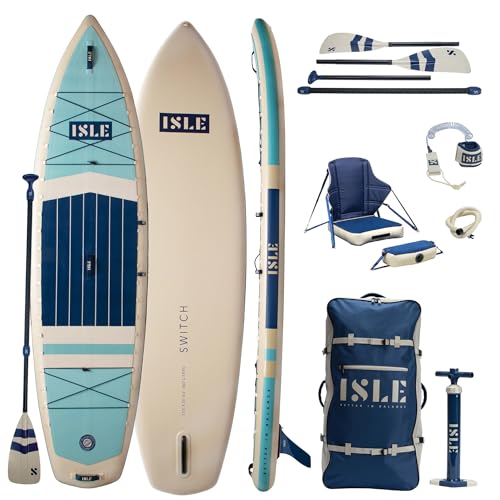
ISLE Pioneer Inflatable Paddle Board
A full-length EVA traction pad covers this inflatable SUP, supporting yoga poses on a padded floor or in a pool. Military-grade PVC over a drop-stitch core holds a 275 pound rating once inflated. Deflating and rolling the board down keeps storage manageable between sessions.
Pros
- Full-length pad supports yoga poses and transitions
- Pump and repair kit come included
- Stable width holds balance poses well
Cons
- Inflation takes 10 to 15 minutes before use
- Floor space needed once inflated still runs long

Retrospec Weekender Inflatable SUP
This roll-up inflatable packs into an included backpack sized for a closet or garage shelf. A shorter length than touring boards keeps indoor setup manageable. Military-grade PVC construction holds a 250 pound rating for daily balance and core drills.
Pros
- Rolls down to a small storage size
- Lower cost than rigid balance boards
- Pump and coil leash included
Cons
- Narrower stance than yoga-focused boards
- Less deck padding than dedicated yoga boards

iRocker All Around Inflatable SUP
Triple-layer PVC construction gives this board a wide, stable stance built for a range of body types. A 350 pound rating, the highest here, suits beginners still learning balance for the first time. An adjustable aluminum paddle and pump complete the setup out of the box.
Pros
- 350 pound capacity suits varied body types
- Wide stance aids beginner stability
- Paddle and pump round out a full accessory kit
Cons
- Bulkier once inflated for small rooms
- Triple-layer construction extends inflation time
How to pick the right one
What counts as an indoor paddleboard trainer Full-length touring SUPs are built for open water and rarely fit indoor spaces. Indoor options split into three types: half-dome balance trainers, wobble or rocker boards, and compact inflatable SUPs that deflate for storage. Each targets the same core and balance muscles a paddleboard works on water.
Stability and weight capacity across board types Base diameter and platform width determine how forgiving a board feels under load. Wider bases, like the iRocker All Around at 350 pounds, suit larger or less experienced users. Narrower wobble boards around 250 to 300 pounds work better once balance feels comfortable.
Choosing a board for home yoga practice Deck traction matters more than length for yoga poses done off water. A full-length EVA pad, found on the ISLE Pioneer, grips bare feet through transitions between poses. Smaller wobble boards concentrate movement in the ankles and core rather than supporting full-body poses.
Best compact options for tight storage space Roll-up inflatables like the Retrospec Weekender pack into a backpack for closet or garage storage. Wobble boards such as the RitFit stay small enough to lean against a wall. Half-dome trainers take up more permanent floor space but fold down less than either alternative.
Compared at a glance
| # | Model | Diameter | Best for | Score | Price |
|---|---|---|---|---|---|
| 1 | BOSU Pro Balance Trainer | 25 inches | Best overall | 9.4 | Check price |
| 2 | RitFit Wobble Balance Board | 15.75 inches | Best value | 9.1 | Check price |
| 3 | URBNFit Balance Board | 15.75 inches | Best budget | 8.8 | Check price |
| 4 | Indo Board Original Balance Trainer | 30 x 18 inches | Best for core and balance training | 8.5 | Check price |
| 5 | ISLE Pioneer Inflatable Paddle Board | 10 feet 6 inches | Best for yoga practice | 8.3 | Check price |
| 6 | Retrospec Weekender Inflatable SUP | 10 feet | Best compact inflatable for home storage | 8.1 | Check price |
| 7 | iRocker All Around Inflatable SUP | 10 feet 6 inches | Best for beginners | 8.0 | Check price |
Questions worth asking
Can you use a paddleboard balance trainer indoors all year?
Yes, wobble boards, half-dome trainers, and inflatable SUPs set up on padded flooring work indoors in any season since none depend on open water access.
What is the difference between a balance board and a SUP trainer?
A balance board like the URBNFit uses a flat deck on a rocker or ball base. A SUP-specific trainer such as the Indo Board adds a roller that mimics the shifting instability of standing on water.
How much weight can an indoor balance trainer hold?
Capacity ranges from about 250 pounds on entry-level wobble boards up to 350 pounds on wider inflatable SUPs such as the iRocker All Around.
Is it safe to inflate a paddleboard inside a garage?
Yes, models like the ISLE Pioneer and Retrospec Weekender use a hand or electric pump rated for indoor inflation, provided there is enough floor clearance around the board.
Which balance board works best for beginners learning SUP stance?
The iRocker All Around suits beginners through its wide stance and higher weight rating, while the URBNFit Balance Board works as a lower-cost starting point for basic wobble drills.
Do indoor SUP trainers actually help with real paddleboard balance?
Owners report that roller-based trainers like the Indo Board Original translate well to on-water balance since the roller recreates a similar side-to-side instability.
How much floor space does an indoor paddleboard trainer need?
Wobble boards need roughly a two-foot square. Half-dome trainers like the BOSU Pro need slightly more clearance for arm movement, and inflated SUPs need several feet of open floor for full-length poses.
Can a balance board replace a paddleboard for yoga practice?
A flat inflatable deck such as the ISLE Pioneer supports full yoga sequences better than a small wobble board, which suits short balance holds more than extended poses.
Final word
BOSU’s Pro Balance Trainer remains the strongest indoor pick for daily core and balance conditioning, backed by a commercial-grade build and dual-sided training modes. Anyone chasing an on-water feel specifically should choose the Indo Board Original Balance Trainer for its roller-based instability. Buyers wanting an actual SUP deck for home yoga should pick the ISLE Pioneer Inflatable Paddle Board instead.
Derek Holt
Derek has a background coaching recreational and amateur athletes and has worked the sales floor at specialty fitness retailers. He focuses on equipment durability, ergonomics and realistic use cases rather than marketing claims.


