How to Try On Snowshoes Indoors Before a Winter Trip
Snowshoes are made for snow, not hardwood floors, but fit still matters before a trip. The MSR Evo Trail has the smallest deck for closet storage. Tubbs Xplore offers the simplest binding to test at home. Yukon Charlie’s Advanced 825 suits heavier hikers checking fit against winter boots.
No snowshoe works indoors, since traction cleats and flotation decks need actual snow underneath. The MSR Evo Trail still stands out for at-home fitting, thanks to a compact deck and a ratchet binding you can adjust on carpet. Its cleats can scuff hard flooring, so test it over a rug.
Shoppers check binding fit and boot compatibility before a trip, not to walk indoors for exercise. We compared binding adjustability, storage footprint and weight capacity across seven current models, then matched each to hikers by boot type and pack weight.
Our top picks

MSR Evo Trail Snowshoes
A 22 inch deck stays compact enough to test boot fit on a living room floor. Ratchet binding tightens and releases by hand, no tools required. Traction rails underneath grip packed trail snow, not carpet or hardwood.
Pros
- Ratchet binding adjusts easily by hand indoors
- Compact deck stores in a closet or under a bed
- Traction rails grip well on packed trail snow
Cons
- Metal cleats can scratch hard indoor flooring
- Smaller deck limits flotation in deep powder

Tubbs Xplore Snowshoes
Strap binding makes it simple to test several boot styles before committing to a size. A 21 inch deck suits shorter hikers on lighter trails. Weight stays lower than aluminum-frame competitors, easing all-day carry.
Pros
- Strap binding simplifies testing different boots
- Lighter than aluminum-frame competitors
- Deck size suits shorter trail hikes
Cons
- Rubber deck wears faster than composite over time
- Weight rating trails heavier-duty models

Yukon Charlie’s Advanced 825
An 8 by 25 inch deck carries higher pack weight than most models here. Cinch strap binding loosens and retightens quickly for repeat testing. Winter boots with gaiters fit the wider frame comfortably.
Pros
- Higher weight rating suits hikers carrying full packs
- Cinch strap binding is quick to test and readjust
- Larger deck improves flotation in deep snow
Cons
- Larger deck takes up more closet space
- Bulkier to carry when not in use

Crescent Moon Gold 10 Snowshoes
A slimmer frame than most aluminum-deck snowshoes stacks flatter in a closet. Buckle binding sizes quickly against different boots at home. Flotation stays solid despite the narrower 10 inch width.
Pros
- Narrower profile stacks flatter for storage
- Buckle binding is quick to size at home
- Solid flotation for the deck’s width
Cons
- Narrower deck feels less stable on side slopes
- Buckle hardware wears faster than enclosed ratchets
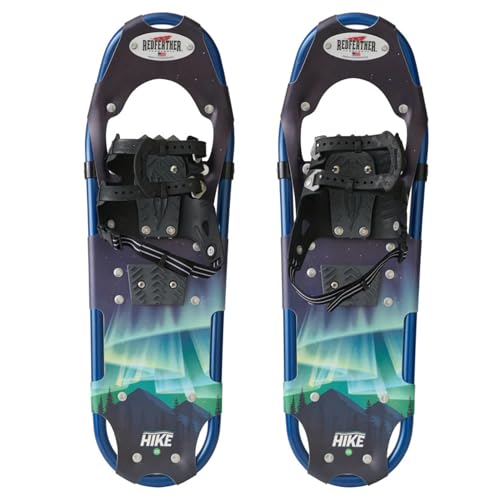
Redfeather Hike Snowshoes
A lighter aluminum frame costs less than premium trail models. Strap binding tests easily against boots on a living room floor. Occasional trail use suits this pair better than daily winter hiking.
Pros
- Lower cost than premium aluminum-frame models
- Strap binding is simple to test at home
- Lightweight for carrying to and from the trailhead
Cons
- Traction cleats less aggressive than premium models
- Frame wears faster under frequent heavy use
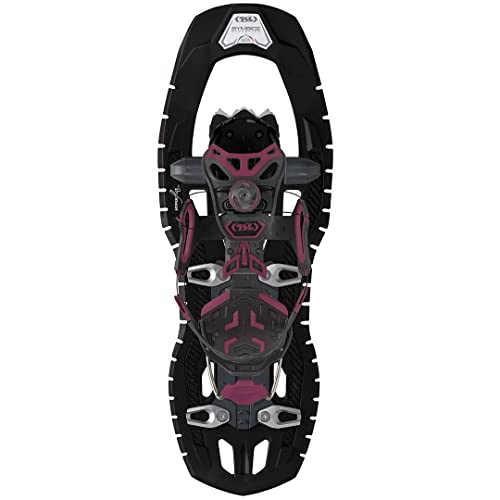
TSL Symbioz Hyperflex Snowshoes
A hinged composite deck flexes with each step, closer to a natural walking motion than a rigid frame. Multi-point binding wraps the boot for a snug test fit. Weight capacity reaches 250 pounds for loaded packs.
Pros
- Hinged deck flexes similarly to a natural stride
- Multi-point binding gives a snug, secure test fit
- Rated for heavier packs and boots
Cons
- Costs more than strap-binding competitors
- Hinge mechanism adds moving parts to maintain

Atlas Helium Trail Snowshoes
A lightweight frame targets occasional hikers testing fit before a first winter trip. Basic strap binding adjusts quickly but offers less precision than ratchet systems. Weight capacity tops out around 170 pounds.
Pros
- Affordable entry point for occasional hikers
- Lightweight frame is easy to store and carry
- Basic strap binding is quick to test at home
Cons
- Lower weight capacity than heavier-duty models
- Less fine-tuning than ratchet bindings offer
Side by side
| # | Model | Deck length | Best for | Score | Price |
|---|---|---|---|---|---|
| 1 | MSR Evo Trail Snowshoes | 22 in | Best overall | 9.3 | Check price |
| 2 | Tubbs Xplore Snowshoes | 21 in | Best for testing binding fit | 9.0 | Check price |
| 3 | Yukon Charlie’s Advanced 825 | 8 x 25 in | Best for heavier hikers | 8.7 | Check price |
| 4 | Crescent Moon Gold 10 Snowshoes | 10 in wide | Best for narrower storage footprint | 8.5 | Check price |
| 5 | Redfeather Hike Snowshoes | 25 in | Best value | 8.3 | Check price |
| 6 | TSL Symbioz Hyperflex Snowshoes | Hinged composite | Best for flexible deck fit | 8.1 | Check price |
| 7 | Atlas Helium Trail Snowshoes | 22 in | Best budget | 8.0 | Check price |
What to look for
What to check before buying, even indoors Traction cleats and flotation decks need snow contact, so nothing here works on hardwood or carpet as designed. Checking binding fit against actual winter boots at home still avoids surprises on the trail. Deck size and weight rating should match body weight plus pack load, not boot size alone. A dry closet or garage protects straps and metal hardware between seasons.
Which binding is easiest to test at home Ratchet and cinch systems, like those on the MSR Evo Trail and Yukon Charlie’s Advanced 825, loosen and retighten fast against different boots. Multi-point wrap systems, like the TSL Symbioz Hyperflex, take longer to adjust but grip more contact points. Testing indoors on carpet avoids scratching hard flooring with metal cleats.
Best for closet or apartment storage Deck size determines how much closet space a pair needs. Narrower models like the Crescent Moon Gold 10 stack flatter than wider decks built for deep powder flotation. Apartment dwellers with limited gear storage should weigh deck width against trail performance before buying.
Best for heavier hikers or loaded packs Weight capacity counts body weight plus pack, boots and layers together, not body weight alone. Hikers carrying overnight gear need a higher-rated deck like the TSL Symbioz Hyperflex or Yukon Charlie’s Advanced 825. Testing the binding at home with a loaded pack on can reveal pinch points before the trail does.
Good to know
Can snowshoes be used indoors on hard flooring?
No. Traction cleats grip snow and can scratch hardwood or tile, and the deck adds no benefit without snow underneath.
How do I check snowshoe fit before a trip?
Put on the winter boots you plan to wear, then adjust the binding at home on carpet, checking that straps or ratchets tighten without pinching.
What size snowshoe deck do I need?
Deck size should match body weight plus pack load, not shoe size. Manufacturer weight capacity charts, like those for the Yukon Charlie’s Advanced 825, list this directly.
Ratchet binding vs strap binding, which tests easier at home?
Ratchet and cinch systems, found on the MSR Evo Trail and Yukon Charlie’s models, adjust and release quickly, making repeat testing against different boots simpler.
Do snowshoes need special storage conditions?
No special conditions are required, but a dry closet or garage keeps straps and metal hardware from corroding between winter seasons.
What boots work best with snowshoe bindings?
Hiking boots suit lighter models like the Tubbs Xplore, while winter boots with gaiters pair better with higher-capacity models like the Yukon Charlie’s Advanced 825.
Is a hinged deck better than a rigid deck?
A hinged composite deck, like the TSL Symbioz Hyperflex, flexes with each stride, which some owners find more comfortable, though rigid decks stay simpler and often lighter.
Are budget snowshoes good enough for occasional use?
Models like the Atlas Helium Trail and Redfeather Hike suit occasional trail hikers well, though frequent heavy use favors higher-rated frames like the MSR Evo Trail.
Which snowshoe suits an apartment with limited storage?
The Crescent Moon Gold 10 stacks flatter than wider decks thanks to its narrower 10 inch profile, freeing up closet space without sacrificing flotation.
Our take
The MSR Evo Trail fits and stores easiest at home while still performing on actual trail snow. Heavier hikers or anyone carrying a loaded pack should pick the Yukon Charlie’s Advanced 825 instead for its higher weight rating. Apartment dwellers with limited storage are better served by the narrower Crescent Moon Gold 10.
Derek Holt
Derek has a background coaching recreational and amateur athletes and has worked the sales floor at specialty fitness retailers. He focuses on equipment durability, ergonomics and realistic use cases rather than marketing claims.