Natural gas grills ranked by heat, grates and build
Weber Genesis E-325s Natural Gas Grill leads on heat control, with 39,000 BTU across three burners and cast iron grates. Weber Spirit II E-310 does similar work on a tighter patio. Searing fans should look at the Napoleon Rogue 425 and its infrared side burner.
Weber Genesis E-325s Natural Gas Grill suits most backyards already plumbed for gas. Three burners make 39,000 BTU across 513 square inches of porcelain enameled cast iron. A 10 foot hose ships in the box. Portability vanishes, which is the honest price of never buying a tank again.
Fuel type trips buyers constantly. Identical model names sell in both propane and natural gas, and a propane grill cannot be hooked to a house line. We compared published BTU ratings against grate area, then grate and firebox materials, hose length and warranty terms. Owner reports on heat evenness and rust after a few seasons settled the close calls.
The shortlist, ranked

Weber Genesis E-325s Natural Gas Grill
Tapered burners and angled Flavorizer bars push heat across all 513 square inches, and owners report fewer cold corners than on rival three burner cabinets. Porcelain enameled cast iron holds sear temperature when a cold steak lands. A dedicated sear zone burner covers high heat work while the side burner reduces a sauce.
Pros
- Temperature stays even from edge to edge
- Sear zone reaches steak heat without a cast iron insert
- Long warranty terms on burners and firebox
Cons
- Footprint claims a dedicated patio corner
- Assembly needs two people and an afternoon

Weber Spirit II E-310 Natural Gas Grill
Same GS4 burner and ignition architecture as the Genesis, packed into a narrower cart. Three burners give 30,000 BTU over 424 square inches, backed by a 105 square inch warming rack for buns and held plates. Open cart legs slide beside a wall where a full cabinet will not fit.
Pros
- Weber heat consistency inside a narrower cart
- Fits patios that a cabinet grill blocks
- Infinity ignition lights reliably in cold air
Cons
- Open cart leaves less enclosed storage
- Tight for two full racks of ribs at once

Char-Broil Performance Series 4-Burner Natural Gas Grill
Four independent burners across 425 square inches deliver real zone control at the low end of the range, which budget grills usually skip. Porcelain coated grates release fish and sliced vegetables reasonably well. Lid and firebox steel runs thinner than Weber or Napoleon, so a cover matters more in wet climates.
Pros
- Four zones allow indirect cooking on a budget
- 150 square inch rack holds finished food
- Wheels make repositioning on a deck easy
Cons
- Thin steel loses heat on windy days
- Grate coating wears through sooner than cast iron
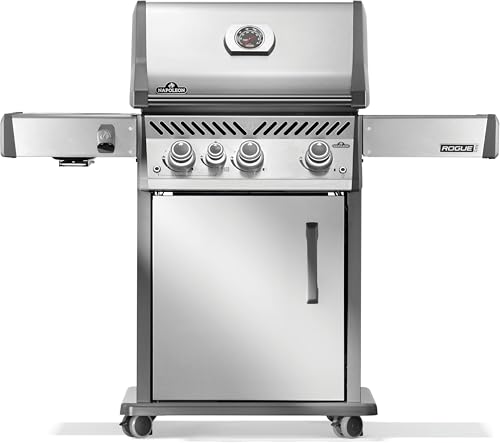
Napoleon Rogue 425 Natural Gas Grill
Iron wave grids leave the broad sear marks people buy a grill for. Napoleon pairs them with an infrared side burner that runs far hotter than a conventional ring, useful for finishing steaks or blistering peppers. Three main burners cover 425 square inches beneath a stainless lid.
Pros
- Infrared burner sears hotter than a standard side ring
- Wave grids print wide, distinct marks
- Stainless lid resists rust better than painted steel
Cons
- Infrared burner burns gas quickly
- Stainless panels show fingerprints constantly

Weber Q 3200 Natural Gas Grill
Cast aluminum body and lid trap heat like a small oven, so whole chickens and pork roasts work better than the size suggests. Two burners produce 21,700 BTU across 393 square inches of total space. Folding side tables collapse to shrink its parked width on a balcony.
Pros
- Cast aluminum holds heat in wind and cold
- Folding tables cut the parked footprint
- Lid shape suits roasting, not only grilling
Cons
- Two burners limit zone cooking
- 393 square inches runs out at a party

Blackstone 36-Inch Natural Gas Griddle
Smash burgers, fried rice, pancakes and fajitas want a flat top, not grates. Four independent burners heat 720 square inches of rolled steel, so a hot zone and a holding zone run at the same time. Seasoning is required maintenance, and grill marks never appear.
Pros
- 720 square inches cooks breakfast for a crowd
- Four zones separate searing from holding
- Handles shrimp and diced vegetables that fall through grates
Cons
- No grill marks or drip smoke flavor
- Rolled steel rusts when seasoning lapses

Bull Outdoor Products Angus Natural Gas Grill Head
Masonry kitchens need a head that drops into a countertop, not a cart. Bull builds this one from 304 stainless, with four burners making 60,000 BTU across 810 square inches plus a rear infrared burner for rotisserie work. Installation assumes a finished island opening and a licensed gas fitter.
Pros
- 304 stainless survives coastal salt air
- Rear burner turns whole birds and roasts
- 810 square inches suits regular entertaining
Cons
- Requires a built island and professional gas fitting
- No cart option, so it never moves again
Before you buy
What changes when you move from propane to natural gas Natural gas arrives at far lower pressure than propane. Different orifices and a different regulator follow from that. Attaching a propane grill to a house line gives weak flames at best. Manufacturers therefore sell separate natural gas versions, usually with a longer hose and a quick disconnect fitting. Rated BTU figures also differ slightly between the two fuel versions of one model. Confirm fuel type on the listing before ordering, because returning an assembled grill is a genuine chore.
How much burner output and grate space you need BTU alone misleads. A thin firebox wastes heat that cast aluminum or heavy steel would hold. Judge output against grate area instead. Roughly 80 to 100 BTU per square inch of primary grate is comfortable for searing. Size follows headcount: 400 square inches feeds four to six people, 500 covers a family plus guests, and past 700 means regular entertaining. Burner count is a separate question. Three or more burners let you run indirect heat, which is how ribs and whole chickens cook through without burning.
Materials that decide how many seasons it lasts Grates set the cooking feel. Porcelain enameled cast iron stores heat and prints dark sear marks. Porcelain coated steel warms faster and wears through sooner. On bodies, 304 stainless resists salt air, 430 stainless sits a step below, and painted steel rusts first at the seams. Flavorizer bars and heat tents shield burners from drippings and cost little to replace, unlike a corroded firebox. Wet or coastal addresses move a cover from optional to necessary.
Matching the grill to your patio and your menu Balconies and courtyards favor the Weber Q 3200, which roasts well on two burners and folds its tables flat. Cooking several nights a week? Spirit II E-310 gives the best balance, and the Genesis E-325s only earns the step up when a sear zone and side burner see real use. Breakfast, fajitas and smash burgers point at the Blackstone griddle rather than any grate grill. Anyone pouring a masonry island should skip carts and budget for the Bull Angus head plus a licensed fitter. Exposed windy decks are the wrong home for thin steel, so the Char-Broil needs a cover in the plan.
How they compare
| # | Model | Main burners | Best for | Score | Price |
|---|---|---|---|---|---|
| 1 | Weber Genesis E-325s Natural Gas Grill | 3, rated 39,000 BTU per hour | Best overall | 9.4 | Check price |
| 2 | Weber Spirit II E-310 Natural Gas Grill | 3, rated 30,000 BTU per hour | Best value | 9.2 | Check price |
| 3 | Char-Broil Performance Series 4-Burner Natural Gas Grill | 4, rated 36,000 BTU per hour | Best budget | 8.9 | Check price |
| 4 | Napoleon Rogue 425 Natural Gas Grill | 3, rated 40,000 BTU per hour | Best for searing | 8.7 | Check price |
| 5 | Weber Q 3200 Natural Gas Grill | 2, rated 21,700 BTU per hour | Best for small patios | 8.5 | Check price |
| 6 | Blackstone 36-Inch Natural Gas Griddle | 4, rated 60,000 BTU per hour | Best for griddle cooking | 8.3 | Check price |
| 7 | Bull Outdoor Products Angus Natural Gas Grill Head | 4, rated 60,000 BTU per hour | Best for built-in islands | 8.1 | Check price |
Common questions
Can I convert a propane grill to natural gas?
Only where the manufacturer sells an approved conversion kit for that exact model, and many do not. Homemade conversions void the warranty and create a fire risk, since orifices and regulator differ.
Do natural gas grills get as hot as propane models?
In practice yes. Rated BTU is often slightly lower on the natural gas version, but any gap in grate temperature is small next to the effect of firebox material and wind.
Which natural gas grill is best for a small patio?
Weber Q 3200 is the compact answer, with 393 square inches, folding side tables and a cast aluminum body that shrugs off wind. Spirit II E-310 is the next step when three burners matter.
How many burners does a family of four need?
Three burners and about 400 square inches handle four people with room for indirect cooking. Two burner grills work for couples but leave no cool zone for finishing thick cuts.
How long can the hose be on a natural gas grill?
Weber supplies 10 feet with its natural gas models, enough for most patios. Longer runs drop pressure, so extending the line is not recommended. Move the outlet rather than stretching the hose.
Do I need a plumber to install a natural gas grill?
Tapping a new line or adding an outdoor stub needs a licensed gas fitter in most jurisdictions. Where a quick disconnect outlet already exists, attaching the grill hose is a homeowner job.
Weber Spirit vs Genesis: which is worth it?
Spirit II E-310 offers 30,000 BTU over 424 square inches on an open cart. Genesis E-325s adds output, a sear zone, a side burner and enclosed storage. Pick Genesis for frequent steaks or guests.
Is a natural gas griddle better than a grill?
Depends on the menu. Flat tops win on smash burgers, eggs, fried rice and anything that falls through grates. Grates win on marks, drip smoke flavor and cooking fat away from the food.
Are natural gas grills cheaper to run than propane?
Per unit of energy, piped gas usually costs less than exchanged tanks. Savings accumulate across years rather than weeks, and the installed line is the upfront tradeoff.
What is a quick disconnect fitting on a gas grill?
A coupling that detaches the grill hose from the house outlet without tools, sealing both sides automatically. It comes standard on natural gas grills and makes winter storage far simpler.
The verdict
Buy the Weber Genesis E-325s Natural Gas Grill if the patio has room, because even heat, a sear zone and cast iron grates handle every backyard job. Tighter spaces and tighter budgets are better served by the Spirit II E-310, which shares the same burner design in a narrower cart. Cooks who make more smash burgers and breakfasts than steaks should take the Blackstone 36-inch griddle and skip grates altogether.
Sierra Daniels
Sierra's background is in landscape design and nursery retail. She focuses on lawn and garden equipment, outdoor furniture and gear durability, weighing published specs against how materials actually hold up outside.