A Reliable Multimeter Makes Electrical Work Safer
Fluke 117 leads this lineup for electricians and serious DIYers, backed by a CAT III 600V rating and true RMS accuracy. Fluke 87V suits demanding industrial diagnostics with CAT IV 600V protection. Klein Tools MM600 delivers rugged auto ranging performance for tradespeople who want dependable results without paying for extra industrial features.
Electricians reaching for a dependable meter tend to land on the Fluke 117, prized for its CAT III 600V rating and built in non contact voltage sensor. Heavier industrial diagnostics push buyers toward the Fluke 87V and its CAT IV 600V clearance. Homeowners and hobbyists get similar auto ranging convenience from the Klein Tools MM600 at a friendlier point in the lineup.
Multimeter shopping gets confusing fast because a flashy display means nothing if the CAT rating cannot handle your circuit. Ghost voltage, nonlinear loads and mismatched safety categories cause real misreadings and real injuries. We compared these seven models on safety category, true RMS response, auto ranging speed and extras like non contact voltage, drawing on published specifications and patterns owners report after months of use.
What we recommend

Fluke 117 Electricians Multimeter
Electricians pick the Fluke 117 for its CAT III 600V clearance and true RMS accuracy on nonlinear loads. A built in non contact voltage sensor flags live wires before contact. Low input impedance mode also filters out ghost voltage that trips up cheaper meters.
Pros
- CAT III 600V rating suits general electrical work
- Non contact voltage sensor built in
- Low impedance mode blocks ghost voltage readings
Cons
- Sits at a premium point among electrician meters
- Skips temperature measurement entirely

Fluke 87V Industrial Multimeter
Industrial technicians rely on the Fluke 87V when motor drives and noisy circuits distort readings. A low pass filter smooths true RMS measurements on variable frequency drives. Built in temperature sensing and a high resolution mode add precision for fine diagnostic work.
Pros
- CAT IV 600V rating clears demanding industrial panels
- Low pass filter steadies motor drive readings
- Built in temperature probe adds diagnostic range
Cons
- Priced above general purpose meters
- Extra modes exceed what casual users need

Klein Tools MM600 Multimeter
Tradespeople choose the Klein Tools MM600 for auto ranging speed on a rugged budget. Voltage, current, temperature and frequency all register through one durable housing built to survive job site drops. A holster and wide function set keep it field ready.
Pros
- CAT IV 600V rating matches pro Fluke meters
- Auto ranging speeds up repeated field checks
- Rugged housing survives job site knocks
Cons
- Not true RMS across every measurement type
- Bulkier body than pocket sized meters

AstroAI DM6000AR Multimeter
Home users and hobbyists get true RMS accuracy from the AstroAI DM6000AR without paying professional rates. Auto ranging with 6000 count resolution handles most household circuits cleanly. A backlit screen and built in kickstand suit garage and workbench use.
Pros
- True RMS accuracy at an entry friendly point on the range
- Wide function set covers home and hobby needs
- Backlit display and kickstand aid workbench use
Cons
- Not rated for heavy industrial circuits
- Stock test leads may need an upgrade later
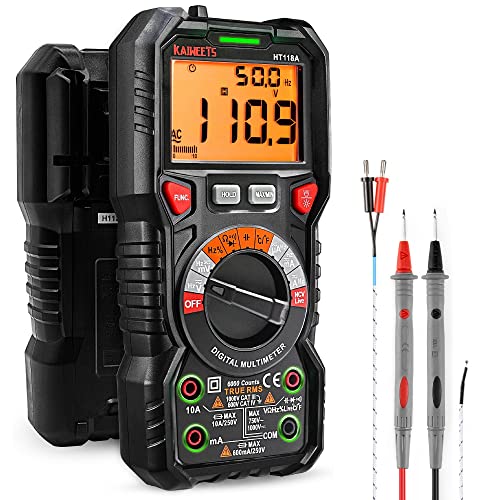
KAIWEETS HT118A Multimeter
DIYers tackling household wiring lean on the KAIWEETS HT118A for consistent everyday readings. True RMS accuracy and 6000 count auto ranging cover outlets, switches and small appliance checks. A low battery indicator and protective holster round out the sturdy build.
Pros
- True RMS accuracy paired with a solid feature set
- Sturdy housing plus a protective holster
- Clear backlit display for everyday tasks
Cons
- Not built for heavy professional workloads
- Bundled leads are entry level quality

Amprobe AM-510 Multimeter
HVAC technicians and maintenance crews reach for the Amprobe AM-510 to cover common field diagnostics. Capacitance and temperature ranges handle compressor and thermostat checks that general meters skip. A compact body slips into a tool pouch alongside other gear.
Pros
- Capacitance range covers common HVAC checks
- Non contact voltage detection built in
- Compact size fits easily in a tool pouch
Cons
- Lower voltage safety rating than pro grade meters
- Not true RMS on this model
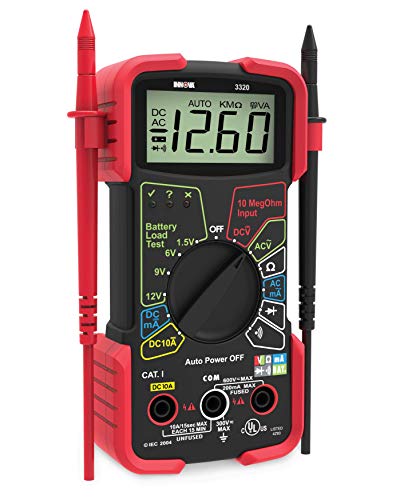
INNOVA 3320 Multimeter
First time owners doing basic car diagnostics find the INNOVA 3320 approachable and affordable. A color coded LED battery test simplifies pass fail checks without reading a display. Protective corner guards help it survive drops around a garage or glovebox.
Pros
- Very approachable price point for occasional use
- Simple layout suits first time owners
- Color coded battery test needs no interpretation
Cons
- CAT II rating limits it to light duty circuits
- Skips true RMS and advanced functions
Side by side
| # | Model | Safety rating | Best for | Score | Price |
|---|---|---|---|---|---|
| 1 | Fluke 117 Electricians Multimeter | CAT III 600V | Best overall | 9.4 | Check price |
| 2 | Fluke 87V Industrial Multimeter | CAT III 1000V and CAT IV 600V | Best for professionals | 9.2 | Check price |
| 3 | Klein Tools MM600 Multimeter | CAT III 1000V and CAT IV 600V | Best for tradespeople who want rugged value | 9.0 | Check price |
| 4 | AstroAI DM6000AR Multimeter | CAT III 600V and CAT II 1000V | Best value for home and hobby use | 8.7 | Check price |
| 5 | KAIWEETS HT118A Multimeter | CAT III 1000V and CAT IV 600V | Best for everyday DIY use around the house | 8.5 | Check price |
| 6 | Amprobe AM-510 Multimeter | CAT III 600V | Best for HVAC and general maintenance checks | 8.2 | Check price |
| 7 | INNOVA 3320 Multimeter | CAT II | Best budget pick for automotive and beginners | 8.0 | Check price |
What to look for
What does the CAT safety rating on a multimeter mean? Category numbers describe how much transient energy a meter can absorb before failing. Work near a service panel demands CAT III 600V or higher, while a car battery check tolerates CAT II. Skipping this check is a leading way electricians get hurt with the wrong tool. Fluke’s 117 and 87V both clear CAT III 600V, with the 87V stretching to CAT IV 600V for panel level work.
True RMS or average responding, which reading can you trust? Average responding meters assume a clean sine wave and calculate from that assumption. Motor drives, LED dimmers and modern electronics distort the wave, throwing those calculations off. A true RMS meter measures the actual signal instead of estimating it. Anyone working past simple household circuits benefits from that accuracy, based on specifications from models like the Fluke 117 and AstroAI DM6000AR.
Which multimeter suits your specific trade or task? Professional electricians lean toward rugged, high category meters such as the Fluke 87V or Klein MM600. Homeowners rarely need CAT IV clearance and do better with a value focused option like the AstroAI DM6000AR or KAIWEETS HT118A. HVAC techs benefit from the capacitance and temperature ranges built into the Amprobe AM-510. Automotive tinkerers can get by with a simpler CAT II meter like the INNOVA 3320.
Which extra features are worth paying for? Non contact voltage sensing confirms a wire is likely live before a probe ever touches it. Temperature and capacitance ranges turn a basic meter into an HVAC diagnostic tool. Auto ranging speeds up quick one off checks, while manual ranging holds steady during repeated measurements at a known value. A backlit display and holster matter more on a job site than in a drawer at home.
Questions worth asking
What does CAT III mean on a multimeter?
CAT III covers equipment permanently connected at the building’s distribution level, like panels and fixed wiring. It signals a meter can absorb higher transient energy than a CAT II tool rated for portable appliances. Both the Fluke 117 and Klein Tools MM600 carry a CAT III 600V rating or better.
Do I need a true RMS multimeter for home use?
Basic outlet and switch testing rarely needs true RMS accuracy. Dimmer switches, variable speed motors and some electronics still distort readings on average responding meters. Models like the AstroAI DM6000AR and KAIWEETS HT118A add true RMS at a home friendly point on the range.
Is the Fluke 87V worth it over the Fluke 117?
The 87V adds CAT IV 600V clearance, a low pass filter and built in temperature sensing that the 117 lacks. Industrial technicians working around motor drives gain real accuracy from those extras. Electricians doing standard residential and light commercial work rarely need the upgrade.
Which multimeter works best for a beginner?
An auto ranging true RMS meter removes guesswork for first time users. The AstroAI DM6000AR and KAIWEETS HT118A both fit that description with clear backlit displays. Drivers doing occasional car checks might prefer the simpler INNOVA 3320 instead.
What is the difference between auto ranging and manual ranging?
Auto ranging selects the correct measurement range automatically, which suits varied daily tasks. Manual ranging locks a fixed range, giving faster and steadier readings once you already know the expected value. Most meters in this lineup, including the Klein MM600 and INNOVA 3320, default to auto ranging.
Can a multimeter test a car battery and alternator?
Yes, voltage and continuity checks cover both battery health and basic alternator output. The INNOVA 3320 includes a color coded LED battery test built specifically for that job. More advanced meters add finer resolution for chasing intermittent electrical faults.
What features matter most when buying a multimeter?
Safety category rating and true RMS accuracy come before any convenience feature. After that, non contact voltage sensing, temperature and capacitance ranges add real value depending on the trade. A backlit display and protective holster matter most for job site use.
How accurate are digital multimeters compared to professional equipment?
Accuracy is stated as a percentage of the reading plus a count tolerance, and tighter specifications cost more. The Fluke 87V includes a high resolution basic mode for fine diagnostic work. Value meters like the AstroAI DM6000AR still hold accuracy that suits most home and hobby tasks.
Is non contact voltage detection necessary?
It adds a quick safety check before touching a wire directly, which many owners consider worth having. The Fluke 117 and Amprobe AM-510 both build the sensor into the meter body. It should support, not replace, a proper measurement before any wire is touched.
How often should a multimeter be recalibrated?
Professionals often follow a fixed recalibration schedule tied to workplace safety policy. Occasional home users can instead check readings periodically against a known reference like a fresh battery. Storing the meter dry and replacing worn leads also helps preserve accuracy over time.
The verdict
Electricians and serious DIYers get the most balanced package from the Fluke 117, between its CAT III 600V rating and built in voltage sensing. Industrial technicians facing motor drives and noisy panels should size up to the Fluke 87V instead. Anyone prioritizing rugged value over brand name lands well with the Klein Tools MM600.
Jake Monroe
Jake worked as a residential contractor for over a decade before shifting to full-time writing. He evaluates power tools, hand tools and workshop gear through the lens of someone who has actually used them on job sites, not just read the box.


