A Trickle Charger Keeps a Motorcycle Battery Ready All Winter
NOCO Genius1 suits most riders first, combining smart multi-stage charging with support for lithium and lead-acid batteries. Battery Tender Junior remains the value pick for simple winter storage. CTEK MXS 5.0 fits riders who want faster recharges alongside a maintenance mode.
NOCO Genius1 suits most riders first, pairing smart multi-stage charging with support for modern lithium and traditional lead-acid batteries in a compact case. Battery Tender Junior stays the value staple for basic seasonal storage. CTEK MXS 5.0 suits riders who want quicker recharges.
Choosing the wrong charger or mode can overcharge a small motorcycle battery, or fail to revive one that ran deeply flat. We compared charging stages, chemistry support and safety features like spark protection, then weighed what owners report after winters of storage.
What we recommend

NOCO Genius1
Smart multi-stage charging and a repair mode pack into a palm-sized unit that handles both lithium and lead-acid batteries. Riders rely on it as a year-round maintainer that safely tops off a bike parked for weeks. One amp of output keeps things gentle on small batteries.
Pros
- Supports lithium and lead-acid
- Compact with repair mode
- Safe spark-proof connection
Cons
- Low amperage charges slowly
- Small buttons on the case

Battery Tender Junior
Automatic switching to a float charge kicks in once the battery reaches full, a hallmark of this long-running winter storage favorite. Set-and-forget simplicity has made it a garage staple for keeping bikes ready by spring. Quick-connect leads make hookup a five-second job.
Pros
- Reliable set-and-forget float
- Affordable and proven
- Easy quick-connect leads
Cons
- Lead-acid focus, not lithium
- Slow for a flat battery
BLACK+DECKER BM3B
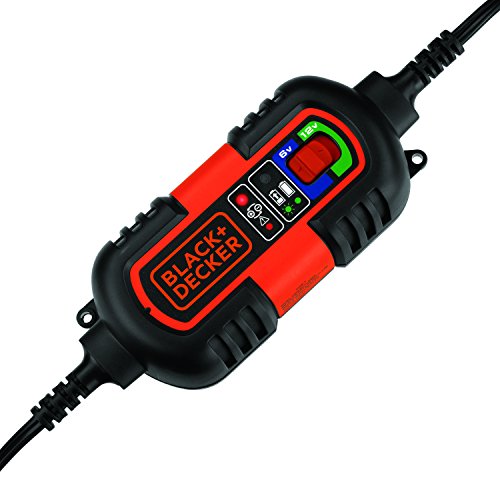
Basic trickle charging covers riders who just need reliability through the off-season at low cost. Simple plug-in operation and included ring and clip connectors keep setup straightforward. Owners appreciate not needing to learn a menu system.
Pros
- Low cost entry point
- Simple plug-in operation
- Includes multiple connectors
Cons
- Maintenance only, slow charge
- No lithium support

CTEK MXS 5.0
Eight charging stages, including a reconditioning mode for tired batteries, come standard on this higher-output charger. Five amps recharges noticeably faster than a one-amp maintainer, while still holding a safe float during storage. Temperature compensation adjusts charging for garage conditions through the seasons.
Pros
- Faster charging output
- Reconditioning stage
- Temperature-compensated charging
Cons
- Priced above simple maintainers
- More program modes to learn

NOCO Genius5
Five amps of output charges faster than the Genius1, while still supporting lithium and lead-acid chemistries. Riders with a bike plus a car or ATV like covering the whole garage with one charger. Repair mode joins charge and maintain functions here too.
Pros
- Handles multiple vehicle types
- Lithium and lead-acid support
- Faster than 1-amp units
Cons
- More than a bike needs alone
- Higher price than trickle chargers

Schumacher SC1319
A straightforward automatic maintenance mode comes with a clear indicator confirming charge status. Riders who want visible feedback that the battery sits topped off get exactly that here. Output stays modest at 1.5 amps, suited to maintenance rather than fast recovery.
Pros
- Clear charge status indicator
- Automatic maintenance mode
- Easy to operate
Cons
- Lead-acid only
- Modest charging speed

Battery Tender Plus
Higher current than the Junior helps this model handle bikes stored many months at a stretch, before settling into a safe float. Based on specifications, it revives a low battery faster while protecting it long term. Quick-connect harness compatibility carries over from the Junior.
Pros
- Faster than the Junior
- Safe long-term float charge
- Proven storage reliability
Cons
- Lead-acid focus only
- Costs more than the Junior
How they stack up
| # | Model | Output | Best for | Score | Price |
|---|---|---|---|---|---|
| 1 | NOCO Genius1 | 1 amp | Best overall | 9.4 | Check price |
| 2 | Battery Tender Junior | 0.8 amp | Best value | 9.1 | Check price |
| 3 | BLACK+DECKER BM3B | 0.75 amp | Best budget | 8.6 | Check price |
| 4 | CTEK MXS 5.0 | 5 amp | Best for faster charging | 9.2 | Check price |
| 5 | NOCO Genius5 | 5 amp | Best for multiple vehicles | 9.0 | Check price |
| 6 | Schumacher SC1319 | 1.5 amp | Best for maintenance | 8.7 | Check price |
| 7 | Battery Tender Plus | 1.25 amp | Best for deep storage | 8.8 | Check price |
How to pick the right one
Confirm your battery chemistry first Modern bikes run lithium, AGM or traditional flooded lead-acid batteries, and each needs a matching charging profile. A charger that supports your chemistry, or several chemistries, prevents overcharging and extends battery life.
Maintainers versus fast chargers Low-amp maintainers keep a parked bike topped off over winter, while higher-output chargers recover a drained battery faster. Many riders keep a small maintainer for storage, then reach for more current only when a battery runs low.
Safety features are not optional Spark-proof connections, reverse-polarity protection and automatic shutoff guard both rider and battery. That matters most when connecting in a tight engine bay or leaving a charger unattended for weeks.
Why connection convenience matters A permanent quick-connect harness bolted to the battery turns hookup into a five-second job. This small addition encourages regular maintenance and saves fighting with clamps in cold weather.
Frequently asked questions
Can I leave a motorcycle charger connected all winter?
Yes, if it is a smart maintainer that floats the battery once full. These are designed for long-term connection and will not overcharge, unlike simple manual chargers.
Will a car charger work on a motorcycle battery?
Only if it has a low enough setting for the small battery, since high current can damage it. A dedicated motorcycle maintainer or a smart charger with a low mode is safer.
Do I need a lithium-compatible charger?
If your bike uses a lithium battery, yes, because lithium needs a different charging profile than lead-acid. Some chargers support both chemistries, which is convenient if you switch battery types.
How long does it take to charge a motorcycle battery?
It depends on the charger output and how flat the battery is. A low-amp maintainer may take many hours from a low state, while a five-amp charger recovers it noticeably faster.
What is float or maintenance mode?
Float mode holds the battery at a safe full charge without overcharging, delivering only what it needs to counter self-discharge. It is what makes long-term connection during storage safe.
Can these chargers revive a dead battery?
Some include a repair or reconditioning stage that can recover a deeply drained battery, though a battery damaged by long neglect may not come back. Results depend on its condition.
Is a higher amperage charger always better?
Higher amperage charges faster but is not always necessary for a small bike battery. For storage a low-output maintainer is gentler, while higher current helps when a quick recharge is needed.
Should I disconnect the battery before charging?
Many smart chargers can safely charge with the battery installed thanks to protection features. Following the charger and bike manuals avoids any electrical issues.
NOCO Genius1 vs Battery Tender Junior: which should I buy?
NOCO Genius1 supports lithium and lead-acid batteries with a repair mode, better suited to riders who might switch battery types. Battery Tender Junior costs less and covers straightforward lead-acid winter storage well.
The bottom line
NOCO Genius1 stands out as the best overall motorcycle charger, pairing smart maintenance with broad battery support in a compact unit. Battery Tender Junior remains unbeatable value for simple seasonal storage. CTEK MXS 5.0 suits riders who want faster recharges.
Tony Russo
Tony trained as an automotive technician and spent years in service and parts retail before moving into writing. He focuses on garage tools, car care products and accessories from a hands-on maintenance perspective.