Marble Run Starter Kits: Matching Age to Piece Size
Ravensburger’s GraviTrax Starter Set wins for its modular, gravity powered track that grows with expansion packs. Toddlers do better with Hape’s Roll and Ring Marble Maze, built from oversized wood pieces with no small parts. Families wanting the most pieces per set should pick Quercetti’s Marble Run 220.
Ravensburger’s GraviTrax Starter Set stands out among marble run kits for older kids. Magnetic, gravity based modules snap onto a pegboard, so builds go vertical instead of following one flat path. Expansion packs sold separately let the same base grow for years. Pieces run small, though, so children under 8 need something different, like Hape’s Roll and Ring Marble Maze, built from oversized, toddler safe pieces.
Not every kit built for a ten year old works for a toddler, and a toddler focused set can bore an older kid within a week. We compared these seven kits on stated age recommendations, piece count, track material, and owner reports on how long each one held attention.
Before you buy
What to look for in a marble run starter kit Three things decide whether a kit works for a specific child: piece size, total piece count, and whether the system can grow later. Toddlers need oversized, choke safe pieces like Hape’s Roll and Ring Maze uses. Kids past age 6 handle smaller connectors and more complex layouts without trouble. Piece count from 30 up to 220 changes how tall or branching a build can get, and material affects how long a kit survives daily play.
Matching age range to piece size Hape’s Roll and Ring Maze uses pieces sized for children as young as 12 months, with no small parts to worry about. Quercetti and Melissa & Doug target ages 4 and up, with moderate sized connectors that still need supervision near younger siblings. GraviTrax and Robotime ROKR list age 8 and up, since both use small parts and advanced building logic. Choosing by stated age range, not interest level alone, keeps play safe.
Piece count and build complexity More pieces usually mean taller, more branching designs, but only if a child has the patience to use them. Quercetti’s 220 piece set and Play22’s 150 piece set reward kids who want to build big. Melissa & Doug’s 34 piece set keeps a first build manageable instead of overwhelming. A high piece count pays off most once a child has already built a few smaller sets.
Wood versus plastic, and when to go expandable Wood pieces, used in Hape, Melissa & Doug, and Robotime ROKR, survive rough handling and hold up over years of play. Plastic pieces, found in Quercetti, PicassoTiles, and Play22, weigh less and snap together faster for quick rebuilds. Neither material wins outright, since durability and ease of assembly pull in different directions. Families expecting a child to stick with the hobby get more long term value from an expandable system like GraviTrax, even at a higher entry cost.
The top picks, ranked

Ravensburger GraviTrax Starter Set
Track pieces click onto a pegboard base instead of following one flat path. Kids build upward and sideways, testing gravity and momentum with each layout. Expansion packs sold separately extend the same base for years of new builds.
Pros
- Pegboard base supports true 3D building, not flat track only
- Expansion packs extend the same set for years
- Gravity and momentum concepts show up naturally during play
Cons
- Pieces run too small for children under 8
- Base set alone offers fewer layouts than with add ons

Hape Roll and Ring Marble Maze
Oversized wood pieces and large marbles remove the choke hazard smaller track pieces carry. A ring and roll design needs no assembly, so a toddler can start right away. Parents of children under 4 call this one of the few marble toys actually safe for that age.
Pros
- Large pieces and marbles avoid choke hazard risk
- Solid wood holds up to toddler handling
- No assembly needed before first use
Cons
- Offers less complexity than modular track kits
- Cannot expand once a child outgrows it

Quercetti Marble Run 220
220 pieces build tall, branching tracks for less per piece than premium branded sets. Bright plastic tubes and connectors snap together without tools. Households with two kids sharing note the piece count covers separate builds at once.
Pros
- High piece count supports large, branching layouts
- Costs less per piece than premium modular kits
- Compatible with other sets in the same line
Cons
- Plastic connectors feel less premium than wood
- Small parts still need supervision around younger siblings

Melissa & Doug Wooden Marble Run
Solid wood ramps and towers give a tactile build, different from snap together plastic. A moderate piece count keeps assembly manageable for a first timer. Parents who prefer wood toys in the playroom pick this set for that material alone.
Pros
- Wood construction feels durable and natural in hand
- Piece count suits first time builders well
- Sturdy enough for repeated rebuilding
Cons
- Fewer total pieces than plastic modular sets
- Limited expansion next to GraviTrax or Quercetti
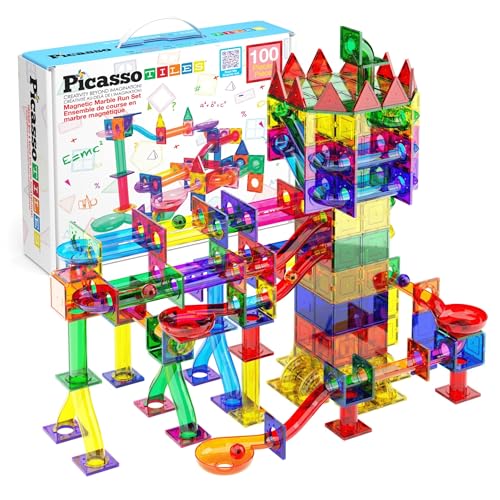
PicassoTiles Marble Run Magnetic Tile Set
Track pieces connect straight to standard magnetic building tiles, so kids build the structure and not just the run. Two toy categories merge into one session. Families who already own magnetic tiles report this set gets used far more than a standalone marble run.
Pros
- Works with existing magnetic tile collections
- Encourages structural building, not just track assembly
- Compact set stores easily between sessions
Cons
- Needs separate magnetic tiles for full structures
- Smaller piece count limits standalone complexity

Robotime ROKR Marble Run Wooden Kit
Laser cut wood pieces require assembly first, closer to a model kit than an instant toy. Older kids who enjoy following build steps get more from this than open ended play. Parents of engineering minded children say assembly is half the appeal.
Pros
- Assembly builds real engineering style skills
- Laser cut pieces fit together precisely
- Finished model looks impressive once complete
Cons
- Assembly takes real time before first play
- Not built for quick rebuilding like snap kits

Play22 Marble Run Set 150 Pieces
150 plastic pieces build varied layouts for less than name brand modular kits. Bright colors and simple connectors suit a child building solo. Parents testing a first marble run for a child under 6 call this a low risk starting point.
Pros
- Costs less than premium branded starter kits
- 150 pieces support varied track layouts
- Simple connectors suit independent building
Cons
- Plastic quality trails Quercetti and Ravensburger
- Fewer STEM features than GraviTrax offers
How they stack up
| # | Model | Age range | Best for | Score | Price |
|---|---|---|---|---|---|
| 1 | Ravensburger GraviTrax Starter Set | 8 years and up | Best overall | 9.4 | Check price |
| 2 | Hape Roll and Ring Marble Maze | 12 months and up | Best for toddlers | 9.0 | Check price |
| 3 | Quercetti Marble Run 220 | 4 years and up | Best value | 8.7 | Check price |
| 4 | Melissa & Doug Wooden Marble Run | 4 years and up | Best classic wooden set | 8.4 | Check price |
| 5 | PicassoTiles Marble Run Magnetic Tile Set | 6 years and up | Best for combining with magnetic tiles | 8.2 | Check price |
| 6 | Robotime ROKR Marble Run Wooden Kit | 8 years and up | Best STEM building challenge | 8.1 | Check price |
| 7 | Play22 Marble Run Set 150 Pieces | 6 years and up | Best budget | 8.0 | Check price |
Common questions
What age is a marble run starter kit good for?
It depends on piece size more than a strict age number. Toddler kits like Hape’s Roll and Ring Maze suit children from 12 months using oversized pieces, while standard kits with small parts are generally built for age 4 and up, and systems like GraviTrax target age 8 and up.
Are marble runs a choking hazard for toddlers?
Standard marble run pieces and marbles are small enough to pose a risk for children under 3, which is why age labeled kits matter. Toddler specific sets use oversized marbles and pieces built to avoid that risk entirely.
Can you mix marble run brands together?
Generally no, since most brands use proprietary connector shapes that only fit their own pieces. Quercetti sets connect within the Quercetti line, and GraviTrax pieces only join with other GraviTrax expansion packs.
Is GraviTrax good for a first time builder?
The GraviTrax Starter Set works as an entry point, though its 3D pegboard style has a steeper learning curve than a flat plastic track kit. Most kids age 8 and up pick up the basics during their first session.
What STEM skills do marble runs teach?
Building a working track teaches gravity, momentum, and cause and effect through trial and error. GraviTrax leans into this directly with modules for acceleration and height, while simpler kits teach the same ideas more informally.
What’s the difference between a marble run and a marble maze?
A marble run usually means a vertical or branching track a marble travels down under gravity. A marble maze, like the Hape Roll and Ring, is often a single contained tower a marble navigates, simpler and more toddler focused.
Do wooden marble runs last longer than plastic ones?
Wood pieces generally resist cracking and warping better over years of handling, especially with younger children who drop or step on pieces. Plastic pieces can crack under stress but cost less to replace individually if lost.
Can two kids build with one marble run set at the same time?
Larger piece count kits, like Quercetti’s 220 piece set, give enough material for two kids to build separate sections without running out. Sets under 50 pieces work better for one child building at a time.
Which marble run kit works best for small hands?
Hape’s oversized wooden pieces suit toddler and preschooler hands best, since nothing requires fine motor precision. Quercetti’s plastic connectors work well by age 4, once a child can twist and snap smaller parts together.
Final word
Ravensburger’s GraviTrax Starter Set fits families with a child age 8 or older who wants a system that grows over time. Parents of toddlers should skip it entirely and choose Hape’s Roll and Ring Marble Maze for its oversized, safe pieces. Anyone chasing the most pieces for the money does better with Quercetti’s Marble Run 220.
Rachel Simmons
Rachel previously worked in child-product retail and brings a practical, detail-first eye to gear reviews, focusing on safety standards, ease of use and the fine print that matters most for new caregivers.


