7 Science Kits That Make Kids Actual Scientists
National Geographic Mega Science Kit ranks first for covering chemistry, geology and physics in one box. Snap Circuits Jr. remains the strongest electronics starter since nothing gets used up. Thames and Kosmos Chem C1000 suits older children ready for real glassware and structured chemistry.
National Geographic Mega Science Kit gives most families the broadest starting point, spanning chemistry, geology and physics. Snap Circuits Jr. covers electronics for kids who want to build rather than mix. Thames and Kosmos Chem C1000 suits children ready to handle real glassware under supervision.
Science kits get bought badly often, because a box advertising fifty experiments frequently means fifty single use reactions gone by the second afternoon. We compared these seven on how many experiments can genuinely repeat, whether instructions explain the science or just list steps, realistic age range rather than the number printed on the box, supervision needs, and what household materials families must supply themselves.
How to pick the right one
How to count experiments a kit can actually repeat A box advertising fifty experiments often means fifty single use reactions from a handful of powder sachets. Once those run out, the kit becomes decoration. Kits built around reusable equipment, snap together electronics, microscopes or lab tool sets, keep working indefinitely instead. One reusable kit for the long term plus an occasional consumable kit for novelty tends to work best.
What age range a kit is really suited for Printed age ratings reflect safety and small parts more than actual intellectual fit. A capable seven year old may find a kit labeled for eight boring, while a nine year old who can’t yet follow multi step instructions alone will need help with one labeled for ten. Read the instruction style instead of the printed number: picture cards suit pre readers, structured manuals suit confident ones.
What extra materials the family needs to supply Many kits assume a family will supply water, vinegar, baking soda, batteries, food coloring or a workspace that can get messy. Knowing that in advance beats discovering it on a rainy afternoon. Read the required materials list before buying, and pick up batteries at the same time, since electronics kits almost never include them.
How much supervision each kit type needs Real chemistry sets include real chemicals, glassware and sometimes a burner, requiring an adult present rather than nearby. Even gentle kits benefit from a wipeable surface, goggles and a firm no tasting rule. Setting up a dedicated tray or corner makes the whole process less daunting for parents, which in practice decides whether a kit gets used more than once.
The best picks, ranked
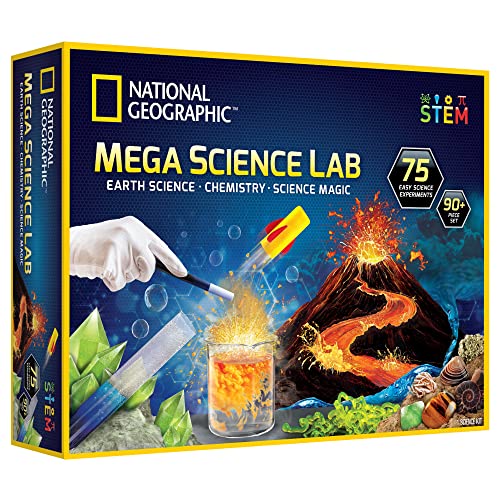
NATIONAL GEOGRAPHIC Mega Science Kit
Chemistry, geology, earth science and physics all sit in one box, useful when a child’s specific interest is still unknown. Real rock and mineral specimens stay behind after the reaction based consumables run out. Instructions explain the underlying science rather than only listing steps to follow.
Pros
- Five science areas let interests develop naturally
- Real specimens remain after consumables are gone
- Explanations cover the why, not just the how
Cons
- Consumable reactions run only once each
- Chemistry sections need an adult close by

Snap Circuits Jr. SC-100 Electronics Exploration Kit
Color coded blocks snap onto a grid, removing the wiring that normally locks young children out of electronics. A circuit works or it doesn’t, so cause and effect stays immediate. Over one hundred included projects mean this outlasts any consumable kit, and kids keep inventing new builds once the manual runs out.
Pros
- No soldering or loose wires required
- Nothing gets used up, so it lasts for years
- Manual difficulty ramps up gradually
Cons
- AA batteries are not included
- Small pieces can go missing over time

Thames & Kosmos Chem C1000 Chemistry Kit
Real glassware, an alcohol burner and a substantial experiment manual make this a proper introductory chemistry set, built for kids past fizzing volcano kits. The manual reads like a course, covering technique alongside results rather than just steps. Genuine adult supervision is required throughout, a reflection of real chemistry rather than a design flaw.
Pros
- Real equipment replaces toy substitutes
- Manual teaches technique alongside theory
- Enough depth to last well past one session
Cons
- An adult must stay present throughout
- Some chemicals need replacing to repeat experiments

Thames & Kosmos Kids First Science Laboratory
Picture based experiment cards work for kids who can’t yet read instructions independently. Household safe materials keep the risk low. Real tools like test tubes and a funnel come scaled to small hands, deliberately gentle enough that an eight year old finds it simple while a five year old finds it just right.
Pros
- Picture instructions suit pre readers well
- Lab tools scale to small hands
- Uses safe, common household materials
Cons
- Too simple for most kids past age seven
- Parents supply most consumables themselves

4M Crystal Growing Experiment Kit
Crystals grow over days rather than seconds, teaching patience and observation in a way instant reactions never do. Compounds, a display base and instructions for several crystal types ship together. One sustained project rather than a broad kit, it stays cheap enough to treat as a single weekend activity.
Pros
- Teaches observation across days, not minutes
- Produces a keepsake at the end
- Costs little for the engagement it delivers
Cons
- Compounds get used up in a single run
- Requires patience some children lack
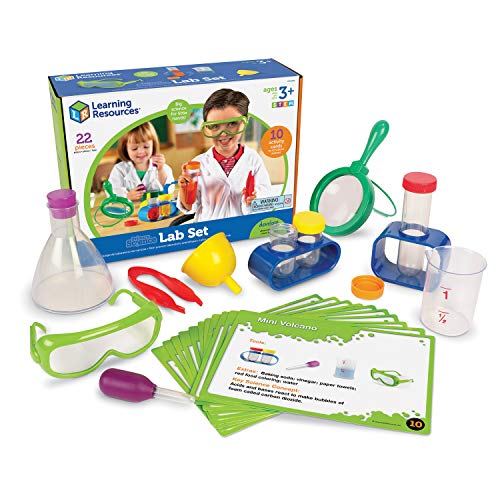
Learning Resources Primary Science Lab Activity Set
Durable, child sized equipment ships here instead of experiments: beakers, test tubes, a magnifier, tweezers and safety goggles, plus an activity guide. Any kitchen table experiment turns into a proper one with this gear, and none of it gets consumed. Pairing it with a consumable kit or online experiment ideas makes it outlast everything else on this list.
Pros
- Nothing runs out, so it lasts indefinitely
- Chunky tools fit small hands well
- Safety goggles are included from the start
Cons
- No chemicals or experiment materials included
- Activity guide runs shorter than full kits

AmScope M30-ABS-KT2-W Beginner Microscope Kit
Glass optics change what a child can actually see compared with a plastic lensed toy, and this kit ships with prepared slides, blanks, tools and a case ready to go. Magnification steps let kids work up from whole specimens toward cell structures. Supervision matters during slide preparation, since small glass pieces are involved.
Pros
- Real optics reveal genuine detail
- Prepared slides give an immediate starting point
- Metal build survives being carried around
Cons
- Glass slides need careful handling
- Learning to focus takes some patience
Side by side
| # | Model | Age range | Best for | Score | Price |
|---|---|---|---|---|---|
| 1 | NATIONAL GEOGRAPHIC Mega Science Kit | Around 8 and up | Best overall | 9.4 | Check price |
| 2 | Snap Circuits Jr. SC-100 Electronics Exploration Kit | Around 8 and up | Best for electronics | 9.2 | Check price |
| 3 | Thames & Kosmos Chem C1000 Chemistry Kit | Around 10 and up | Best for older kids | 9.0 | Check price |
| 4 | Thames & Kosmos Kids First Science Laboratory | Around 5 and up | Best for young children | 8.8 | Check price |
| 5 | 4M Crystal Growing Experiment Kit | Around 10 and up | Best single project | 8.6 | Check price |
| 6 | Learning Resources Primary Science Lab Activity Set | Around 3 and up with supervision | Best tool set | 8.3 | Check price |
| 7 | AmScope M30-ABS-KT2-W Beginner Microscope Kit | Multiple steps from 40x upwards | Best microscope | 8.0 | Check price |
Frequently asked questions
What age are science kits suitable for?
Kits exist from about age three upward, though content varies enormously. Picture instruction kits suit four to seven year olds, broad multi science kits suit roughly eight to twelve, and real chemistry sets generally target ten and up with adult supervision.
Are chemistry sets safe for children to use?
Kits from established brands use chemicals selected for home use and include safety instructions. Adult supervision, goggles and a sensible workspace still matter. Read the manual before the first session, not during it, and store the kit away between uses.
Which science kit lasts the longest for kids?
Kits built on reusable equipment last the longest. Snap together electronics, microscopes and lab tool sets have nothing to run out, so children return to them for years. Consumable chemistry and crystal kits typically finish in one or two sessions unless refills get purchased.
Do science kits include everything a child needs?
Rarely. Most assume the family supplies water and common household items, and battery powered kits usually skip batteries entirely. Check the required materials section before buying so a shopping trip doesn’t delay the first session.
Are kids science kits actually educational or just toys?
The better ones explain the underlying science instead of only listing steps, and that difference is worth looking for. A manual that asks a child to predict a result before running the experiment teaches far more than one that simply produces a color change.
What is a good first science kit for a five year old?
Look for picture based instructions, real but safe tools and household ingredients. At that age the goal is handling equipment and noticing what happens, not understanding chemical reactions, so a gentle introductory lab set beats a complex kit a child can’t use alone.
Can science kits work for school projects?
Often yes, particularly kits with structured experiments and clear explanations, since those provide both a method and a result to write up. Reusable equipment sets prove especially useful, letting a child design their own experiment instead of following a supplied one.
How much adult supervision do these kits need?
Introductory kits with household materials need an adult in the room. Full chemistry sets with glassware and a burner need an adult at the table for the entire session. Electronics and microscope kits fall in between, needing help at the start and less afterward.
Electronics kit vs chemistry kit: which suits my child better?
Electronics kits like Snap Circuits Jr. suit kids who enjoy building and get immediate visual feedback with no consumables to replace. Chemistry kits suit kids drawn to reactions and hands on lab technique, at the cost of needing supervision and occasional refills.
Our pick
National Geographic Mega Science Kit stays the first buy for most families, since its breadth lets a child find which branch of science actually interests them. Snap Circuits Jr. wins as the better long term buy for anything electrical, since nothing ever gets used up. Thames and Kosmos Chem C1000 becomes the right step once a child is ready for real equipment and real supervision.
Rachel Simmons
Rachel previously worked in child-product retail and brings a practical, detail-first eye to gear reviews, focusing on safety standards, ease of use and the fine print that matters most for new caregivers.