Which Kids Camera Actually Survives a Drop?
VTech’s KidiZoom Duo DX is the strongest overall pick for younger children because its grip and menus suit small hands. Fujifilm’s Instax Mini 12 gives the best value for instant prints, and Kodak’s PIXPRO FZ45 suits older kids ready for a real camera.
VTech’s KidiZoom Duo DX is the camera we would hand a younger child first. Fujifilm’s Instax Mini 12 offers better value for families wanting instant prints, and Kodak’s PIXPRO FZ45 suits older children ready to graduate to a proper compact.
Age gaps make this category tricky, since a preschooler and a ten year old need two entirely different products. Toy cameras use chunky grips and forgiving software but produce soft images, while entry level compacts take genuinely good photos and break when dropped. We compared published specifications, storage and battery arrangements, plus recurring themes in owner reviews about what survives real family use.
How to pick the right one
How do you pick the right kids camera by age? Under about six, grip shape and durability decide everything, and image quality barely registers with the child. From roughly seven to nine, kids start noticing their photos look worse than a parent’s phone. Past ten, most are better served by an entry level compact than by anything marketed as a kids camera.
Instant prints or digital files: which gets used more? A camera that fills a memory card nobody ever opens gives a child very little back. Instant film and thermal printers create something tangible right away. Choosing digital means agreeing in advance on a routine for viewing or printing shots, since that feedback loop is what keeps a camera in use.
What battery and storage setup should you check for? Rechargeable built in batteries avoid a drawer full of dead AAs but leave the camera unusable while charging. AA powered cameras keep going on holiday if spares travel along. Confirm whether a memory card ships in the box, since many listings show one in photos without actually including it.
Which cameras survive drops, water and rough handling? A silicone shell handles ordinary indoor drops well. Only a properly sealed model such as the COOLPIX W150 survives being taken into water. Owners report that lanyards and wrist straps prevent more damage than any case, mainly because the camera never hits the ground in the first place.
Our top picks

VTech KidiZoom Duo DX
VTech gets the ergonomics right, with a dual grip body a young child can hold steady and a front camera for selfies that keeps them engaged. Onboard games and photo effects are why it stays in use rather than getting abandoned after a week. Image quality remains toy grade, and no menu setting changes that.
Pros
- Dual grip body suits small hands
- Effects and games keep younger children interested
- Rechargeable rather than eating batteries
Cons
- Photo quality is basic
- Small low resolution screen

Fujifilm Instax Mini 12
Instant film turns photography into something physical, holding a child’s attention in a way a folder of digital files does not. Exposure is automated, so shots come out usable without adjustment. Film costs add up, and kids burn through it faster than most parents expect.
Pros
- Physical prints hold attention better than files
- Automatic exposure means fewer wasted shots
- Very simple to operate
Cons
- Film is a continuing expense
- No digital copy of the image

Kodak PIXPRO FZ45
For a child who has outgrown toy cameras, the PIXPRO FZ45 is a proper point and shoot with optical zoom and image quality that holds up on a screen. AA batteries make it convenient on holiday and mildly annoying at home. No ruggedising is built in, so a protective case becomes essential.
Pros
- Genuine image quality step up from toy cameras
- Optical zoom rather than digital crop
- AA batteries are easy to replace anywhere
Cons
- No drop or water protection
- Battery drain is noticeable with heavy use
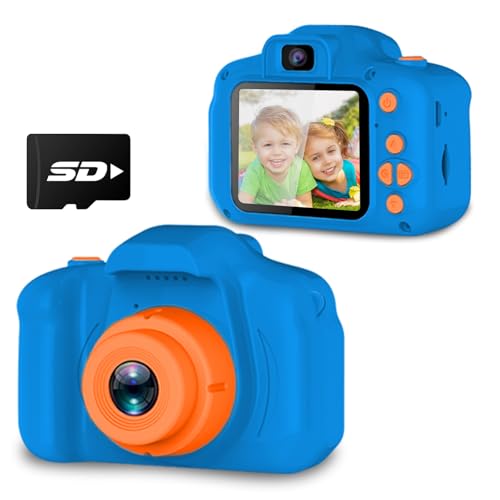
Seckton Kids Digital Camera
Wrapped in silicone, this budget model survives being dropped, lost and rediscovered, which is the life a first camera usually leads. It shoots stills and short video and comes with a lanyard attached. Photos look fine on a phone screen and not much further than that.
Pros
- Low enough cost that damage is not a disaster
- Silicone shell absorbs drops
- Lanyard reduces the chance of losing it
Cons
- Soft, noisy images
- Menus are clumsily translated

myFirst Camera Insta 2
A digital sensor pairs with a built in thermal printer here, so children get a paper copy instantly while the file stays on the card. Thermal paper costs less than instant film, easing the running cost problem. Prints are monochrome only, which some kids love and others find dull.
Pros
- Instant prints without instant film costs
- Keeps a digital copy as well as a print
- Refill paper is inexpensive
Cons
- Prints are black and white only
- Thermal prints fade over time

Nikon COOLPIX W150
Waterproof and shock resistant construction makes this the camera for a child who takes it into the sea or drops it on a pool deck. Nikon layers a simplified, child friendly interface on top of a genuine compact camera. Cost runs highest in this group, but it is the only option that fully solves the durability problem.
Pros
- Genuinely waterproof for pool and beach use
- Shock resistant body handles drops
- Real image quality behind a simple interface
Cons
- Priciest option we ranked
- Seals need checking before each water session

Canon IVY CLIQ Plus 2 Instant Camera Printer
Prints from this model peel and stick, using zink paper that kids apply to notebooks and bedroom walls rather than filing away. A phone app connection lets it print photos taken elsewhere too. Image quality straight from the camera lens stays modest.
Pros
- Sticker backed prints appeal strongly to kids
- Doubles as a printer for phone photos
- No ink cartridges to manage
Cons
- Camera image quality is basic
- Zink paper adds ongoing cost
How they stack up
| # | Model | Age range | Best for | Score | Price |
|---|---|---|---|---|---|
| 1 | VTech KidiZoom Duo DX | Preschool through early primary | Best overall | 9.4 | Check price |
| 2 | Fujifilm Instax Mini 12 | Instant film camera | Best value | 9.2 | Check price |
| 3 | Kodak PIXPRO FZ45 | Compact digital camera | Best for older kids | 9.0 | Check price |
| 4 | Seckton Kids Digital Camera | Silicone protective shell | Best budget | 8.8 | Check price |
| 5 | myFirst Camera Insta 2 | Digital camera with thermal printer | Best hybrid | 8.6 | Check price |
| 6 | Nikon COOLPIX W150 | Waterproof and shock resistant | Best for pools and beaches | 8.3 | Check price |
| 7 | Canon IVY CLIQ Plus 2 Instant Camera Printer | Instant camera printer | Best for sticker prints | 8.0 | Check price |
Frequently asked questions
What age is a kids camera suitable for?
Toy style cameras suit roughly three to eight. From eight or nine, children usually get more from a basic compact camera, and by eleven or twelve many prefer a phone camera or a proper entry level model.
Are kids cameras any good for actual photos?
Toy cameras produce soft, noisy images that look acceptable on a small screen and poor when printed large. Choose a compact such as the Kodak PIXPRO FZ45 instead if photo quality matters to you.
Instant film or digital, which suits a child better?
Instant film delivers immediate physical results, which younger children respond to strongly, though each shot costs money. Digital shooting is free and better for experimentation. Hybrid models such as the myFirst Camera Insta 2 split the difference.
Do kids cameras need a separate memory card?
Most have limited internal storage and take a microSD card. Check whether one is included, and if buying separately, a modest capacity card is plenty since these cameras produce small files.
How do you get photos off a kids camera?
Usually by USB cable to a computer, or by removing the microSD card and using a reader. A few models include phone apps. Owners report card readers as the most reliable route.
Will a kids camera survive being dropped repeatedly?
Silicone shelled toy cameras handle household drops well. Compacts such as the PIXPRO do not, unless a case gets added. Only rugged models rated for shock and water can be treated carelessly.
Can a kids camera be used underwater?
Only models specifically rated for it, such as the Nikon COOLPIX W150. Splash resistance and waterproofing are different claims, so check the listing wording rather than the marketing image.
How much should a first camera for a child cost?
For a young child, a low cost model is the sensible starting point, since the risk of damage or loss stays high. Save a bigger purchase for once the child shows sustained interest.
The verdict
For a younger child, VTech’s KidiZoom Duo DX is the camera most likely to survive and stay in use, since the grip and interface were built around small hands. Choose Fujifilm’s Instax Mini 12 when instant prints will hold their attention, and step up to Kodak’s PIXPRO FZ45 once photo quality starts to matter to them.
Rachel Simmons
Rachel previously worked in child-product retail and brings a practical, detail-first eye to gear reviews, focusing on safety standards, ease of use and the fine print that matters most for new caregivers.