RV Water Filters Built for Daily, High-Volume Use
Clearsource Premium RV Water Filtration System sustains the highest flow for full-time RVers running two fixtures at once. ProOne RV/Marine Water Filter System fits tighter storage bays and stretches cartridge life further. Camco TastePURE Twin Pack roughly doubles inline capacity over a single filter without canister costs.
Clearsource Premium RV Water Filtration System tops this list for full-time RVers who run a shower and a kitchen faucet together. Its twin-canister design splits sediment filtration from carbon filtration into separate housings. Storage bay space becomes the tradeoff, since two canisters take up more room than one inline filter.
Manufacturer capacity claims rarely match real usage, and a filter sized for weekend trips falls short under daily full-time draw. We compared published flow rates, connection hardware, and owner feedback on cartridge life to rank these filters by sustained performance rather than marketing gallons.
Our top picks
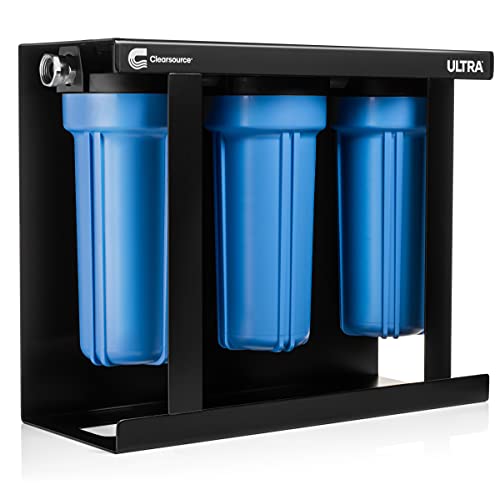
Clearsource Premium RV Water Filtration System
Sediment filtration and carbon filtration happen in two separate canisters rather than one crowded cartridge. A 5-micron pre-filter removes grit before water reaches the carbon block stage. Flow rate holds near 5 GPM, enough to run a shower and a faucet at the same time.
Pros
- Two-stage design keeps sediment filtration separate from carbon filtration
- Clear housings show cartridge condition without disassembly
- 5 GPM flow supports two fixtures running together
Cons
- Twin canisters need a dedicated storage bay
- Replacement cartridges cost more than single inline filters

ProOne RV/Marine Water Filter System
One G2.7 canister houses ProOne’s carbon composite element, rated to outlast typical inline cartridges. A garden hose quick-connect and mounting bracket attach it near the city water inlet. Chlorine taste, odor, and fine sediment all get addressed in a single pass, though flow rate tops out at 1.5 GPM.
Pros
- Single cartridge outlasts typical inline filter elements
- Compact canister mounts with the included bracket
- Cuts chlorine taste and odor in one filtration pass
Cons
- 1.5 GPM flow trails twin-canister systems under heavy draw
- Replacement cartridges cost more per unit than Camco inline filters

Camco TastePURE RV/Marine Water Filter Twin Pack
Two TastePURE inline filters connect in series between the hose and the RV, roughly doubling single-filter capacity to about 1,000 gallons. Granular activated carbon and KDF media fill each compact housing. Flexible hose protectors at both ends cut down on connection strain during travel.
Pros
- Series connection extends capacity past a single filter
- No bracket or housing needed beyond the inline units
- Hose protectors reduce strain at each fitting
Cons
- Two filters in series add length at the hookup point
- Total capacity still trails canister-based systems
Camco TastePURE RV/Marine Water Filter with Flexible Hose Protector
This single TastePURE filter shares the twin pack’s carbon and KDF media in one compact inline housing rated near 500 gallons. A flexible hose protector keeps the connection from kinking. Weekend and seasonal trips suit it better than daily full-time draw.
Pros
- Costs less than the twin pack or canister systems
- Installs on a standard hose in minutes without tools
- Small enough for a tight storage bay
Cons
- 500-gallon rating limits it to occasional use
- Needs replacement more often under daily draw
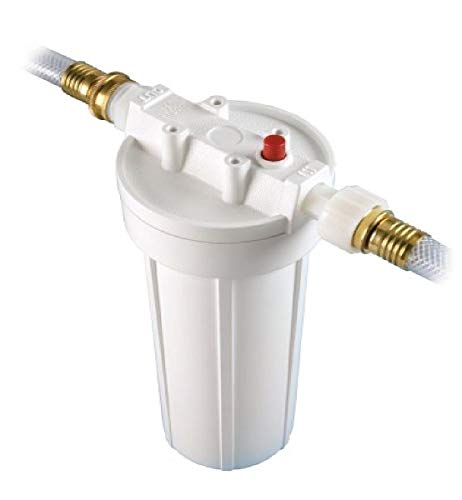
Culligan RV-800 Exterior Inline RV Water Filter
A coconut shell activated carbon cartridge sits inside a translucent inline housing, so sediment buildup is visible without opening it. Garden hose quick-connects on both ends speed up hookup at the campsite. Culligan rates the cartridge near 2,000 gallons, enough for several months of seasonal use.
Pros
- Translucent housing shows sediment buildup at a glance
- Quick-connects on both ends simplify setup and teardown
- Cuts chlorine taste and odor reliably
Cons
- No dedicated sediment pre-filter stage
- Sits more exposed than bay-mounted canister systems

Hydro Life 52122 Exterior RV Water Filter with Hose Protector
KDF and carbon block media pack into a shorter inline housing than most competitors, so it coils into tight storage bays. A built-in hose protector loop guards the connection during travel. Quick-connect fittings mean setup takes no tools, though rated capacity tops out near 1,500 gallons.
Pros
- Short housing fits tight storage spaces
- Quick-connect fittings need no tools to install
- Hose protector loop reduces connection strain
Cons
- 1.5 GPM flow trails twin-canister systems under heavy demand
- Carbon block cartridge cannot be refilled

Waterdrop WD-GHF-1 Garden Hose Water Filter
A sediment mesh layer sits ahead of KDF55 and coconut shell carbon media inside one inline cartridge, aimed at water sources with visible particulate. Standard 3/4 inch garden hose threads let it work at RV parks, campgrounds, or a home spigot. Waterdrop rates the cartridge near 4,000 gallons before replacement.
Pros
- Sediment layer suits cloudy or well-fed hookups
- 4,000-gallon rating extends time between changes
- Fits standard hose threads without adapters
Cons
- 1 GPM flow is the lowest among filters compared here
- Cartridge body is bulkier than compact inline models
What matters most
What to look for in an RV water filter Filtration media comes first, since granular carbon, KDF, and carbon block target different contaminants. Connection type matters just as much; quick-connect fittings save time at every hookup. Rated capacity in gallons signals how long a cartridge lasts before replacement. Flow rate in GPM determines whether pressure drops when two fixtures run together.
Capacity and flow rate for full-time use A single inline filter rated for a few hundred gallons suits weekend campers fine. Full-time RVers pull far more water through showers, dishes, and laundry, so a filter rated in the thousands of gallons cuts down on cartridge changes. Splitting sediment and carbon filtration into separate stages, as Clearsource does, keeps flow higher than a single crowded cartridge. Bottlenecks still show up at low flow rates, like the Waterdrop WD-GHF-1’s 1 GPM, when two fixtures run at once.
Inline vs canister systems Camco’s TastePURE line threads onto the hose with no mounting hardware, keeping setup simple for seasonal trips. ProOne and Clearsource mount to a bracket inside a storage bay instead, holding a larger filter element. Less frequent replacement comes with that larger element, but installation takes longer and claims permanent space. Owners who swap a filter between an RV and a truck camper often favor inline units for portability.
Matching a filter to well water, municipal hookups, or campground spigots Chlorine disinfection is standard at campground spigots and municipal RV park connections, and carbon-based filters like the Culligan RV-800 handle it well. Rural well water tends to carry more visible sediment, so a dedicated sediment stage, built into the Clearsource system or the Waterdrop WD-GHF-1, earns its keep. Rotating between multiple sources on a full-time trip favors a filter that covers both sediment and carbon rather than carbon alone. Checking source water clarity before connecting helps decide which filter to prioritize at that stop.
How they compare
| # | Model | Filter Capacity (gallons) | Best for | Score | Price |
|---|---|---|---|---|---|
| 1 | Clearsource Premium RV Water Filtration System | approximately 5,000 before sediment cartridge change | Best overall | 9.4 | Check price |
| 2 | ProOne RV/Marine Water Filter System | approximately 1,500 per cartridge | Best for full-time RVers | 9.1 | Check price |
| 3 | Camco TastePURE RV/Marine Water Filter Twin Pack | approximately 1,000 gallons combined | Best value | 8.9 | Check price |
| 4 | Camco TastePURE RV/Marine Water Filter with Flexible Hose Protector | approximately 500 gallons | Best budget | 8.6 | Check price |
| 5 | Culligan RV-800 Exterior Inline RV Water Filter | approximately 2,000 gallons | Best for high flow rate | 8.4 | Check price |
| 6 | Hydro Life 52122 Exterior RV Water Filter with Hose Protector | approximately 1,500 gallons | Best compact/inline | 8.2 | Check price |
| 7 | Waterdrop WD-GHF-1 Garden Hose Water Filter | approximately 4,000 gallons | Best for sediment-heavy water | 8.0 | Check price |
Good to know
How often should I replace an RV water filter?
Replacement timing follows rated capacity and actual usage, not a fixed calendar. A 500-gallon inline filter used daily wears out far faster than the same filter on occasional weekend trips. Watching a translucent housing, like the Culligan RV-800’s, for discoloration confirms when a cartridge is due.
What is the difference between an inline and a canister RV water filter?
Inline filters thread directly onto the hose and skip mounting hardware entirely. Canister systems, including the ProOne and Clearsource units, bolt to a bracket and hold a larger element. Canisters generally last longer between changes but take up more permanent space in a bay.
Can I use a regular garden hose filter for my RV?
A standard garden hose filter, such as the Waterdrop WD-GHF-1, works fine as long as its threads match the RV’s fresh-water inlet. Most garden hose filters share the same 3/4 inch threading as RV city water connections, so compatibility rarely becomes an issue.
Which RV water filter works best for full-time living?
Clearsource Premium RV Water Filtration System suits full-time living best, since its twin-canister design holds flow steady under daily draw from multiple fixtures. ProOne RV/Marine Water Filter System offers a compact alternative for full-timers who want longer cartridge life without the twin-canister footprint.
Do RV water filters remove bacteria, or just chlorine taste?
Carbon and KDF filters covered here target chlorine taste, odor, and sediment rather than bacteria. RVers worried about microbial contamination in well water or unknown sources typically add a separate disinfection step or a pathogen-rated filter.
How much flow rate does an RV water filter need?
A flow rate of 2 GPM or higher, like the Culligan RV-800 or Camco TastePURE Twin Pack deliver, keeps a single shower or faucet running without a noticeable pressure drop. Running two fixtures at once, such as a shower and a sink, calls for the 5 GPM rating on the Clearsource Premium system.
Clearsource vs ProOne: which RV water filter handles higher demand?
Clearsource Premium rates higher for flow at 5 GPM against ProOne’s 1.5 GPM, making it the better fit for simultaneous fixture use. ProOne trades some flow rate for a compact single canister and a cartridge rated for longer service life.
Is a sediment pre-filter necessary for RV water filtration?
A sediment pre-filter earns its place when drawing from well water, unfiltered campground spigots, or older park plumbing where particulate shows up often. Clearsource and the Waterdrop WD-GHF-1 both build in a sediment stage ahead of carbon filtration, while single-stage inline filters like the Camco TastePURE rely on carbon and KDF alone.
What size RV water filter fits a small storage bay?
Compact inline models like the Hydro Life 52122 or Camco TastePURE take up the least space, coiling into tight bays without a bracket. Twin-canister systems need dedicated bay space and are not a fit for RVs with limited storage.
Is a twin-canister RV water filter worth the extra cost?
A twin-canister system earns its higher cost for full-time RVers running multiple fixtures daily, since separate sediment and carbon stages keep flow higher longer. Weekend campers rarely draw enough water to justify the extra expense over an inline filter.
The bottom line
Clearsource Premium RV Water Filtration System is the strongest pick for full-time RVers running multiple fixtures who want sediment filtration kept separate from carbon. Weekend or seasonal campers after a lower cost, no-bracket setup should choose the Camco TastePURE Twin Pack instead, since it doubles inline capacity without claiming storage bay space.
Tony Russo
Tony trained as an automotive technician and spent years in service and parts retail before moving into writing. He focuses on garage tools, car care products and accessories from a hands-on maintenance perspective.


