How to Pick a 12V Water Pump for a Solar-Charged RV
SEAFLO’s 55-Series pump leads for most rigs, moving 5.5 GPM at 60 PSI on an 8-amp draw from a solar-charged battery bank. VEVOR’s 4.5 GPM pump balances flow against draw for mid-size trailers. Camco’s 34445 suits single-bathroom rigs on a tighter 5-amp budget. All three self-prime and wire into standard 12V circuits.
SEAFLO’s 55-Series 12V pump is the strongest overall pick, moving 5.5 GPM at 60 PSI for rigs running a shower and several fixtures together. It suits owners charging a house battery from rooftop solar who want steady pressure without a generator running. Its main tradeoff is an 8-amp draw that a small 100-watt panel setup can struggle to replace.
GPM, PSI, and amp draw pull against each other, and a pump oversized for a small battery bank drains reserves fast. We compared published flow and pressure specs, self-priming lift, port sizing, and owner feedback on noise and pulsation across current Amazon listings.
What to look for
Why RV Water Pumps Run on 12V, Not Directly on Solar Every pump here is a standard 12V DC diaphragm pump built for RV and marine plumbing. None plugs into a solar panel directly. Panels instead charge a house battery through a charge controller, and the pump draws current from that battery like any other 12V accessory. Panel and battery sizing should follow the pump’s amp draw, not a marketing label.
Matching Flow Rate and Pressure to Your Fixtures A single bathroom sink and toilet rarely need more than 3 GPM at 40 PSI to feel normal. Rigs with an outdoor shower, dishwasher, or two bathrooms benefit from 4.5 to 5.5 GPM and 60 to 90 PSI so pressure holds when two fixtures run together. Oversizing GPM for a small galley sink wastes battery capacity and can make faucet aerators sputter. Count fixtures before chasing the highest flow number on the shelf.
Sizing Amp Draw Against a Solar-Charged Battery Bank Pumps in this group draw between 3 and 9 amps at 12V while running, though they cycle on only during active water draw. Boondockers charging with 100 to 200 watts of solar into one battery should favor pumps under 6 amps, such as the SEAFLO 21-Series Mini or SHURflo Revolution. Larger 400-watt-plus arrays paired with lithium banks carry more headroom for the higher-draw 5 to 5.5 GPM options. Amp draw, not the wattage printed on the box, determines real-world battery drain.
Self-Priming, Mounting, and Noise: What to Expect All seven pumps self-prime and can lift water a few feet from an empty line, though priming time varies with hose length and check valve condition. Diaphragm pumps produce a pulsing hum that transmits through rigid mounting, so many owners add rubber isolation feet or foam padding. Triplex designs, like the Flojet, run measurably quieter than single or dual diaphragm units at similar flow rates. Winterizing means draining the pump head fully, since trapped water can crack the housing when it freezes.
Our top picks

SEAFLO 55-Series 12V 5.5 GPM Water Pressure Pump
This diaphragm pump moves 5.5 GPM at 60 PSI on a standard 12V circuit, enough for a shower and sink running together without a pressure drop. It draws about 8 amps under load and self-primes from an empty line. Owners running two-bathroom rigs mention it most often for steady pressure on solar-charged battery banks.
Pros
- Handles multiple fixtures running at once
- Self-primes quickly from empty lines
- Replacement parts stay widely stocked
Cons
- 8-amp draw needs a larger solar array
- Pulses noticeably without rubber mounts

Bacoeng 12V Self-Priming Diaphragm Water Pump
Rated at 5.0 GPM and 90 PSI, this pump suits rigs with an outdoor shower or dishwasher alongside standard fixtures. It self-primes and draws roughly 9 amps at full flow, per the listing. That higher pressure ceiling keeps flow steady when two outlets open together.
Pros
- Highest pressure ceiling in this group
- Strong flow for multi-fixture use
- Built-in check valve cuts backflow
Cons
- Highest amp draw of the seven pumps
- Needs a robust battery bank to avoid sag

VEVOR 12V Diaphragm Water Pump 4.5 GPM
This pump lists 4.5 GPM at 70 PSI on an 8-amp draw, splitting the difference between flow and pressure. Owners note reliable self-priming after winterizing, and standard 1/2 inch NPT plumbing needs no adapters. Mid-size trailers with one bathroom and a galley sink fit its output well.
Pros
- Strong flow and pressure for the output level
- Standard NPT fittings skip extra adapters
- Owners report easy self-priming after storage
Cons
- Runs louder than the SHURflo and Flojet picks
- Mounting brackets use thinner gauge metal
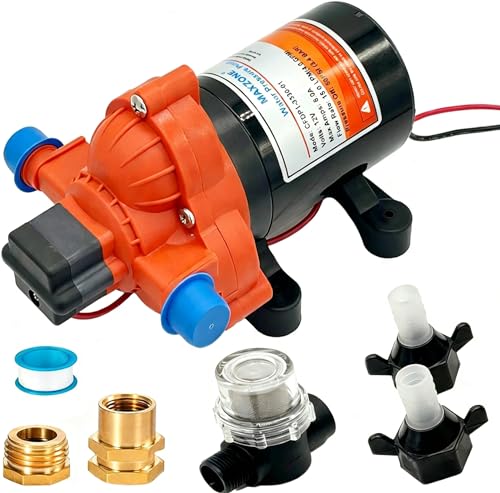
Camco 34445 RV 12V Water Pump
Camco’s 12V pump delivers 3.0 GPM at 40 PSI on a 5-amp draw, sized for single-bathroom trailers and small campers. It self-primes and uses standard 1/2 inch inlet and outlet ports. Lower flow keeps amp draw modest, a fit for smaller solar arrays.
Pros
- Low amp draw suits smaller battery banks
- Bolts in as a straightforward replacement for many trailers
- Compact housing fits tight cabinets
Cons
- Pressure drops when two fixtures run together
- Not enough flow for an outdoor shower

SHURflo 4008-101-A65 Revolution 12V Water Pump
The Revolution series pairs 3.0 GPM and 45 PSI with a built-in accumulator tank that smooths pulsation at the tap. Amp draw runs around 6 amps per the listing. Owners running a single galley or bathroom sink cite it for the least pulsing hum of any pump here.
Pros
- Accumulator tank cuts faucet pulsation
- Cycles more quietly than basic diaphragm pumps
- Moderate amp draw fits mid-size solar setups
Cons
- 3.0 GPM limits use to one fixture at a time
- Costs more per GPM than the Camco or VEVOR

Flojet R4426143A Triplex 12V Water Pump
Flojet’s triplex diaphragm design spreads output across three chambers, delivering 3.5 GPM at 35 PSI with less pulsation than single or dual diaphragm pumps. Amp draw sits near 5 amps at full flow. Boondockers mention the lower vibration noise as easier to live with parked overnight.
Pros
- Triplex design cuts noise and vibration
- Moderate amp draw suits off-grid battery banks
- Delivers smooth pressure without an accumulator tank
Cons
- Lower max pressure than single-diaphragm rivals
- Triplex housing costs more to service

SEAFLO 21-Series Mini 12V Water Pump
This compact pump is rated at 1.2 GPM and 45 PSI, drawing about 3 amps under load, the lowest of the seven. It self-primes and suits small campers, teardrop trailers, or boats with a single low-flow faucet. Its small footprint fits cabinets too shallow for full-size pumps.
Pros
- Lowest amp draw pairs well with a single 100W panel
- Compact size fits small cabinets
- Runs off a small battery without deep discharge
Cons
- 1.2 GPM is too low for a shower
- Not enough flow for more than one fixture
Compared at a glance
| # | Model | Voltage | Best for | Score | Price |
|---|---|---|---|---|---|
| 1 | SEAFLO 55-Series 12V 5.5 GPM Water Pressure Pump | 12V DC | Best overall | 9.4 | Check price |
| 2 | Bacoeng 12V Self-Priming Diaphragm Water Pump | 12V DC | Best for high GPM demand | 9.1 | Check price |
| 3 | VEVOR 12V Diaphragm Water Pump 4.5 GPM | 12V DC | Best value | 8.8 | Check price |
| 4 | Camco 34445 RV 12V Water Pump | 12V DC | Best budget | 8.6 | Check price |
| 5 | SHURflo 4008-101-A65 Revolution 12V Water Pump | 12V DC | Best for low-flow sinks | 8.4 | Check price |
| 6 | Flojet R4426143A Triplex 12V Water Pump | 12V DC | Best for off-grid boondocking | 8.2 | Check price |
| 7 | SEAFLO 21-Series Mini 12V Water Pump | 12V DC | Best for small solar setups | 8.0 | Check price |
Questions worth asking
How many amps does a 12V RV water pump draw?
Draw across current listings ranges from about 3 amps for compact mini pumps like the SEAFLO 21-Series up to 9 amps for higher-output models like the Bacoeng. Actual draw depends on flow rate and how many fixtures run at once.
What GPM do I need for an RV water pump?
A single sink or toilet runs fine on 3.0 GPM. Rigs with a shower, dishwasher, or two bathrooms generally need 4.5 GPM or more to avoid pressure drops when fixtures run together.
Can an RV water pump run directly off a solar panel?
No, these pumps run on 12V from a battery, not a panel directly. Solar recharges the battery through a charge controller, and the pump draws from that stored power like any other 12V accessory.
Is a higher PSI RV water pump better?
Higher PSI, such as 70 to 90 PSI on the VEVOR and Bacoeng pumps, keeps pressure steady when multiple fixtures open at once. A single low-flow sink does fine on 40 to 45 PSI and draws less amperage.
SEAFLO 55-Series vs SHURflo Revolution, which is better?
The SEAFLO 55-Series moves more water at 5.5 GPM and suits rigs with multiple fixtures. The SHURflo Revolution’s accumulator tank runs quieter for a single sink but caps out at 3.0 GPM.
What is the best RV water pump for a small solar setup?
The SEAFLO 21-Series Mini draws about 3 amps, the lowest of the pumps compared here, so it runs easier off a single small panel and a modest battery.
Do RV water pumps need to be self-priming?
Yes, self-priming lets a pump pull water up from an empty line after storage or a dry tank without manually filling the pump head. All seven pumps compared here self-prime.
Why is my RV water pump loud or pulsing?
Diaphragm pumps pulse naturally as each chamber cycles, and that vibration transmits through a rigid mount into cabinetry. Rubber isolation feet, foam padding, or a triplex design like the Flojet cut the noise.
12V pump vs 24V pump for an RV, does voltage matter?
Nearly all RV house battery systems run 12V, which is why every pump compared here is a 12V model. A 24V pump would need a separate battery bank and wiring, which few RVs carry.
Final word
For most solar-equipped rigs, the SEAFLO 55-Series 12V pump is the strongest pick, balancing 5.5 GPM and 60 PSI against an 8-amp draw a mid-size battery bank can support. Owners running a single small panel and one low-flow sink should choose the SEAFLO 21-Series Mini instead, since its 3-amp draw fits a smaller solar setup without deep daily discharge.
Tony Russo
Tony trained as an automotive technician and spent years in service and parts retail before moving into writing. He focuses on garage tools, car care products and accessories from a hands-on maintenance perspective.