Heavy Duty Battery Testers for the Home Garage Bench
ANCEL BA101 suits most home garages, reading 100 to 2000 CCA across flooded, AGM, gel and start stop batteries with cranking and charging tests built in. FOXWELL BT705 prints a dated slip for maintenance records. KONNWEI KW208 covers the same core checks for occasional use.
ANCEL BA101 earns its bench space in most home garages. Chemistry selection plus cranking and charging tests replace three separate checks with one tool. Copper clad clamps bite through the corrosion that ruins readings on a neglected terminal. Coverage stops at 12 volts, so anyone servicing a 24 volt truck needs a different unit.
Voltage alone hides a failing cell, which is why cheap testers send owners to the parts counter for batteries that were fine. We compared CCA ranges against real battery labels, chemistry menus covering AGM, gel and start stop, cranking and charging functions, clamp material and cable reach. Owner reports about readings on deeply discharged batteries broke the ties. Plain voltmeters with no CCA figure were left out.
Our top picks

ANCEL BA101 Battery Load Tester
A chemistry menu covers flooded, AGM, gel and start stop, so readings match the plates inside. Cranking and charging tests follow the battery result, pointing at a starter or alternator before parts get replaced. Power draws off the battery under test, leaving no internal cells to die in a drawer.
Pros
- Cranking and charging tests isolate starter and alternator faults
- Copper clad clamps cut through terminal corrosion
- Runs on the tested battery, with no cells to replace
Cons
- Handles 12 volt batteries only
- Backlit screen fades in direct sunlight
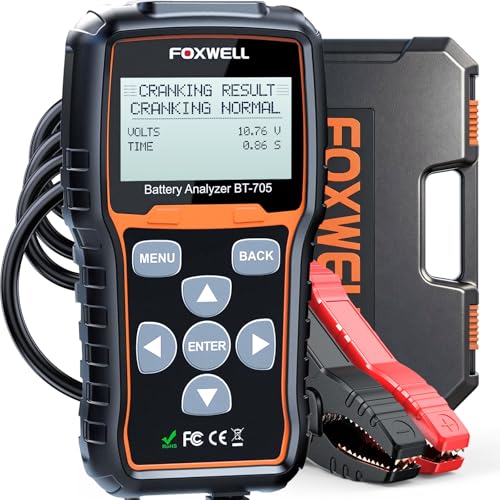
FOXWELL BT705 Battery Analyzer
A thermal printer sits in the housing and produces a dated slip listing CCA, internal resistance and state of health. Battery testing stays 12 volt, while cranking and charging checks extend to 24 volt systems. Owners juggling a diesel truck, a trailer and two cars end up with a record per battery instead of a guess.
Pros
- Printed slips date stamp each battery check
- Cranking and charging tests reach 24 volt systems
- Reports internal resistance alongside the CCA figure
Cons
- Paper rolls are a recurring consumable
- Bulkier than a pocket conductance tester

TOPDON BT200 Battery Tester
Bluetooth pushes each result to a phone app, which files reports per vehicle for later comparison. Conductance testing spans 100 to 2000 CCA on 12 volt batteries, plus cranking and charging on 12 and 24 volt systems. Rating standards include CCA, JIS, DIN, EN and IEC, so an import battery label still matches a menu entry.
Pros
- Covers CCA, JIS, DIN, EN and IEC label standards
- App keeps a per vehicle history of readings
- Handles 24 volt cranking on vans and equipment
Cons
- Full reporting depends on the phone app
- Cables are shorter than bench style testers

Autel MaxiBAS BT506 Battery and Electrical System Tester
Adaptive conductance adjusts as internal resistance climbs, tracking an aging battery more closely than a fixed curve. Results reach a phone app or an Autel diagnostic tablet over Bluetooth. Ripple voltage appears beside battery health and starter draw, exposing alternator diodes that are breaking down.
Pros
- Ripple reading catches failing alternator diodes early
- Adaptive algorithm suits batteries past three years old
- Pairs with Autel diagnostic tablets already on the bench
Cons
- No onboard screen, so a phone is required
- More capability than a single car household needs

KONNWEI KW208 Battery Tester
A colour LCD shows state of health as a percentage bar, so a reading needs no interpretation before a decision. Coverage runs 100 to 2000 CCA on 12 volt batteries, with cranking and charging checks included at a tier that usually skips them. Menus run in several languages and accept the main CCA rating standards.
Pros
- Health bar reads clearly without decoding numbers
- Includes starter and alternator checks at a low tier
- Small enough to live in a glovebox
Cons
- Clamps feel lighter than professional grade units
- Readings wander on deeply discharged batteries

Schumacher BT-100 Battery Load Tester
A carbon pile applies a genuine 100 amp draw at 12 volts and shows how far the voltage sags. Six volt batteries get a 50 amp load, which covers garden tractors and older classics. Analogue needle readout means no menus and no firmware, but no CCA figure either.
Pros
- Applies a real load instead of estimating conductance
- Tests 6 volt batteries in tractors and classics
- Nothing electronic to fail or update
Cons
- Housing heats up during back to back tests
- Reports no CCA number or health percentage

MOTOPOWER MP0514A 12V Digital Battery Tester
A monochrome screen and three step sequence deliver battery, cranking and charging results with no menu diving. Coverage is 12 volt only, from 100 to 2000 CCA. Short leads mean working right beside the terminal, which suits open engine bays more than a battery buried under a truck seat.
Pros
- Lightest and smallest unit in this group
- Three step operation with nothing to set up
- Reverse polarity protection on the leads
Cons
- Short cables limit reach on trucks and SUVs
- No AGM specific test mode
What to look for
What a battery tester actually measures Resting voltage reports state of charge, not state of health, so a worn battery can still show 12.6 volts. Conductance units push a small AC signal through the plates and measure internal resistance, which climbs as plates sulphate. Software converts that resistance into an estimated CCA figure. Compare it against the number stamped on the battery label rather than a generic threshold. Below roughly 70 percent of the label rating, replacement is due.
Conductance testers vs carbon pile load testers Conductance tools such as the ANCEL BA101 finish in seconds, stay cool and work on a partly discharged battery. Carbon pile units like the Schumacher BT-100 pull a real 100 amps and show voltage sag directly. Heat is the tradeoff, along with the need for a reasonably charged battery and the absence of a CCA number. For a home garage, conductance handles daily work while a load tester settles arguments about a marginal lead acid battery.
Testing AGM, gel and start stop batteries AGM plates carry lower internal resistance than flooded cells, so a flooded algorithm flatters them. Select the chemistry before testing on the ANCEL BA101, FOXWELL BT705 or TOPDON BT200. Gel batteries in mobility scooters and solar banks need their own setting or the result means nothing. Start stop cars usually run EFB or AGM batteries that must be registered to the vehicle after replacement, which no tester here does for you.
Checking the alternator, starter and 24 volt systems Cranking tests watch how far voltage drops while the engine turns, which exposes a starter pulling excess current. Charging tests read output at idle and at raised RPM, where roughly 13.8 to 14.7 volts is normal. Ripple voltage, reported by the Autel BT506, finds rectifier diodes failing before charging voltage itself falls. Trucks, tractors and buses wiring two batteries in series need the 24 volt support found on the FOXWELL BT705 and TOPDON BT200. Run battery, cranking and charging in sequence so a healthy battery does not get replaced for an alternator fault.
How they stack up
| # | Model | CCA range | Best for | Score | Price |
|---|---|---|---|---|---|
| 1 | ANCEL BA101 Battery Load Tester | 100 to 2000 | Best overall | 9.4 | Check price |
| 2 | FOXWELL BT705 Battery Analyzer | 100 to 2000 | Best for record keeping | 9.2 | Check price |
| 3 | TOPDON BT200 Battery Tester | 100 to 2000 | Best for 12V and 24V systems | 9.0 | Check price |
| 4 | Autel MaxiBAS BT506 Battery and Electrical System Tester | 100 to 2000 | Best for diagnostic depth | 8.8 | Check price |
| 5 | KONNWEI KW208 Battery Tester | 100 to 2000 | Best value | 8.6 | Check price |
| 6 | Schumacher BT-100 Battery Load Tester | Carbon pile load | Best true load tester | 8.3 | Check price |
| 7 | MOTOPOWER MP0514A 12V Digital Battery Tester | 100 to 2000 | Best budget | 8.0 | Check price |
Common questions
How do you tell a bad battery from a flat one?
Charge it fully, leave it to rest an hour, then test. A battery holding 12.6 volts yet reading far below its rated CCA has failing plates. One that reads low at first and recovers its CCA after charging was simply discharged.
What CCA reading means it is time to replace a battery?
Replacement is usually called once measured CCA drops under about 70 percent of the label rating. A 650 CCA battery reading 400 still starts a warm engine and fails on the first frost. Always compare to the stamped rating, since a small car battery and a diesel truck battery share no common threshold.
Can a battery tester check AGM and start stop batteries?
ANCEL BA101, FOXWELL BT705 and TOPDON BT200 let you pick AGM, gel or start stop before the test. Choose the wrong chemistry and the result comes back optimistic, because AGM shows naturally lower internal resistance. Testers without a chemistry menu belong on flooded batteries.
Is a load tester better than a conductance tester?
Carbon pile testers apply a real draw, which many technicians still trust on older marginal batteries. Conductance units finish in seconds, output a CCA number and tolerate a partial charge. Daily home garage work favours conductance, with a load test as a second opinion.
Do you need a 24 volt battery tester for a home garage?
Only when heavy trucks, buses, tractors or marine rigs with two batteries in series come through the door. FOXWELL BT705 and TOPDON BT200 cover 24 volt cranking and charging. Cars and light trucks stay 12 volt throughout, so the other five units are enough.
Can a battery tester find a bad alternator?
Yes, through the charging test, which samples output voltage at idle and with the engine revved. Healthy output sits near 13.8 to 14.7 volts. Autel BT506 adds a ripple reading, catching rectifier diodes that fail while charging voltage still looks normal.
Should the battery be disconnected before testing?
Conductance testers are designed to read with the battery still bolted in place. Pull the negative terminal only when chasing a parasitic draw. Carbon pile units also work in situ, though heat builds around the housing during repeat tests.
How often should you test a car battery at home?
Twice a year covers most owners, once before winter and once before a long summer drive. Batteries past three years old deserve a check every few months. Owners report that failures cluster on the first hard cold snap, exactly when a weak CCA reading would have warned them.
Why do batteries fail on the first cold morning?
Cold slows the chemical reaction, cutting available current, while thick oil makes the starter demand more. A battery at 60 percent of its rated CCA copes in mild weather and falls short at freezing. Testing in autumn catches the ones that will not survive.
Do these testers work on motorcycle or lawn mower batteries?
Most conductance units start at 100 CCA, so small powersport batteries rated near or below that give unstable readings. Schumacher BT-100 covers 6 volt tractor batteries with a 50 amp load. For a 12 volt mower battery, any of the conductance testers here will read it.
Final word
ANCEL BA101 is the pick for a one or two car garage, because chemistry selection plus built in cranking and charging tests answer nearly every 12 volt fault without a second tool. Step up to the FOXWELL BT705 if you maintain a diesel truck, a trailer or anything on 24 volts and want a printed record per battery. Anyone who trusts a real load over an algorithm should keep the Schumacher BT-100 on the bench and accept that it reports no CCA figure.
Tony Russo
Tony trained as an automotive technician and spent years in service and parts retail before moving into writing. He focuses on garage tools, car care products and accessories from a hands-on maintenance perspective.

