Portable battery testers built for long road trips
TOPDON BT200 is the strongest road trip pick, running battery, cranking and charging checks in one pass and logging them to a phone. ANCEL BA101 matches its 100 to 2000 CCA range without any pairing. Motopower MP0514A handles fast voltage checks from a door pocket.
TOPDON’s BT200 suits drivers covering long distances, since one test sequence reports battery health, cranking voltage and alternator output. Results land in a phone app, so a record travels with you to whichever shop you reach. Bluetooth pairing is the weak spot, and owners report occasional reconnects before a test will start.
Roadside diagnosis gets messy because three parts share the blame: the battery, starter draw and alternator output. Voltage-only readouts cannot separate them. We compared stated CCA ranges, chemistry support across AGM, EFB and lithium, cranking and charging functions, clamp cable length and how each unit powers itself. Owner feedback about accuracy against shop equipment settled the close calls.
The shortlist, ranked

TOPDON BT200 Car Battery Tester
Battery state of health, starter cranking voltage and charging output all come out of a single test run. That sequence is exactly what a rest stop check calls for. Coverage spans flooded, AGM, EFB and gel packs from 100 to 2000 CCA, plus 24V cranking for trucks.
Pros
- One pass covers battery, starter and alternator
- Saved app reports back up a warranty claim
- 24V support reaches trucks, vans and motorhomes
Cons
- Pairing sometimes needs a second attempt
- Full reporting requires a TOPDON account

ANCEL BA101 Automotive Battery Load Tester
Everything reads off a 2.4 inch backlit LCD, so no phone, pairing or firmware update sits between you and a result. Power comes from the battery under test, which means the unit never goes dead in a glovebox. Range runs 100 to 2000 CCA across flooded, AGM and gel.
Pros
- Ready to use with nothing to charge or pair
- Backlight stays legible on a dark shoulder
- Menu switches between several languages
Cons
- Needs roughly 7 volts present to power up
- Readings cannot be saved or exported

Motopower MP0514A Digital Battery Tester
About phone sized, this unit reads resting, cranking and charging voltage on 12V systems. CCA and state of health are not calculated, so treat the numbers as a screen rather than a verdict. Settling whether a slow crank means a flat battery or a dead alternator takes under a minute.
Pros
- Smallest body here, fits a door pocket
- Reverse polarity alert catches clamp mistakes
- Zero setup before the first reading
Cons
- No CCA or state of health figure
- Short leads struggle with batteries under a cowl
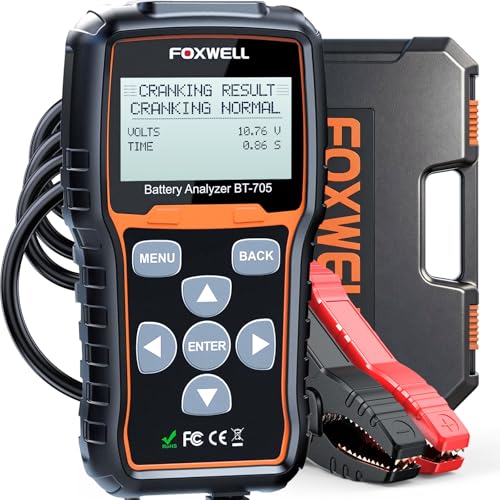
FOXWELL BT705 Battery Analyzer
A thermal printer inside the case produces a slip listing measured CCA, internal resistance and state of health. Shops hand over that same paperwork when a battery goes back under warranty. Bulk is the trade, because the printer and paper roll make this the largest unit in the group.
Pros
- Printed slip supports a battery warranty claim
- Reports internal resistance, not voltage alone
- Lithium sits alongside the lead-acid chemistries
Cons
- Heaviest and largest option here
- Paper rolls need replacing and curl in summer heat
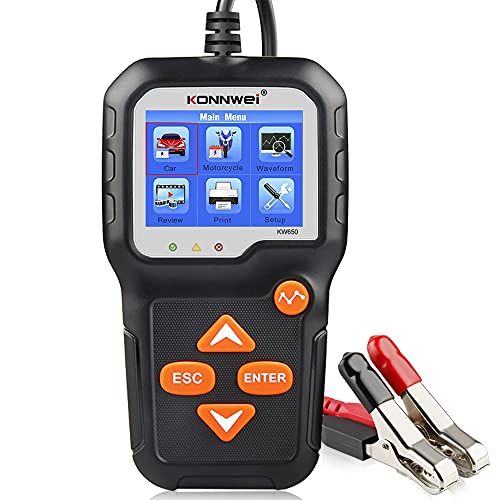
Konnwei KW650 Battery Tester
Six-volt support makes this the choice when a motorcycle, classic car or compact tractor travels with you. On 12V it still runs cranking and charging tests across 100 to 2000 CCA. Fewer buttons than the TOPDON means a roadside check finishes faster.
Pros
- One of the few 6V capable testers in this group
- Simple button layout works with gloves on
- Leads reach most under-seat motorcycle batteries
Cons
- No export or app connection
- Screen washes out in direct sunlight

Autel BT506 Battery and Electrical System Analyzer
Adaptive conductance testing estimates remaining capacity more closely on aged batteries than a basic conductance meter manages. Starter draw and alternator ripple get separate readings, which points at the failing component instead of guessing. Menu depth is the cost, and learning the layout takes longer than a single-purpose handheld.
Pros
- Holds accuracy on batteries several years old
- Separates a starter fault from a charging fault
- Reads lithium packs used in newer vehicles
Cons
- Deeper menus slow a quick roadside check
- Bulkier than the plain handheld testers

Schumacher BT-100 Battery Load Tester
Carbon pile load testing with a colour-banded analog gauge means no firmware, no screen and nothing to pair. Applying a real 100 amp load on 12V exposes a weak cell that conductance meters can score as healthy. Weight and case heat are what that approach costs.
Pros
- Applies a genuine load instead of estimating
- No electronics to fail in heat or cold
- Copper-plated clamps bite through terminal corrosion
Cons
- Around three pounds, too heavy for a glovebox
- Case gets hot during and after a load test
What matters most
What a road trip battery tester needs to do Three readings settle most roadside arguments. Resting voltage shows charge state. Cranking voltage shows whether the battery still delivers current under load. Charging voltage shows whether the alternator replaces what the starter took. Anything reporting only the first number can call a dying battery healthy and leave you stuck that same afternoon. Match the CCA range to the figure printed on your battery label before buying, since a 2000 CCA ceiling matters for diesel trucks and almost nothing else.
Conductance testers vs load testers Handheld units mostly use conductance. A small signal passes through the battery, internal resistance gets measured, and an estimated CCA appears in seconds without heat or thick cables. Load testers such as the Schumacher BT-100 pull a real 100 amp current and watch the voltage sag. Speed, safety and packability all favour conductance for travel. Blunt as it is, a load test still catches the weak cell that conductance sometimes scores as fine, which is why bench techs keep one within reach.
Which testers handle AGM, EFB and lithium batteries Chemistry changes the internal resistance a tester expects, so a wrong menu selection produces a misleading number. Stop-start cars usually run AGM or EFB; leaving the setting on flooded underrates them every time. Lithium iron phosphate packs, now common in RV house banks and some newer vehicles, need a tester that lists lithium outright. FOXWELL’s BT705 and the Autel BT506 do. Simpler units in this group do not. Read the battery label at home rather than on the shoulder of a highway.
Packing size, clamp reach and glovebox storage A tester only helps if it actually travels with you. Motopower’s MP0514A drops into a door pocket, and the ANCEL BA101 lies flat under a seat. Trunk space is the requirement for the FOXWELL BT705 because of its printer. Measure clamp lead length against your own car, since batteries now hide under a cowl, behind a wheel arch or beneath a rear seat. Storing the unit in a soft case keeps bare clamps from shorting against loose tools.
How they stack up
| # | Model | Battery range | Best for | Score | Price |
|---|---|---|---|---|---|
| 1 | TOPDON BT200 Car Battery Tester | 12V, 100 to 2000 CCA | Best overall | 9.4 | Check price |
| 2 | ANCEL BA101 Automotive Battery Load Tester | 12V, 100 to 2000 CCA | Best value | 9.2 | Check price |
| 3 | Motopower MP0514A Digital Battery Tester | 12V systems | Best budget | 9.0 | Check price |
| 4 | FOXWELL BT705 Battery Analyzer | 12V and 24V, 100 to 2000 CCA | Best for printed records | 8.7 | Check price |
| 5 | Konnwei KW650 Battery Tester | 6V and 12V, 100 to 2000 CCA | Best for motorcycles and 6V batteries | 8.5 | Check price |
| 6 | Autel BT506 Battery and Electrical System Analyzer | 6V and 12V, 100 to 2000 CCA | Best for electrical system diagnosis | 8.3 | Check price |
| 7 | Schumacher BT-100 Battery Load Tester | 6V and 12V systems | Best analog backup | 8.0 | Check price |
Questions worth asking
How do you tell if it is the battery or the alternator?
Two readings answer it. Engine off, a healthy 12V battery rests near 12.6 volts. Start up and read again; a working alternator should land between roughly 13.8 and 14.7 volts. Low at rest but normal running points at the battery. Normal at rest and flat while running points at the charging system.
What CCA reading means a battery needs replacing?
Compare measured CCA against the rating stamped on the label. Most testers flag replacement once measured capacity drops below about 60 to 70 percent of that figure. A pack reading well under its label while holding 12.6 volts at rest is living on borrowed time, and the first cold morning usually ends it.
Can a battery tester check AGM batteries?
Yes, as long as AGM gets selected in the menu first. TOPDON BT200, ANCEL BA101, FOXWELL BT705, Konnwei KW650 and Autel BT506 all list AGM support. Leaving the setting on flooded makes a healthy AGM battery look weak and sends you shopping early.
Do battery testers work on lithium car batteries?
Only some do. FOXWELL’s BT705 and the Autel BT506 name lithium in their specifications. Conductance testers built purely for lead-acid return meaningless numbers on a lithium iron phosphate pack, so confirm support rather than assuming it.
TOPDON BT200 vs ANCEL BA101: which is better for a road trip?
Choose the BT200 for saved reports and 24V coverage, which matter for a truck or motorhome. Choose the BA101 to skip pairing entirely, since it runs straight off the clamps with a backlit screen. Both share the same 100 to 2000 CCA window, so accuracy is not the deciding factor.
Is it safe to test a completely dead battery?
Conductance testers generally need about 7 volts just to power up, so charge first and test afterwards. Swollen cases, cracks or leaking electrolyte change the answer entirely. Replace a battery in that condition instead of clamping onto it.
Which battery tester is best for an RV?
Look for 12V and 24V coverage plus explicit lithium support, since many house banks now run lithium iron phosphate. FOXWELL’s BT705 and the TOPDON BT200 both qualify. A printed slip from the BT705 also helps when a house bank is still under warranty.
How often should you test a car battery?
Twice a year covers most drivers, plus once before any long drive. Autumn testing matters most, because cold raises the current a starter demands while cutting what the battery can supply. Past three years of service, check every few months.
Is a portable battery tester worth carrying for one trip?
For a single short drive, jumper cables or a jump pack do more good. Value shows up on repeat trips, on vehicles past three years of battery age, and anywhere a tow is expensive or slow. Knowing which component failed also stops you replacing a good battery when the alternator was the problem.
Our pick
Pack the TOPDON BT200 if your routes run long, because one sequence separates a tired battery from a failing alternator and keeps the result on your phone for the next shop visit. Drivers who never want to pair anything should carry the ANCEL BA101 instead, which runs the same core tests from its own backlit screen. Riders and classic car owners need 6V coverage, and that points at the Konnwei KW650.
Tony Russo
Tony trained as an automotive technician and spent years in service and parts retail before moving into writing. He focuses on garage tools, car care products and accessories from a hands-on maintenance perspective.