Heavy Duty Battery Testers for 12V and 24V Shop Work
ANCEL BST500 covers the most shop work, reading 12V and 24V systems to 2000 CCA and printing a slip on the spot. TOPDON BT600 shows the same verdict on a color screen for customers. Schumacher BT-100 still matters where a carbon pile load test settles a warranty claim.
ANCEL BST500 fits most independent shops, since 12V and 24V coverage plus a 2000 CCA ceiling handles cars, light trucks and dual battery rigs. A thermal printer in the housing puts the result straight into the job file. Its monochrome screen is the weak point under a lift light. Counter facing shops should take the color display on the TOPDON BT600 instead.
Battery faults hide well. A shorted cell can read 12.4 volts at rest and still fail on the first cold morning. Conductance testers estimate health from a small signal, while carbon pile units apply a genuine load. We compared voltage support, CCA range, chemistry coverage for AGM, EFB and gel, cranking and charging tests, clamp construction and record keeping. Reports from independent shops on clamp wear and repeat readings decided the order.
The best picks, ranked

ANCEL BST500 Battery Load Tester
Three tests cover what a shop actually bills for: battery health, cranking voltage drop and charging output. Coverage runs across 12V and 24V systems up to 2000 CCA, so a van and a box truck both fit. A thermal printer inside the housing produces a slip for the job file.
Pros
- 24V support covers commercial and dual battery rigs
- Prints a result without pairing a phone or laptop
- Reads AGM, EFB, gel and flooded chemistries
Cons
- Monochrome screen goes dim under overhead lights
- Thermal rolls are a consumable to keep stocked

TOPDON BT600 Battery Tester
Results land on a color display as pass, marginal or replace, which shortens the conversation at the counter. Coverage spans 12V and 24V batteries to 2000 CCA, plus cranking and charging analysis. An integrated printer repeats that verdict on paper for the invoice.
Pros
- Color verdicts make sense to customers immediately
- Handles flooded, AGM, EFB, gel and start stop batteries
- Cranking and alternator ripple checks run in one sequence
Cons
- Larger body is awkward in a tight engine bay
- Screen washes out working outdoors in sun

Autel MaxiBAT BT506 Battery and Electrical System Analyzer
Adaptive conductance replaces a fixed algorithm, which steadies readings on aged batteries. Testing extends past the battery to starter draw and alternator output, so the real fault surfaces. Bluetooth sends the report to a phone or a MaxiSys tablet instead of thermal paper.
Pros
- Separates a tired battery from a failing starter
- Digital reports attach to a customer record
- Runs standalone or alongside Autel diagnostic tablets
Cons
- No onboard printer, so paper records need a phone
- App pairing adds a step on a busy bay
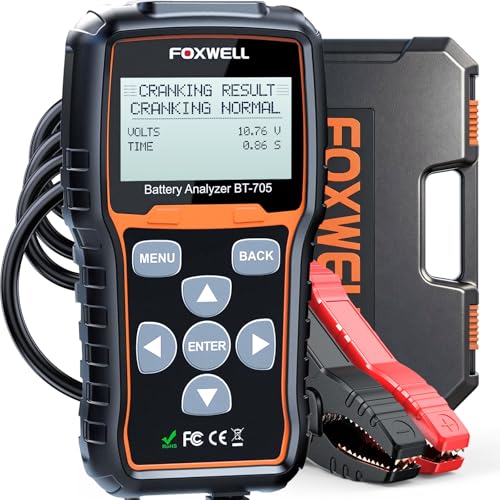
FOXWELL BT705 Battery Analyzer
A 3000 CCA ceiling pulls large commercial batteries into range, the widest span in this group. Support for 12V and 24V systems plus cranking, charging and ripple tests makes it a full bench tool rather than a quick checker. Copper plated clamps bite through the light corrosion common on truck terminals.
Pros
- Highest CCA ceiling here at 3000
- Replaceable clamp cable extends the tool’s working life
- Ripple test flags a failing alternator diode
Cons
- Menu navigation is slower than a one button tester
- Printing requires the separate printer model in the range

Schumacher BT-100 Battery Load Tester
A carbon pile draws a genuine 100 amps through the battery while an analog needle shows the voltage sag. Warranty processes still accept that proof when a conductance number looks borderline. Support for 6V keeps tractors, classics and older yard equipment in scope.
Pros
- Applies a real load instead of estimating one
- 6V range covers farm equipment and classic cars
- Nothing to charge, update or restock
Cons
- Load bank heats up and needs a pause between tests
- No digital record, cranking test or 24V support

Clore Automotive SOLAR BA327 Battery Tester
Documentation drives this design. An integrated printer and test codes tie each result to one specific battery, which matters on a fleet contract. Range starts at 40 CCA for powersport batteries and climbs to 2000 for light commercial units.
Pros
- 40 CCA floor suits motorcycle and ATV batteries
- Printed test codes back up warranty claims
- Short keypad sequence limits operator error
Cons
- Battery test itself covers 12V units only
- Monochrome display shows less detail than color rivals
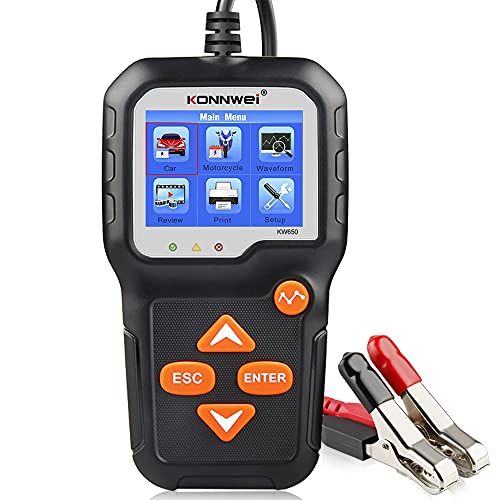
KONNWEI KW600 Battery Tester
One job, done fast: check a 12V battery at the roadside or the parts counter. Readings cover voltage, CCA from 100 to 2000, internal resistance and state of health. Power comes from the battery under test, so nothing needs charging before you use it.
Pros
- Single screen verdict with no menu digging
- Needs no internal battery or charging
- Fits a service truck door pocket
Cons
- No 24V support, so commercial vehicles are out
- Short fixed cable limits reach on truck terminals
What matters most
What separates a shop tester from a voltmeter Resting voltage reports charge state, nothing more. A battery with one shorted cell can read 12.4 volts and still fail to crank on a cold morning. Shop grade units add a CCA measurement, a cranking voltage drop reading and an alternator output check. Together those three point at the fault instead of the symptom. Chemistry selection counts just as much, since start stop cars run AGM and EFB batteries that a generic algorithm misjudges. Clamp jaws are the underrated spec here. Worn teeth cause more bad readings than the electronics ever do.
Conductance testing compared with a carbon pile load test Conductance units send a small signal through the battery and calculate health from the response. ANCEL BST500 and Autel MaxiBAT BT506 both work that way. Speed, safety on a flat battery and repeatable numbers are the payoff. Carbon pile testers such as the Schumacher BT-100 pull a real 100 amps and show the sag on a needle, which some warranty processes still ask for. Heat is the catch, because a load bank needs a cooling pause between runs. Plenty of shops keep both: conductance for volume work, the load bank for disputes.
Testing 24V systems and commercial batteries Heavy duty usually means two 12V batteries wired in series. A 12V only tester cannot read that pair as one system. Units listing 24V support, including the FOXWELL BT705 and TOPDON BT600, test the pack first and then each battery to find the weak one. CCA ceiling matters here too. Large commercial batteries pass 2000 CCA, which is where the 3000 CCA range on the BT705 pays off. Cable reach becomes a practical problem when terminals sit low behind a step. KONNWEI KW600 is right for passenger cars and wrong for a fleet bay.
Printing, records and warranty claims A printed slip ends most arguments. Customers who read a replace verdict on paper stop pushing back, and manufacturers increasingly want a test code before approving an exchange. Onboard printers on the BST500, BT600 and SOLAR BA327 keep that whole process inside the bay. Thermal rolls become a restock item in return. Autel trades paper for a digital file that attaches to a customer record, which suits shops running management software. Log the battery date code alongside every test, because repeat failures only show up when the history is traceable.
The lineup, side by side
| # | Model | Voltage support | Best for | Score | Price |
|---|---|---|---|---|---|
| 1 | ANCEL BST500 Battery Load Tester | 12V and 24V systems | Best overall | 9.4 | Check price |
| 2 | TOPDON BT600 Battery Tester | 12V and 24V systems | Best for customer facing shops | 9.2 | Check price |
| 3 | Autel MaxiBAT BT506 Battery and Electrical System Analyzer | 6V and 12V batteries, 12V and 24V systems | Best for full system diagnosis | 9.0 | Check price |
| 4 | FOXWELL BT705 Battery Analyzer | 12V and 24V systems | Best value | 8.8 | Check price |
| 5 | Schumacher BT-100 Battery Load Tester | Carbon pile load, 100 amp | Best true load tester | 8.6 | Check price |
| 6 | Clore Automotive SOLAR BA327 Battery Tester | 12V batteries and 12V or 24V charging systems | Best for fleet record keeping | 8.3 | Check price |
| 7 | KONNWEI KW600 Battery Tester | 12V batteries only | Best budget | 8.0 | Check price |
Questions worth asking
What is the best battery tester for a professional mechanic?
For general shop work, a 12V and 24V conductance tester with a printer covers the widest set of jobs. ANCEL BST500 and TOPDON BT600 both fit that description and reach 2000 CCA.
How do you test a battery that is not fully charged?
Conductance testers still return a usable health reading on a partly discharged battery, though accuracy improves above roughly 12.4 volts. Carbon pile load tests should only run on a charged battery.
Can a 12V battery tester check a 24V truck system?
No. Connecting a 12V only unit to a 24V system risks damage and returns no valid result. Use a tester listing 24V support, then check each battery separately to find the failing one.
Is a carbon pile load tester still worth buying?
Yes for warranty disputes and older equipment, since it proves performance under a real 100 amp draw. Day to day checks go faster with a conductance unit such as the BST500.
Do battery testers work on AGM and lithium batteries?
AGM, EFB and gel are covered by every digital tester here once the correct chemistry is selected. Lithium iron phosphate packs need a tester that specifically lists LiFePO4, because lead acid conductance algorithms do not apply.
What CCA reading means a battery should be replaced?
Many shops replace once measured CCA drops below roughly 70 percent of the rated value and cranking voltage runs low. Compare against the rating printed on the battery label rather than a generic figure.
Which heavy duty battery testers print results?
ANCEL BST500, TOPDON BT600 and Clore Automotive SOLAR BA327 carry integrated printers. Autel MaxiBAT BT506 sends its report to a phone or tablet instead.
Can a battery tester diagnose a bad alternator?
Most shop units run a charging system test covering output voltage and ripple. Excess ripple usually points at a failed diode, and both the FOXWELL BT705 and Autel BT506 report it directly.
ANCEL BST500 vs TOPDON BT600: which suits a small shop?
Choose the BST500 when tests stay in the bay and the slip goes in a job file. Go with the BT600 if customers see the screen, because a color pass or replace verdict explains itself.
How often should a shop test customer batteries?
A quick conductance check at every service visit catches decline before a no start call. Batteries past three years and any vehicle with a recent jump start deserve a full cranking and charging test.
The verdict
ANCEL BST500 is the tester to buy for a general repair bay, because 24V coverage, a 2000 CCA ceiling and an onboard printer handle almost everything that rolls through the door. Shops that show results to customers should spend the extra on the TOPDON BT600 for its color verdict screen. Fleet and truck work leans toward the FOXWELL BT705 and its 3000 CCA range. Keep a Schumacher BT-100 on the bench regardless, since warranty disputes still get settled by a real load.
Tony Russo
Tony trained as an automotive technician and spent years in service and parts retail before moving into writing. He focuses on garage tools, car care products and accessories from a hands-on maintenance perspective.