How to Choose Gesso That Won’t Crack on Canvas
Liquitex Basics Gesso primes most canvas and wood surfaces with smooth, flexible coverage. Golden Acrylic Gesso lays denser coats for textured or professional work. Daler-Rowney System3 fits classroom budgets. Coverage and dry time vary more than quality across these seven.
Liquitex Basics Gesso covers most canvas and wood priming jobs, drying smooth in about 30 minutes with gallon sizing for repeat projects, though raw canvas often needs two coats. Painters prepping heavily textured work get denser coverage from Golden’s professional formula, and classrooms save money with Daler-Rowney’s student-grade System3.
Gesso brands differ mainly in pigment density, dry time, and bottle size rather than dramatic formula changes, so side-by-side comparison is the fastest way to choose. We compared base formula, dry time, available sizes, and compatible surfaces across student and professional-grade options based on listed specifications.
Before you buy
What gesso actually does Raw canvas or wood soaks up paint until gesso seals the surface first. It also adds tooth, a slight texture that helps the first layer grip. Acrylic gesso works under both acrylic and oil paint, while oil-based grounds only suit oil work. Drying time across most bottles falls between 30 minutes and an hour per coat.
Choosing between student and professional grades Cost per ounce drops with student-grade gesso like Daler-Rowney’s System3, though pigment load drops too. Golden’s professional formula needs fewer coats for full opacity, which matters most on large canvases. Many small projects cost less to prime with student grades instead. Denser, more consistent coverage from professional lines pays off for exhibition or gallery work.
Priming canvas vs wood or paper Filling canvas weave takes enough gesso without stiffening the fabric too much to stretch. Wood panels absorb less, so a single coat often blocks the surface fully. Paper takes gesso well for mixed-media work but can warp under a coat applied too thick. Plaster joins canvas and wood on U.S. Art Supply’s list of compatible surfaces, useful for muralists.
How many coats and how much gesso to buy Cracking risk drops when two thin coats replace one thick coat, since canvas still needs to flex. A 16-ounce bottle covers roughly two to three 16×20 canvases across two coats. Gallon sizes like U.S. Art Supply’s save money for muralists or classrooms priming dozens of surfaces. Full drying before sanding keeps the final surface smoother.
What we recommend
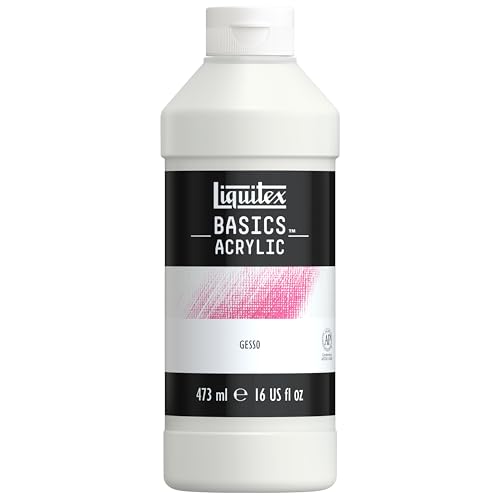
Liquitex Basics Gesso
This gesso lays down a smooth, absorbent surface for both acrylic and oil paint. It dries to the touch in about 30 minutes and stays flexible enough for stretched canvas without cracking. Larger 16-ounce jugs and up cover several full-size canvases per bottle.
Pros
- Sands smooth for detailed underpainting
- Works under both acrylic and oil paint
- Available in a gallon size for large projects
Cons
- Thinner than some professional-grade gessoes
- May need two coats on raw canvas

Golden Acrylic Gesso
Golden formulates this gesso with a higher pigment load than student-grade brands, giving denser coverage in fewer coats. Painters building texture with a knife or brush find it holds tooth well after drying. Professional and exhibition-bound work suits it more than casual crafting.
Pros
- Dense coverage needs fewer coats
- Holds texture from brush or palette knife
- Consistent formula across batch sizes
Cons
- Higher cost per ounce than student brands
- Slower dry time than lighter formulas

Arteza Gesso Primer
A 2-pack of 16-ounce bottles ships with this gesso, aimed at painters covering multiple canvases per project. Its smooth, non-toxic acrylic formula is rated for canvas, wood, and paper. Two thin coats typically block raw canvas texture fully.
Pros
- Two-bottle pack stretches further per project
- Non-toxic formula suits shared studio spaces
- Smooth finish reduces sanding time
Cons
- Sold only in the 2-pack size
- Thinner consistency needs careful layering

U.S. Art Supply White Gesso
A full gallon jug ships with this gesso, suited to classrooms and muralists priming large surfaces. The formula stays workable long enough to cover a full canvas before it starts to set. Cost per ounce runs lower than boutique brands at this volume.
Pros
- Gallon size lowers cost per project
- Covers plaster and wood in addition to canvas
- Long open time before it sets
Cons
- Gallon size is heavy and bulky to store
- Consistency varies slightly by batch

Winsor & Newton Galeria Gesso
Winsor & Newton primes canvas here with a formula matched to its own Galeria acrylic paint range. It brushes on evenly without pooling at canvas edges. Painters layering thin acrylic washes over it report consistent absorbency across the surface.
Pros
- Formulated to pair with Galeria acrylic paints
- Even brushing without edge pooling
- Consistent absorbency for thin washes
Cons
- Metric sizing is smaller than US quart options
- Limited to two bottle sizes

Liquitex Professional Gesso
A thicker body sets this gesso apart from the Basics line, built for painters prepping heavily textured surfaces. It fills minor canvas weave before the first paint layer goes down. Flexibility holds up on both stretched canvas and rigid panels.
Pros
- Thicker body fills canvas weave in fewer coats
- Flexible enough for stretched canvas
- Matches Liquitex Professional paint line
Cons
- Thicker consistency needs a stiffer brush
- Longer dry time between coats

Daler-Rowney System3 Gesso
Daler-Rowney markets this gesso toward students and classroom settings with a straightforward, budget formula. It applies smoothly with a standard bristle brush and dries fast enough for same-day layering. Bottle sizes suit smaller individual projects rather than bulk priming.
Pros
- Budget-friendly for classroom or student use
- Fast dry time allows same-day painting
- Smooth application with standard brushes
Cons
- Smaller bottle sizes run out quickly
- Less pigment density than professional lines
The lineup, side by side
| # | Model | Base | Best for | Score | Price |
|---|---|---|---|---|---|
| 1 | Liquitex Basics Gesso | Acrylic polymer | Best overall | 9.4 | Check price |
| 2 | Golden Acrylic Gesso | Acrylic polymer, high pigment load | Best for professional work | 9.1 | Check price |
| 3 | Arteza Gesso Primer | Acrylic polymer | Best value | 8.9 | Check price |
| 4 | U.S. Art Supply White Gesso | Acrylic polymer | Best budget | 8.6 | Check price |
| 5 | Winsor & Newton Galeria Gesso | Acrylic polymer | Best for canvas priming | 8.4 | Check price |
| 6 | Liquitex Professional Gesso | Acrylic polymer, thick body | Best for heavy texture | 8.2 | Check price |
| 7 | Daler-Rowney System3 Gesso | Acrylic polymer | Best for beginners | 8.0 | Check price |
Questions worth asking
What is gesso used for?
Gesso seals absorbent surfaces like canvas, wood, or paper before paint goes on. It stops paint from soaking through the fabric and adds tooth, a slight texture that helps the first layer grip. Most gesso is white, though clear and colored versions exist for specific effects.
Can you paint over gesso with oil paint?
Yes. Acrylic gesso, used on nearly every product here, cures into a flexible film that both acrylic and oil paint can sit on top of. Oil paint should never go directly under acrylic gesso, since oil-based layers beneath acrylic can crack over time.
How many coats of gesso does canvas need?
Manufacturer instructions across brands like Liquitex and Winsor & Newton call for two coats to block raw canvas weave fully. A single thick coat risks cracking once the canvas flexes on its stretcher bars. Light sanding between coats keeps the final surface smoother for detailed work.
Is gesso the same as primer?
Gesso is a type of primer specific to painting, though the word originally described a chalk-and-glue ground used since the Renaissance. Modern acrylic gesso, like the products here, replaces that traditional recipe with acrylic polymer and calcium carbonate.
Can gesso be used on wood?
Yes, most acrylic gesso formulas list wood panels as a compatible surface, including Liquitex Professional and U.S. Art Supply. Wood absorbs less than canvas, so a single coat often seals it fully. Sanding the wood first helps the gesso grip evenly.
How long does gesso take to dry?
Most acrylic gesso dries to the touch within 30 minutes to an hour, though full curing takes longer. Golden’s professional formula runs closer to an hour due to its denser pigment load. Humidity and coat thickness both slow drying time.
Do you need to sand gesso before painting?
Light sanding after the gesso dries smooths brush marks and canvas texture for detailed painting. Looser, textured styles where visible brushwork adds character don’t require it. Fine-grit sandpaper, around 220 grit, avoids removing too much of the primed surface.
What is the difference between white and clear gesso?
White gesso is the standard choice, giving a bright, neutral base that keeps paint colors true. Clear or colored gesso skips that opacity, letting canvas texture or an underlying tone show through. None of the seven gessoes compared here ship in a clear formula.
Our pick
Liquitex Basics Gesso covers the most painters well, with a smooth finish and gallon sizing for repeat projects. Painters prepping textured or exhibition-bound canvases get more from Golden’s denser professional formula, while classrooms and students save money with Daler-Rowney’s System3. Skip the Arteza 2-pack if a single large canvas needs priming, since its bottles run smaller than a quart each.
Jake Monroe
Jake worked as a residential contractor for over a decade before shifting to full-time writing. He evaluates power tools, hand tools and workshop gear through the lens of someone who has actually used them on job sites, not just read the box.


