Airlock Lids That Keep Mason Jar Ferments Safe
Masontops’ Pickle Pipe is the simplest airlock lid here, flexing open under pressure to vent gas without water or moving parts. Kraut Source’s stainless lid follows for a one-piece metal build, and Fermentools’ kit suits anyone who also wants a weight included.
Masontops’ Pickle Pipe earns the top spot for turning airlock venting into a single silicone piece with nothing to fill, spill, or lose.
We compared venting mechanism, jar mouth size, material, and owner reports on seal reliability to rank these seven kits, since none publish independent pressure-rating data.
How to choose
What an airlock lid does during fermentation Fermenting vegetables release carbon dioxide as bacteria convert sugars into acid. An airlock lid lets that gas escape without letting outside air, mold spores, or fruit flies back in. Without one, batches either need daily manual burping or risk a lid popping off from built-up pressure.
Waterless valves versus water-filled airlocks Waterless designs like the Pickle Pipe flex open under pressure and reseal on their own, with nothing to fill or spill. Water-filled or bubbling airlocks, more common on homebrew-style kits, need periodic water top-offs but make gas release visible as bubbles.
Matching lid style to jar mouth size Wide mouth mason jars have the widest selection of airlock lids, since most brands design for that size first. Regular mouth jars need a lid specifically listed for that size, or an adapter ring, since a wide mouth lid will not seal on a narrower opening.
Who should skip an airlock lid entirely Anyone fermenting in a large crock rather than mason jars does not need this style of lid at all, since crocks use their own water-seal rim. Buyers making only one or two small batches a year may also find manual burping with a loose-fitting lid simpler than buying a dedicated kit.
The top picks, ranked

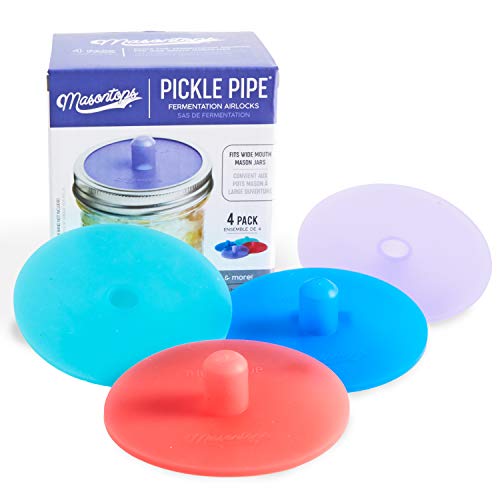
Masontops Pickle Pipe Waterless Fermentation Airlock
The Pickle Pipe is a silicone disk that flexes outward to release built-up gas and reseals itself, so there is no water chamber to fill or spill. It snaps onto a standard wide mouth mason jar ring.
Pros
- No water to refill or spill during fermentation
- Simple one-piece design with nothing to lose
- Fits standard wide mouth canning rings
Cons
- Regular mouth jars need a separate adapter
- Silicone can develop odor if not cleaned between batches

Easy Fermenter Wide Mouth Lid Kit
This kit pairs a vented lid with a glass weight, so buyers get both pieces needed to start a batch in one order. The lid uses a built-in grommet airlock rather than a separate pump.
Pros
- Includes a weight, skipping a second purchase
- Covers four jars in one kit for batch fermenting
- Grommet airlock vents steadily without manual pumping
Cons
- Plastic lid shows scratches sooner than metal options
- Grommet needs occasional replacement after heavy use

Kraut Source Fermentation Lid
Kraut Source replaces the usual plastic lid with a stainless steel disk that has a built-in trough airlock, so there is no separate grommet piece to track. It also doubles as a tamper for packing down the ferment.
Pros
- All-metal build avoids plastic odor absorption over time
- Built-in tamper feature packs vegetables below the brine
- Trough airlock is easy to see is working at a glance
Cons
- Higher cost per unit than multi-pack plastic kits
- Trough needs periodic water top-offs
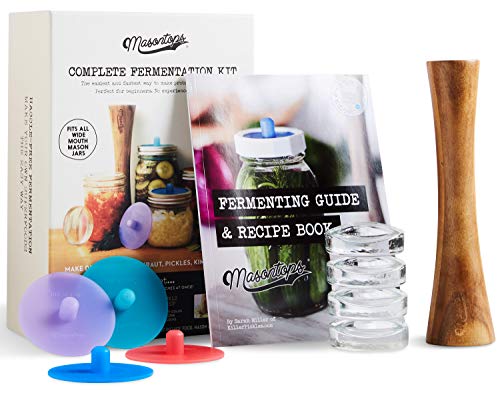
Fermentools Complete Fermenting Kit
Fermentools bundles a grommet lid, a bubbling airlock, and a glass weight, covering every piece a first batch needs. The airlock is the same style used on homebrewing carboys, adapted for mason jars.
Pros
- Bundles every piece needed for a first batch
- Bubbling airlock makes gas venting visible
- Familiar design for anyone who has homebrewed before
Cons
- Covers one jar per kit, so batches need multiple orders
- Grommet seal can loosen and needs occasional checking
Ball Fermentation Lids
Ball, long known for canning jars, makes a vented lid with a built-in one-way valve that screws onto its own wide mouth jars without an adapter. Three lids ship per pack.
Pros
- Guaranteed fit on Ball’s own wide mouth jars
- Three lids cover multiple batches without reordering
- Valve requires no water or manual venting
Cons
- Fit on non-Ball jars can vary slightly
- No weight included, so one is needed separately

FARMcurious Fermentation Lids
FARMcurious makes a simple plastic lid with a silicone grommet airlock, aimed squarely at home fermenters making kraut and kimchi in small batches. The lid fits both wide and regular mouth jars depending on the version ordered.
Pros
- Separate regular mouth version avoids needing an adapter
- Grommet seal is simple to clean between batches
- Priced for buyers starting with just a jar or two
Cons
- Wide and regular mouth are sold as separate listings
- Plastic build feels less durable than metal alternatives
Cultures for Health Fermentation Lid Kit
Cultures for Health, known mainly for starter cultures, sells this lid kit with printed fermentation guidance aimed at first-time buyers. The grommet-style airlock matches the mechanism used across most of this list.
Pros
- Printed guidance helps first-time fermenters get started
- Grommet airlock is straightforward to maintain
- Brand recognition from its broader fermentation product line
Cons
- No weight included in the base kit
- Plastic lid is less durable than stainless options
The lineup, side by side
| # | Model | Jar Fit | Best for | Score | Price |
|---|---|---|---|---|---|
| 1 | Masontops Pickle Pipe Waterless Fermentation Airlock | Wide mouth mason jar | Best overall | 9.3 | Check price |
| 2 | Easy Fermenter Wide Mouth Lid Kit | Wide mouth mason jar | Best starter kit with weight included | 9.0 | Check price |
| 3 | Kraut Source Fermentation Lid | Wide and regular mouth with adapter | Best metal build | 8.9 | Check price |
| 4 | Fermentools Complete Fermenting Kit | Wide mouth mason jar | Best all-in-one kit | 8.8 | Check price |
| 5 | Ball Fermentation Lids | Ball wide mouth mason jar | Best from a canning-brand name | 8.6 | Check price |
| 6 | FARMcurious Fermentation Lids | Wide or regular mouth, version dependent | Best for small-batch home fermenters | 8.5 | Check price |
| 7 | Cultures for Health Fermentation Lid Kit | Wide mouth mason jar | Best for learning the basics | 8.7 | Check price |
Common questions
What does a fermentation airlock lid do?
It vents carbon dioxide produced during fermentation while blocking outside air, mold spores, and insects from entering the jar.
Can you use a regular mason jar lid instead of an airlock lid?
You can, but it needs to be loosened daily to release gas, or pressure can build up and push the lid off.
Do airlock lids work on regular mouth jars?
Some do, but most are designed for wide mouth jars first; check the listing for a regular mouth version or adapter.
How often do you need to check an airlock lid?
Waterless valve lids need little checking; water-filled airlocks should be topped off every few days as the water evaporates.
Is a waterless airlock better than a water-filled one?
Waterless valves need less maintenance, but water-filled airlocks make active gas venting visible, which some fermenters prefer.
Do fermentation airlock lids need a weight too?
Most ferments also need a weight to keep vegetables submerged under brine; some kits include one, others sell it separately.
Can airlock lids be reused for multiple batches?
Yes, after washing; silicone and stainless versions hold up longer than thin plastic grommet seals over repeated use.
Why is my airlock lid not venting any gas?
A dry seal, a clogged grommet, or a batch that has not yet started active fermentation can all cause this; check the seal first.
Do these lids fit jars from brands other than the jar they are sold with?
Most wide mouth lids fit any standard wide mouth canning jar, but fit can vary slightly between jar brands.
Final word
Masontops’ Pickle Pipe is the easiest recommendation for most home fermenters, since it needs no water and reseals on its own after venting. Anyone who wants a metal build that doubles as a tamper should choose Kraut Source instead, and first-time fermenters who want everything in one box should start with Fermentools’ complete kit.
Dana Whitfield
Dana spent eight years buying and merchandising for a regional kitchenware retailer before moving into editorial work. She has handled thousands of SKUs across cookware, small appliances and kitchen organization, and focuses on the practical differences that matter once a product is actually in daily use.


