Which Drywall Knife Gives the Smoothest Seams?
Warner’s 6-Inch ProGrip Stainless Steel Joint Knife handles most taping and patch work, backed by the Marshalltown 8-Inch DuraSoft Joint Knife for value and the Goldblatt Stainless Steel Corner Finishing Knife for inside corners. Blade flex and width separate these three, while the rest fill specific gaps like wide finishing or detail patches.
Warner’s 6-Inch ProGrip Stainless Steel Joint Knife suits DIYers and pros running taping and patch jobs, thanks to a flexible stainless blade and a non-slip grip. Six inches stays too narrow for wide finish coats, so bigger jobs need a second blade.
We compared blade width, steel type, handle material and flex across listings from Warner, Wal-Board Tools, Marshalltown, HYDE, Goldblatt, Bon Tool and Kraft Tool, then weighed owner feedback on edge retention and rust resistance.
The top picks, ranked

Warner 6-Inch ProGrip Stainless Steel Joint Knife
This Warner knife pairs a 6 inch stainless blade with a ProGrip rubber over polypropylene handle. Wet hands keep their grip through long taping sessions instead of sliding on the handle. Medium flex suits first coats over tape, and owners report the beveled edge stays smooth after repeated compound scraping.
Pros
- Non-slip grip holds steady through long taping sessions
- Stainless blade resists rust from wet joint compound
- Medium flex works for both taping and light finish coats
Cons
- Six inches falls short for wide finish coats
- Blade corners can leave lines without careful feathering

Marshalltown 8-Inch DuraSoft Joint Knife
Marshalltown built this 8 inch knife around a DuraSoft cushioned handle. Hand fatigue drops noticeably during long fill coat sessions compared to a hard plastic grip. High carbon steel holds an edge well but needs a quick wipe to avoid rust spots, and the width sits between a taping knife and a finishing knife for daily use.
Pros
- DuraSoft grip cuts hand fatigue on long jobs
- Width bridges fill coats and light finish work
- Costs less than most premium stainless models
Cons
- Carbon steel needs drying and light oiling to prevent rust
- Stiffer flex takes more practice to feather edges
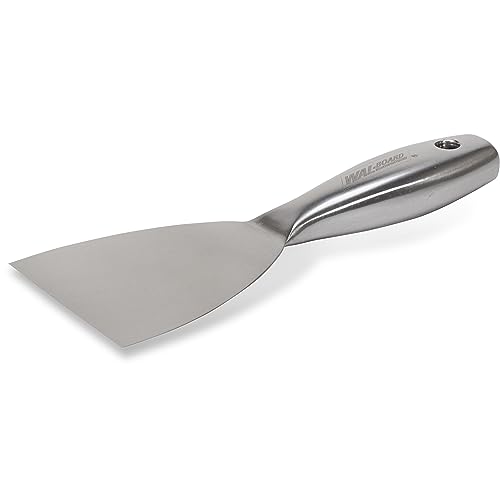
Wal-Board Tools 10-Inch Stainless Steel Joint Knife
Wal-Board Tools mounts a 10 inch stainless blade on a traditional wood handle riveted through a tapered tang. Extra width bridges fill and finish coats over butt joints and larger patches. Stiffer flex helps lay compound flat across wide spans without extra pressure.
Pros
- Wide blade covers butt joints in fewer passes
- Wood handle holds up through repeated washdowns
- Stainless blade will not rust between jobs
Cons
- Stiffer flex feels heavy for detail or corner work
- Wood handle can loosen after years of heavy use

HYDE Tools 6-Inch Black and Silver Stainless Steel Joint Knife
HYDE’s Black and Silver line puts a 6 inch stainless blade on a riveted nylon handle. Pricing sits below most stainless competitors, since thinner blade stock keeps manufacturing cost down. Flex still handles basic taping and patch work, making it a solid first knife or backup.
Pros
- Low price makes it an easy starter knife
- Stainless blade resists corrosion in storage
- Light weight reduces wrist strain on small jobs
Cons
- Thinner blade stock flexes more than premium models
- Nylon handle feels less durable under daily job site use

Goldblatt Stainless Steel Corner Finishing Knife
Goldblatt shapes this stainless blade into a fixed 90 degree angle for inside corners. A wood handle anchors the tool and balances weight during overhead corner work. One pass finishes tape and mud where a flat blade usually needs two.
Pros
- Fixed angle keeps corners consistently straight
- Finishes inside corners in a single pass
- Stainless blade wipes clean without rust spots
Cons
- Only useful for inside corners, not flat seams
- Fixed angle cannot adjust for out of square walls

Bon Tool 4-Inch Stainless Steel Putty Knife
Bon Tool’s 4 inch blade suits small patches, screw dimples and touch up work rather than full length seams. A stiff stainless blade paired with a wood handle gives precise control in tight spots like corners and outlets. Its small size also works for scooping compound from a bucket into a mud pan.
Pros
- Compact size fits tight areas like outlets and corners
- Stiff blade gives precise control on small patches
- Doubles as a scooping tool for loading a mud pan
Cons
- Too small for taping or finishing full length seams
- Not a substitute for a wider finishing knife

Kraft Tool 12-Inch Stainless Steel Mud Pan
This Kraft Tool pan holds and carries joint compound while a knife loads from it. Rounded edges on the 12 inch stainless body let a blade scrape clean without catching. It pairs well with any knife above, since a wide blade needs constant reloading during long runs.
Pros
- Rounded edges let a blade scrape clean every time
- Stainless body resists dents and rust from wet mud
- Grip rail makes one handed carrying easier
Cons
- Adds no value without a separate joint knife
- Stainless surface can get slippery when compound splashes over the side
How they compare
| # | Model | Blade Width | Best for | Score | Price |
|---|---|---|---|---|---|
| 1 | Warner 6-Inch ProGrip Stainless Steel Joint Knife | 6 inches | Best overall | 9.4 | Check price |
| 2 | Marshalltown 8-Inch DuraSoft Joint Knife | 8 inches | Best value | 9.1 | Check price |
| 3 | Wal-Board Tools 10-Inch Stainless Steel Joint Knife | 10 inches | Best for wide finishing coats | 8.9 | Check price |
| 4 | HYDE Tools 6-Inch Black and Silver Stainless Steel Joint Knife | 6 inches | Best budget | 8.6 | Check price |
| 5 | Goldblatt Stainless Steel Corner Finishing Knife | Fixed angle corner blade | Best for inside corners | 8.4 | Check price |
| 6 | Bon Tool 4-Inch Stainless Steel Putty Knife | 4 inches | Best for small repairs and detail work | 8.2 | Check price |
| 7 | Kraft Tool 12-Inch Stainless Steel Mud Pan | 12 inches | Best for loading and carrying compound | 8.0 | Check price |
What to look for
What to look for in a drywall knife Blade width decides how much compound spreads in a single pass. Handle material affects grip once hands turn slick with mud. Flex matters too: a stiffer blade lays compound flatter across wide areas, while a softer blade feathers edges more easily. Stainless steel resists rust between jobs, though some finishers still prefer carbon steel for its stiffer feel. Rivets or a full tang keep the blade from working loose during repeated bending against a wall.
Matching blade width to each coat Most drywall jobs move through three coats, each suited to a different width. A 4 to 6 inch knife embeds tape and fills screw dimples. Fill coats usually call for an 8 to 10 inch blade, wide enough to bridge the first coat without ridges. Final finish coats often need a 10 to 14 inch blade to feather edges invisibly into the wall. A mud pan speeds up loading a wide blade, since scooping straight from a bucket slows long passes. Two or three widths cover most residential patch and repair work without buying every size on the market.
Stainless steel vs carbon steel blades Stainless steel blades resist rust even when left damp overnight, useful on humid job sites. Carbon steel blades, like the one on the Marshalltown DuraSoft knife, often hold a sharper edge but need a quick wipe and occasional light oiling. Weight differs slightly too, since carbon steel tends to feel heavier at the same width. Owners report stainless models last longer in storage between projects, while carbon steel wins among painters who use a knife daily and never let it sit idle.
Best choices for corners and small repairs Inside corners give flat blades trouble, since bending a straight edge by hand rarely produces a consistent angle. A fixed angle corner knife, like the Goldblatt model, finishes both sides of the corner in one motion. Small patches, screw dimples and outlet boxes call for a narrower blade instead, closer to 4 inches. A compact putty knife also works well for scooping compound out of a bucket before starting a wider pass.
Good to know
What size drywall knife do I need?
Most DIYers need at least two sizes: a 4 to 6 inch knife for taping and patches, and a 10 to 12 inch knife for finish coats. An 8 inch knife in between smooths the transition for larger repairs.
Stainless steel vs carbon steel drywall knife: which is better?
Stainless steel resists rust and needs less maintenance, so it suits occasional use and humid conditions. Carbon steel often holds a sharper edge but needs drying and light oiling after each job.
How do I clean a drywall knife after use?
Wipe compound off with a damp rag before it dries, then dry the blade fully. Carbon steel blades benefit from a light coat of oil if they sit unused for weeks.
Can I use a putty knife instead of a joint knife?
A putty knife works for small patches and screw dimples, but its short, stiff blade cannot bridge a full seam. A dedicated joint knife in 6 inches or wider handles taping and finish coats better.
What is a corner knife used for in drywall finishing?
A corner knife has a fixed angle blade shaped for inside corners. It applies and smooths compound on both sides of a 90 degree corner in a single pass instead of two.
Do I need a mud pan with a joint knife?
A mud pan is not required, but it speeds up work by letting you load a wide blade in one scoop. Without one, most finishers load compound directly from the bucket, which slows down long runs.
How flexible should a drywall knife blade be?
Narrower knives used for taping benefit from more flex, since they feather edges more easily. Wider finishing knives work better with a stiffer blade that lays compound flat without bowing.
Wood handle or plastic handle: which lasts longer on a joint knife?
Wood handles hold up well if kept dry but can loosen after years of washdowns. Rubber over plastic handles resist water damage better and often stay comfortable longer during repeated use.
Is a 6 inch or 12 inch drywall knife better for beginners?
A 6 inch knife suits beginners learning to tape and patch, since its smaller size is easier to control. A 12 inch blade takes more practice and works best once basic technique feels comfortable.
Our take
Warner’s 6-Inch ProGrip Stainless Steel Joint Knife remains the pick for most drywall repairs, thanks to a rust resistant blade and a grip that holds up during long taping sessions. Anyone finishing wide butt joints or skim coating full walls should add the Wal-Board Tools 10-Inch Stainless Steel Joint Knife for wider coverage. Buyers who mainly patch corners can skip a flat blade entirely and go straight to the Goldblatt Stainless Steel Corner Finishing Knife instead.
Jake Monroe
Jake worked as a residential contractor for over a decade before shifting to full-time writing. He evaluates power tools, hand tools and workshop gear through the lens of someone who has actually used them on job sites, not just read the box.

