What Makes a Putty Knife Worth Keeping in Your Toolbox?
Hyde 02750 balances blade flex and edge quality better than similarly priced knives, based on specifications and owner feedback. Warner’s 2 inch flexible knife covers the same patching work for less money. Hyde MAXXGRIP PRO handles heavy scraping where a flexible blade folds instead of cutting through old paint or adhesive.
Hyde 02750 Black and Silver Flexible Putty Knife suits general patching work best, combining even blade flex with a durable full tang build. Warner 2-Inch Flexible Putty Knife performs comparably for less. Hyde MAXXGRIP PRO steps in when the job calls for scraping instead of spreading.
Flexible and stiff blades look nearly identical in listing photos, yet using the wrong one turns a quick patch into a frustrating mess. A flexible blade spreads compound evenly while a stiff one removes material by force, and swapping the two roles ruins results. We compared blade steel, stated flex rating, width, handle material and tang construction, then weighed owner feedback on edge life and springback to rank each model.
Our top picks

Hyde 02750 Black and Silver Flexible Putty Knife
A 1.5 inch high carbon steel blade flexes evenly from edge to edge, which lets joint compound feather smoothly instead of ridging. The nylon handle ends in a hammerhead, so setting a popped nail head does not require a second tool. Grinding leaves a straight edge that holds up through repeated stone sharpening.
Pros
- Even flex across the blade feathers compound without ridges
- Hammerhead end sets nails without switching tools
- Full tang resists bending at the ferrule under pressure
Cons
- Flexible blade struggles with heavy paint removal
- Carbon steel rusts if stored damp

Hyde MAXXGRIP PRO Stiff Putty Knife
Stiff hardened steel transfers force directly to the edge, which matters when lifting old paint or dried adhesive. A soft grip overmold cuts hand fatigue during long scraping sessions. At the butt end, a steel striking cap absorbs hammer blows for chiseling out stubborn material.
Pros
- Striking cap allows hammer assisted scraping
- Overmolded grip reduces fatigue on long jobs
- Stiff blade holds its line under lateral pressure
Cons
- Too rigid for feathering joint compound
- Heavier than flexible knives of the same width
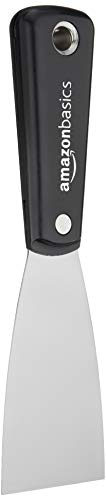
Warner 2-Inch Flexible Putty Knife
Two inches of flexible blade covers most patching jobs, from nail holes to small drywall repairs. Depending on the version, the handle is wood or composite, riveted through the tang for a secure fit. Out of the package, the edge arrives ground and ready without extra dressing.
Pros
- Two inch width suits most household patching jobs
- Riveted handle resists loosening over time
- Costs less than premium equivalents with similar flex
Cons
- Handle comfort trails soft grip designs
- Blade finish shows rust spots sooner than stainless

Purdy Premium Flexible Putty Knife
Stainless steel resists rust after washing, which matters for painters cleaning latex products off a blade daily. A shaped hardwood handle balances the tool during long stretches of glazing and caulk tooling. Medium flex sits between spreader and scraper, so one knife covers both light tasks.
Pros
- Stainless blade avoids rust after water cleanup
- Hardwood handle balances well during long sessions
- Medium flex covers spreading and light scraping in one tool
Cons
- Wood handle needs drying time to avoid swelling
- Costs more than steel and plastic equivalents

Marshalltown Flexible Putty Knife
Blade geometry favors skimming compound over tape joints, with a slight crown that leaves a smooth pass. Marshalltown pairs a full tang with a durable polymer handle sized for gloved hands. Wider blades in the same line exist for finishing coats on larger areas.
Pros
- Wider blade covers tape joints in fewer passes
- Spring steel returns to flat after flexing
- Handle sizing works well with gloves on
Cons
- Three inch width is unwieldy for small nail holes
- Overkill for occasional household repairs

Bates Putty Knife Set
Five blades span roughly 1 to 4 inches, so one purchase covers nail holes through wide skim coats. Stainless steel construction simplifies cleanup after water based compounds. Rubber grips stay usable even when hands are wet from mixing.
Pros
- Covers every common width in a single purchase
- Stainless blades resist rust after washing
- Soft grips hold well with damp hands
Cons
- Individual blades run thinner than trade grade knives
- No stiff scraper included for paint removal

Red Devil 4200 Flexible Putty Knife
A basic flexible blade with a molded plastic handle covers household patching and glazing tasks. Edge quality suits filling nail holes and small dings rather than precision finishing work. Low cost makes it easy to keep several in a paint kit and replace once an edge nicks.
Pros
- Lowest cost knife in this comparison for occasional jobs
- Wide blade covers small patches quickly
- Light weight suits overhead ceiling work
Cons
- Blade edge nicks more easily than trade grade steel
- Molded handle can loosen with heavy use
The lineup, side by side
| # | Model | Blade width | Best for | Score | Price |
|---|---|---|---|---|---|
| 1 | Hyde 02750 Black and Silver Flexible Putty Knife | 1.5 inches | Best overall | 9.4 | Check price |
| 2 | Hyde MAXXGRIP PRO Stiff Putty Knife | 2 inches | Best for scraping | 9.2 | Check price |
| 3 | Warner 2-Inch Flexible Putty Knife | 2 inches | Best value | 9.0 | Check price |
| 4 | Purdy Premium Flexible Putty Knife | 1.5 inches | Best for painters | 8.8 | Check price |
| 5 | Marshalltown Flexible Putty Knife | 3 inches | Best for drywall work | 8.6 | Check price |
| 6 | Bates Putty Knife Set | 5 knives, about 1 to 4 inches | Best set | 8.3 | Check price |
| 7 | Red Devil 4200 Flexible Putty Knife | 3 inches | Best budget | 8.0 | Check price |
Before you buy
Flexible vs stiff: which putty knife do you actually need? Flex determines the job a blade can do well. Flexible blades bend under light pressure, letting filler feather into the surrounding surface, while stiff blades transfer force directly, which suits lifting paint, adhesive and old caulk. Purdy’s medium flex model splits the difference for owners who want one knife. Keeping one of each style covers nearly every task a homeowner runs into.
What putty knife width works best for each job? Narrow blades around 1 to 1.5 inches press filler into small holes without spreading it across clean drywall. Two inch blades, like the Warner, cover most household repairs by default. Three and four inch blades, offered by Marshalltown and included in the Bates set, exist for skimming and feathering wide areas. Using a wide blade on a single nail hole wastes compound and adds sanding work later.
Stainless or carbon steel: which holds up better? Carbon steel takes a finer edge but rusts quickly if left wet, which is how most blades fail early. Stainless steel, used on the Purdy and Bates knives, trades a bit of edge retention for tolerance to water during latex cleanup. Dressing a nicked edge on a flat stone or sandpaper restores a clean line. A burred edge drags streaks through fresh compound on every pass.
Do handle and tang construction matter for durability? Full tang construction, where steel runs the length of the handle, stops a blade from bending at the ferrule under load. Hyde and Marshalltown both build their knives this way. Hammerhead ends and striking caps let a knife set nails or absorb mallet blows without cracking the handle. Soft overmolds, like the one on the MAXXGRIP PRO, cut fatigue during extended scraping sessions.
Frequently asked questions
What is the difference between a putty knife and a scraper?
Putty knives typically use flexible blades built for spreading filler smoothly. Scrapers rely on stiff blades to remove material by force. Hyde MAXXGRIP PRO functions as a scraper despite its name, while the Hyde 02750 is a true flexible spreader.
What size putty knife is best for drywall repair?
Two inches handles nail holes and small patches without wasting compound. Move up to three or four inches for taped joints and skim coats, which fits how the Marshalltown blade is built. Many finishers keep a narrow and a wide knife on hand together.
Should a putty knife be stainless or carbon steel?
Carbon steel holds a keener edge and typically costs less, but it rusts if stored damp. Stainless, as used on the Purdy and Bates knives, survives water cleanup after latex compounds. Pick stainless if tools get washed in a sink regularly.
Can a putty knife remove old paint?
A stiff blade can, though a dedicated scraper still performs better on large areas. Hyde MAXXGRIP PRO includes a striking cap built for hammer assisted work. Flexible blades fold under that same pressure and will not cut through paint film.
How do you clean a putty knife after use?
Wipe compound off before it sets, then wash and dry the blade completely. Dried joint compound leaves ridges that transfer straight into your next pass. Store carbon steel blades dry and add a light coat of oil in humid shops.
Hyde vs Warner putty knives: what actually differs?
Hyde generally uses thicker steel, full tang construction and extras like a hammerhead end. Warner delivers a comparable working width for less through simpler handle construction. Frequent users tend to notice the difference; occasional users often do not.
Is a putty knife set worth buying over a single knife?
One 2 inch flexible knife covers most household jobs on its own. A set like the Bates five piece makes sense for anyone patching regularly at different scales. Sets rarely include a stiff scraper, so budget for one separately.
How do you sharpen a putty knife blade?
Lay fine sandpaper or a whetstone flat and draw the blade across it at a shallow angle. Work both faces evenly to remove any burrs. A clean, straight edge is the single biggest factor in whether compound lays flat afterward.
Do putty knives work for applying wood filler and caulk?
Flexible blades spread wood filler and caulk the same way they spread joint compound. Narrower widths like the 1.5 inch Purdy suit detail work such as glazing window putty. Wider blades waste material on small repairs like these.
Our pick
Hyde 02750 Black and Silver Flexible Putty Knife remains the strongest choice for patching and glazing, with flex and edge quality that hold up over years of use. Pair it with the stiff Hyde MAXXGRIP PRO whenever scraping becomes part of the job. Occasional users patching just a few holes will do fine with the Warner 2-Inch Flexible Putty Knife instead.
Jake Monroe
Jake worked as a residential contractor for over a decade before shifting to full-time writing. He evaluates power tools, hand tools and workshop gear through the lens of someone who has actually used them on job sites, not just read the box.

