How to Pick a Document Scanner for Paperless Filing
Ricoh ScanSnap iX1600 leads on speed and one touch simplicity for most home offices. Epson WorkForce ES-500W II matches its throughput at a lower cost. Canon imageFORMULA R40 suits anyone wanting dependable duplex scanning without extra software to manage. All three handle receipts and contracts cleanly.
Ricoh ScanSnap iX1600 is the pick most people should start with, since profile buttons remove nearly every decision from a repeat scanning job. Epson WorkForce ES-500W II delivers nearly the same throughput with less fuss and a lower price. Canon imageFORMULA R40 sets up in minutes and needs nothing downloaded first.
Comparing scanners is tricky because a headline pages per minute figure ignores misfeeds, OCR quality and how much of the workflow hides behind an app. We ranked these by published duplex speeds, feeder capacity, connectivity and software licensing, then weighed the problems owners report most after a year of use.
Our top picks

Ricoh ScanSnap iX1600 Document Scanner
A fast duplex feeder pairs with a color touchscreen that saves scan profiles for receipts, contracts and photos. ScanSnap Home software handles OCR and folder routing locally, no computer needed mid job. Owners report it as the least fiddly scanner to share across a household.
Pros
- Profile buttons make repeat jobs one tap
- Reliable duplex feeding on mixed paper
- Software runs without a subscription
Cons
- Larger footprint than portable rivals
- Sits at the premium end of the range

Epson WorkForce ES-500W II Document Scanner
A 50 sheet feeder pairs with strong ultrasonic double feed detection, which matters when clearing a shoebox of receipts. Scan to cloud destinations works directly from the unit over Wi-Fi. Specifications show it matching the top pick on throughput for noticeably less money.
Pros
- Excellent misfeed detection
- Handles cards and thin receipts
- Good bundled OCR export options
Cons
- Button controls rather than a touchscreen
- Wi-Fi setup takes a few attempts for some owners
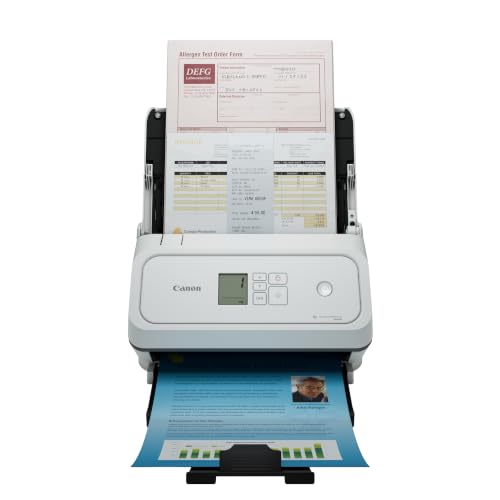
Canon imageFORMULA R40 Document Scanner
USB power and software preloaded on the device mean nothing needs downloading before a first scan. Duplex color scanning and searchable PDF output suit a single desk setup well. Owners report it as the easiest model to hand to a non technical family member.
Pros
- No driver hunting on first use
- Large 60 sheet feeder
- Compact upright footprint
Cons
- No wireless option at all
- Software feature set stays basic

Brother ADS-1700W Compact Document Scanner
A touchscreen and wireless scan to cloud pack into a body barely wider than a sheet of paper. The 20 page feeder runs smaller than rivals, better suited to steady drip feeding than archive marathons. Desk space becomes the deciding factor here.
Pros
- Genuinely small on a desk
- Touchscreen shortcuts to cloud folders
- Scans ID cards and receipts cleanly
Cons
- Small feeder slows big batches
- Slower than the top three

Epson FastFoto FF-680W Photo and Document Scanner
Stacks of loose prints pull through quickly, capturing any handwriting on the back in the same pass. A 100 sheet feeder still handles ordinary document work. Boxes of inherited family photos justify the extra outlay for this specialist.
Pros
- Fastest way to digitize loose prints
- Huge feeder for document work too
- Restoration and colour tools included
Cons
- Overkill if only scanning paperwork
- Bulky on a small desk

Brother DS-640 Mobile Document Scanner
A single sheet wand runs entirely off USB power, so it lives in a laptop bag without a wall adapter. Feeding pages one at a time still produces clean searchable PDFs. Owners report it works best as a travel tool rather than a primary archiving scanner.
Pros
- Fits in a laptop sleeve
- No mains power needed
- Very low cost of entry
Cons
- One page at a time only
- No duplex scanning

Canon CanoScan LiDE 400 Flatbed Scanner
Bound books, stapled reports and delicate originals need a flatbed, since a roller feeder would chew them up. High optical resolution and an upright stand save desk space. Volume work runs slow, so pairing it with a sheetfed model covers frequent scanning.
Pros
- Handles books and fragile originals
- Very high detail for photos
- Single cable operation
Cons
- Far too slow for stacks of paper
- No automatic document feeder
What to look for
Sheetfed or flatbed: which type do you actually need? A sheetfed scanner pulls loose pages through an automatic feeder, the right tool for receipts, statements and contracts. A flatbed keeps the original still under glass, needed for books, stapled bundles and anything fragile. Most people clearing a backlog want sheetfed first, adding a small flatbed later for awkward items. Buying the wrong type is the most common regret owners report.
Why duplex scanning matters more than page speed Single pass duplex captures both sides in one trip through the feeder. On double sided paperwork that effectively halves scanning time, a bigger factor than the gap between a 35 ppm and a 40 ppm rating. Confirm duplex runs single pass rather than a reverse and rescan trick, since the second method doubles jam risk on thin paper.
What OCR and file routing features actually help? A scan only earns its keep if it can be searched later. Bundled optical character recognition should write a searchable PDF layer, and checking whether the license is one off or an ongoing subscription avoids surprise costs. Direct scan to cloud folder from the device itself saves a step every time, and programmable profiles route receipts and contracts to separate folders automatically.
Which paper handling features prevent lost or jammed pages? Ultrasonic double feed detection listens for two sheets traveling together and halts the job, the difference between a clean archive and a silently missing page. Roller quality and a stated daily duty cycle show how a scanner copes with sustained work. Anyone feeding stiff cards, receipts or photos should confirm the feed path can be straightened, since a tight U turn creases thicker media.
Compared at a glance
| # | Model | Scan speed | Best for | Score | Price |
|---|---|---|---|---|---|
| 1 | Ricoh ScanSnap iX1600 Document Scanner | Up to 40 ppm simplex | Best overall | 9.4 | Check price |
| 2 | Epson WorkForce ES-500W II Document Scanner | Up to 35 ppm simplex | Best value | 9.2 | Check price |
| 3 | Canon imageFORMULA R40 Document Scanner | Up to 40 ppm simplex | Best for simple setup | 9.0 | Check price |
| 4 | Brother ADS-1700W Compact Document Scanner | Up to 25 ppm simplex | Best compact desktop | 8.8 | Check price |
| 5 | Epson FastFoto FF-680W Photo and Document Scanner | One photo per second at 300 dpi | Best for photo archives | 8.6 | Check price |
| 6 | Brother DS-640 Mobile Document Scanner | Up to 16 ppm | Best portable | 8.3 | Check price |
| 7 | Canon CanoScan LiDE 400 Flatbed Scanner | 4800 by 4800 dpi | Best for books and fragile pages | 8.0 | Check price |
Questions worth asking
How many pages per minute do I actually need?
For household paperwork, anything above 20 pages per minute feels instant, since squaring the stack takes longer than the scan itself. Speeds above 35 pages per minute only pay off when digitizing years of files in long sessions.
Does a document scanner replace my printer scanner?
For loose paperwork, usually yes, and it runs faster with fewer jams. Keeping an all in one or flatbed around still makes sense for books, glued bundles and occasional copies.
What resolution should I scan documents at?
300 dpi is the standard for text documents and gives reliable OCR results without huge files. Photos, and anything likely to be enlarged later, do better at 600 dpi or higher.
Will these scanners work with a Mac?
All seven models listed publish macOS drivers, and several support scanning straight to a cloud folder without a computer at all. Checking the manufacturer support page for the exact macOS version avoids surprises before buying.
Is a subscription required for the software?
Not for the core scanning and OCR features on these models. Some brands bundle trials of extra cloud or document management services, which can be declined without losing basic searchable PDF output.
Can I scan receipts and business cards?
Yes, sheetfed models on this list handle small and stiff media, and most include automatic size detection so each item crops correctly. Crumpled thermal receipts still feed better inside a carrier sheet.
What is single pass duplex and why does it matter?
Two sensors capture the front and back at the same time in one trip through the feeder. That halves the time spent on double sided documents and cuts jam risk compared with rescanning the stack a second time.
How should I store the scanned files?
Searchable PDF remains the most portable format for text documents, and a consistent folder naming pattern by year and category saves hours later. Keeping at least one backup copy off the source machine protects against drive failure.
Sheetfed vs flatbed: which is better for a mixed paper pile?
Sheetfed wins for loose receipts, statements and contracts, since the feeder clears volume fast. Flatbed wins for anything bound, stapled or fragile that a roller would damage, so a mixed pile often needs both.
The bottom line
Ricoh ScanSnap iX1600 belongs on most desks, since profile buttons remove nearly all decision making from a repetitive job. Epson WorkForce ES-500W II matches its paper handling closely while adding excellent double feed detection for less. Canon CanoScan LiDE 400 works best as a companion for books and fragile originals, not a primary scanner.
Marcus Chen
Marcus covered consumer electronics for enthusiast tech publications for six years before joining ChoiceCrest. He specializes in translating manufacturer spec sheets into plain-language buying advice, with a focus on audio, computing accessories and smart-home gear.


