Which Jump Starter Should Ride in Your Glovebox?
HULKMAN Alpha85 wins for road trips. Its colour screen reports charge percentage and clamp faults before you crank. NOCO Boost Plus GB40 suits drivers who want 1000 amps in a glovebox. GOOLOO GT4000S covers diesel pickups and RV engines up to 8 litres when you tow.
HULKMAN Alpha85 is the road trip pick, because its screen names the problem instead of blinking at you: charge percentage, clamp state, fault reason. Bulk is the trade, since 2.6 pounds will not vanish into a door pocket. Drivers who want a pack small enough to forget about should take the NOCO Boost Plus GB40 instead.
Listings lead with peak amps, a brief surge that brands measure differently. What decides a trip is whether the pack still holds charge after weeks in a hot car, how many cranks it manages, and whether it also refills a phone. We compared stated engine limits, capacity in milliamp hours, display detail, USB output and operating temperature ranges, then weighed owner reports on self-discharge and cold starts.
What to look for
What to look for in a road trip jump starter Peak amps describe a surge lasting a fraction of a second, measured differently by every brand. Read the stated engine limit instead, because that maps to the car in your driveway. Capacity in milliamp hours predicts how many cranks and phone charges you get between refills. Clamp safety matters just as much: spark-proof jaws and reverse polarity protection cover the classic roadside mistake. Low self-discharge closes the list, since a rescue pack that drained in April rescues nobody in July.
What the digital display actually tells you A numeric readout says the pack sits at 62 percent. Three LEDs only hint. HULKMAN’s Alpha85 goes further and names why the clamps refused to arm, which stops the disconnect-and-retry cycle that ends in sparks. AVAPOW’s A58 and the DBPOWER unit also print a percentage, while the NOCO GB40 stays with a bar. Choose between information and the smallest possible package, because very few packs offer both.
Matching a pack to your engine and your climate Four and six cylinder gas cars start on 800 to 1000 amps in mild weather, which is the NOCO GB40 territory. V8 pickups want around 2000 amps, so the Alpha85 fits. Towing a trailer or running a large diesel points at the GOOLOO GT4000S, since glow plugs draw heavily before the starter even turns. Cold shrinks the current any lithium cell can deliver, so winter routes favour rated units such as the Alpha85 at minus 4 Fahrenheit or the Schumacher SL1639. Buying far past your engine mostly buys weight.
Charging on the road and storing it in a hot car Heat speeds up self-discharge, so a glovebox pack in July reads lower than one kept indoors. Check the level every two or three months and top it up before any long drive. USB-C Power Delivery shortens that chore: the NOCO Boost X GBX55 accepts 60 watts and the GOOLOO GT4000S takes 100. Units limited to USB-A can need most of a day to fill. Keep any pack off a sunlit dashboard, where temperature protection may simply refuse to run.
Our top picks

HULKMAN Alpha85
Charge percentage, clamp status and fault reasons all appear on the colour screen before you crank. Rated at 2000 peak amps with a 20000 mAh cell, it clears gas engines to 8.5 litres and diesels to 6 litres. Operation down to minus 4 Fahrenheit keeps it usable on winter passes.
Pros
- Named fault messages beat one blinking LED
- Current headroom suits V8 trucks and most diesels
- Owners report slow self-discharge across months of storage
Cons
- Too large for a door pocket at about 2.6 pounds
- More pack than a four cylinder commuter car needs
NOCO Boost Plus GB40
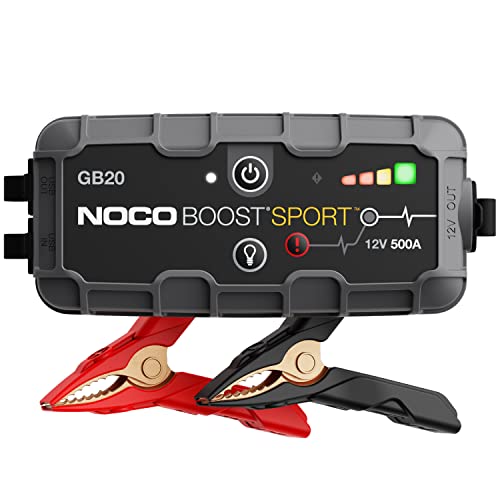
Glovebox size is the whole argument, and 1000 peak amps still turns gas engines to 6 litres and diesels to 3 litres. Spark-proof clamps and reverse polarity protection forgive a wrong connection in the dark. A seven-mode LED adds SOS and strobe, which counts for more on a rural shoulder than a headline amp figure.
Pros
- Fits a glovebox at roughly 2.4 pounds
- Reversed clamps will not throw a spark
- Years on sale with consistent owner feedback
Cons
- Charge reads as an LED bar, not a percentage
- Short on headroom for large diesel engines

GOOLOO GT4000S
Four thousand peak amps and a 26800 mAh cell reach gas engines to 10 litres and diesels to 8 litres. An LCD reports remaining charge alongside output state. USB-C runs at 100 watts in both directions, so the pack refills a laptop at a campsite and itself at a fast wall adapter.
Pros
- Cranks diesel pickups and RV engines
- 100 watt USB-C powers a laptop directly
- Capacity covers several starts between refills
Cons
- Largest and heaviest unit in this group
- Refills slowly without a high-wattage USB-C adapter

NOCO Boost X GBX55
Two-way 60 watt USB-C Power Delivery refills the pack from a laptop charger, then fast charges a phone from the same port. Peak output of 1750 amps covers gas engines to 7.5 litres and diesels to 5 litres. An IP65 housing shrugs off rain and grit at the roadside.
Pros
- Turnaround beats USB-A only packs by hours
- One port serves the pack and your phone
- Sealed to IP65 against dust and water
Cons
- Quoted refill times assume a 60 watt charger
- Charge indicator stays simpler than a full LCD
AVAPOW A58
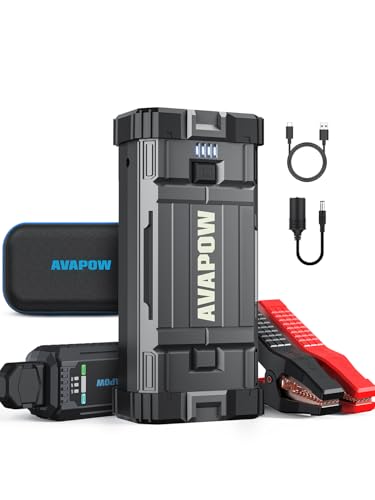
Peak output reaches 2500 amps, unusual headroom for a mid-market pack. An LCD prints remaining charge and output status rather than hinting with LEDs. Two USB-A ports run a phone and a dash cam at once, and the built-in light carries strobe and SOS modes for a breakdown after dark.
Pros
- High peak current without a premium brand badge
- Dual USB-A covers phone and dash cam together
- Numeric charge readout instead of a bar
Cons
- Clamp cables run shorter than premium rivals
- Recharges slower than Power Delivery packs

Schumacher SL1639
Cold cranking is the design brief for this 1500 amp lithium pack, and cold is what finishes off a weak battery. A digital gauge shows charge level the night before a frozen morning, not after. USB-C handles refilling the unit and charging devices from it.
Pros
- Aimed at gas and light diesel cold starts
- Charge level reads numerically before you leave
- Long-standing automotive brand with wide support
Cons
- Peak current trails the GOOLOO and HULKMAN packs
- No high-wattage laptop charging

DBPOWER 800A Portable Jump Starter
Eight hundred peak amps and an 18000 mAh cell target four and six cylinder cars, which describes most rental-sized road trip vehicles. Listed limits stretch to 7.2 litres gas and 5.5 litres diesel, though that leaves thin margin on a cold morning. A small LCD reports remaining charge, and the pack doubles as a phone power bank.
Pros
- Charge percentage shown despite the entry-level position
- Compact enough for a small car glovebox
- Doubles as an 18000 mAh phone power bank
Cons
- Lowest peak current of these seven
- Repeated cranking on a very flat battery drains it fast
The lineup, side by side
| # | Model | Peak current | Best for | Score | Price |
|---|---|---|---|---|---|
| 1 | HULKMAN Alpha85 | 2000 amps | Best overall | 9.4 | Check price |
| 2 | NOCO Boost Plus GB40 | 1000 amps | Best compact | 9.2 | Check price |
| 3 | GOOLOO GT4000S | 4000 amps | Best for big engines | 9.0 | Check price |
| 4 | NOCO Boost X GBX55 | 1750 amps | Best for fast recharging | 8.8 | Check price |
| 5 | AVAPOW A58 | 2500 amps | Best value | 8.5 | Check price |
| 6 | Schumacher SL1639 | 1500 amps | Best for cold weather | 8.3 | Check price |
| 7 | DBPOWER 800A Portable Jump Starter | 800 amps | Best budget | 8.0 | Check price |
Frequently asked questions
What size jump starter do I need for a road trip?
For a four or six cylinder car, 800 to 1000 peak amps is enough, which covers the NOCO Boost Plus GB40. Large V8s and diesel trucks want 2000 amps or more, putting the HULKMAN Alpha85 or GOOLOO GT4000S in range.
How many amps does a V8 truck need to start?
Plan on 2000 peak amps for a large gas V8, more once a diesel and its glow plugs join in. Alpha85 covers gas to 8.5 litres and diesel to 6 litres. GT4000S stretches to 10 litres gas and 8 litres diesel.
Can a jump starter charge a phone or laptop?
Yes, every pick here carries USB output. GOOLOO’s GT4000S pushes 100 watts over USB-C, enough for most laptops, while the NOCO Boost X GBX55 delivers 60 watt Power Delivery for fast phone charging.
How often should you recharge a jump starter in storage?
Every two to three months, and always before a long trip. Summer heat inside a parked car accelerates self-discharge, so a pack that lived in a glovebox all season will read lower than one stored indoors.
Do jump starters work in freezing weather?
They work, but deliverable current falls as temperature drops. Pick a model rated for cold operation, such as the Alpha85 at minus 4 Fahrenheit or the Schumacher SL1639. Warming the pack inside a jacket for a few minutes helps before the first attempt.
Is it safe to leave a lithium jump starter in a hot car?
Current packs include temperature protection and shut down outside their safe range. Storage in a glovebox or under a seat beats a dashboard in direct sun, where the unit heats fastest and may refuse to operate.
NOCO vs HULKMAN: which suits long drives better?
GB40 wins on packability and simplicity, ideal when the pack lives permanently in a small car. Alpha85 wins on information and raw current, better if you drive a truck, tow, or expect to help other vehicles.
How many jumps does one charge deliver?
Capacity and engine size set the answer. A 20000 mAh pack handles many starts on a healthy four cylinder, while a large diesel swallows far more per attempt. Recharge after any use rather than trusting leftover capacity.
Do you still need jumper cables if you carry a jump starter?
Keep cables as a backup. A flat pack helps nobody, and cables let you draw from another vehicle when your starter fails or the battery sits too deeply discharged for a portable unit to wake.
The bottom line
Pack the HULKMAN Alpha85 for long distances in a truck or through cold country, since its screen removes guesswork at exactly the moment you need clarity. Ordinary four cylinder drivers do better with the NOCO Boost Plus GB40, small enough to stay in the glovebox and be forgotten until it matters. Step up to the GOOLOO GT4000S only if you tow a trailer or run a large diesel.
Tony Russo
Tony trained as an automotive technician and spent years in service and parts retail before moving into writing. He focuses on garage tools, car care products and accessories from a hands-on maintenance perspective.