How Often Should You Replace Ignition Coils?
Ignition coils do not have a set replacement interval. They are not listed in most maintenance schedules and typically last anywhere from 60,000 to over 150,000 miles depending on the engine, heat exposure, and plug condition. Replace a coil when it fails, not on a fixed schedule, though replacing all coils at once on a high-mileage engine is a reasonable preventive choice.
Ignition coils are not a scheduled maintenance item
Unlike spark plugs, air filters, or timing belts, ignition coils do not appear in the maintenance schedule for most vehicles. There is no mileage at which the manufacturer says to replace them. They are designed to last the life of the engine under normal conditions, and many do. The reason you hear about them failing is that they are a wear item in practice, not by design. Heat, vibration, and voltage stress eventually break down the internal insulation, and when that happens the coil is replaced individually.
What actually determines how long a coil lasts
The biggest factor is heat. Coils sit on or near the engine, and the constant thermal cycling from cold starts to operating temperature slowly degrades the epoxy and wire insulation inside. Spark plug condition matters just as much: a worn plug with a widened gap requires higher voltage to fire, and that extra stress pushes the coil harder. Oil leaks, a failing valve cover gasket, or a bad PCV system that lets oil vapor into the coil boot can also shorten life. In practice, a coil on an engine with fresh plugs and no oil leaks tends to last far longer than one on a neglected engine.
Why coils usually fail one at a time
Most modern engines use one coil per cylinder, often called coil-on-plug. Each coil operates independently, so when one fails, the others are usually still fine. This is why the common advice is to replace only the failed coil, not the whole set. The exception is when the coils share a common stressor, like a bad set of spark plugs that has been overdue for a long time, or a valve cover gasket leaking oil into multiple coil wells. In those cases, several coils may fail in close succession.
Signs a coil is failing before it dies completely
A failing coil often gives warning before it quits entirely. You might notice a misfire at idle, a stumble under acceleration, or a check engine light with a P0300-series code pointing to a specific cylinder. Sometimes the engine runs fine cold but misfires when hot, which is a classic sign of a coil breaking down under heat. Ignoring these symptoms can damage the catalytic converter, because unburned fuel from a misfiring cylinder overheats the converter. That is why a known misfire should be diagnosed and fixed promptly rather than driven on.
Should you replace all coils at once on a high-mileage engine?
This is a judgment call. If one coil fails at 120,000 miles and the others are original, some mechanics recommend replacing all of them as preventive maintenance, reasoning that the remaining coils have the same age and heat exposure and may fail soon. Others argue that coils often last much longer and replacing working parts is unnecessary. A middle ground is to replace the failed coil and inspect the others for cracked housings or oil contamination, then replace those if they show signs of wear. There is no single right answer, but the one-at-a-time approach is usually the most economical.
How to make coils last longer
The most effective thing you can do is keep the spark plugs fresh. Plugs are cheap and coils are not, and a worn plug puts extra voltage demand on the coil. Use the plug type and gap the manufacturer specifies, since some engines are sensitive to plug choice. Fix oil leaks promptly, especially valve cover gasket leaks that can fill the spark plug wells with oil and degrade the coil boot. Avoid pressure-washing the engine, which can force water into coil connectors. Finally, address misfires early, because a coil that is misfiring due to a bad plug or a lean condition will eventually fail from the extra stress.
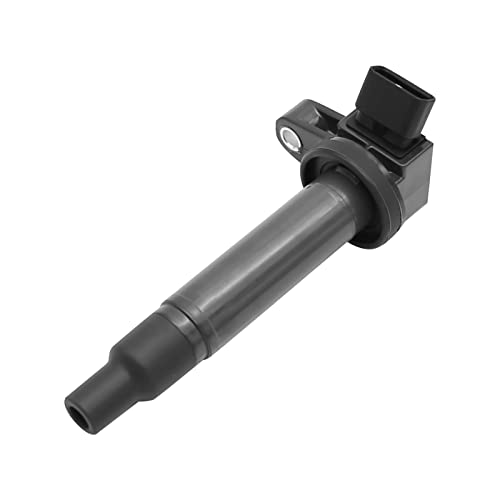
Denso 673-1303 Ignition Coil
An OEM-quality coil-on-plug replacement from a supplier that makes original equipment coils for many Japanese brands.

NGK 48664 Ignition Coil
A widely available coil from a brand known for ignition components, often used as a direct-fit replacement on many domestic and import engines.
Good to know
How often should ignition coils be replaced?
There is no fixed interval. Most manufacturers do not list ignition coils as a scheduled maintenance item. They are replaced when they fail, which typically happens somewhere between 60,000 and 150,000 miles depending on engine heat, spark plug condition, and oil leaks.
Do ignition coils wear out over time?
Yes, they degrade gradually. Heat cycling, vibration, and the electrical stress of firing a spark plug slowly break down the coil’s internal insulation. Eventually the coil can no longer produce enough voltage and misfires.
Can I replace just one ignition coil or should I do all of them?
You can replace just the failed coil, and that is the most common approach. Replacing all coils at once is a preventive choice some mechanics recommend on high-mileage engines, but it is not required and can be unnecessarily expensive.
What causes ignition coils to fail prematurely?
The most common causes are worn spark plugs with too large a gap, oil leaking into the spark plug well from a bad valve cover gasket, and a faulty coil boot or connector. Heat and vibration also contribute, but those are normal and unavoidable.
How long do ignition coils typically last?
Many last the life of the vehicle, but when they do fail it is often past 100,000 miles. Some fail earlier due to engine-specific heat issues or neglected maintenance. There is no universal number because design and operating conditions vary widely.
Will a bad ignition coil damage my engine?
A misfiring coil can damage the catalytic converter over time because unburned fuel overheats it. It can also cause rough running and reduced power, but the engine itself is usually not physically damaged unless the misfire is ignored for a long time.
How do I know which ignition coil is bad?
A scan tool can read misfire codes that often identify the specific cylinder. You can also swap the suspect coil to a different cylinder and see if the misfire moves with it, which confirms the coil is the problem rather than a plug or injector.
Is it normal for ignition coils to fail one at a time?
Yes, because each cylinder usually has its own coil and they operate independently. When one fails, the others are often still healthy, which is why replacing only the failed coil is common practice.
Can bad spark plugs cause ignition coils to fail?
Yes, a worn plug with an enlarged gap requires more voltage to fire, which puts extra strain on the coil. Over time that added stress can cause the coil to fail. This is why replacing plugs on schedule helps protect coils.
Do I need to replace ignition coils if I replace spark plugs?
No, not unless a coil is already failing. Spark plugs and coils are separate parts with different lifespans. However, if a coil boot is cracked or oil-soaked when you change plugs, that coil may need attention soon.
How much does it cost to replace an ignition coil?
The part itself is usually modest, and labor is often simple on engines where the coils are accessible on top. Costs vary by vehicle, but it is generally not a major repair. Replacing all coils at once multiplies the parts cost.
Can I drive with a bad ignition coil?
You can, but it is not recommended. Driving with a misfire can overheat and destroy the catalytic converter, which is a much more expensive repair than a coil. If the check engine light is flashing, stop driving and get it fixed.
Why do ignition coils fail when the engine is hot?
Heat expands materials and can cause a marginal coil to break down internally. A coil with weakened insulation may work fine when cold but fail to produce enough voltage once the engine bay heats up, leading to a misfire that appears only after warm-up.
Are OEM ignition coils better than aftermarket?
OEM coils are generally the safest choice for fit and longevity, especially on engines with known coil issues. Quality aftermarket brands can also be fine, but very cheap generic coils have a reputation for shorter life.
Can a bad ignition coil cause other codes besides misfire codes?
Yes, a persistent misfire can trigger codes for catalytic converter efficiency, oxygen sensor response, or fuel trim as the engine computer tries to compensate. The root cause is still the coil if the misfire is traced to that cylinder.
How can I make my ignition coils last longer?
Keep spark plugs fresh and correctly gapped, fix oil leaks like a leaking valve cover gasket, avoid pressure-washing the engine, and address misfires promptly. Those steps reduce the electrical and thermal stress that shorten coil life.
Do ignition coils have a break-in period?
No, a new coil does not require a break-in period. Once installed and connected properly, it should work immediately. If a misfire persists after replacement, the problem may be elsewhere, such as the plug, injector, or wiring.
Is it worth replacing all coils on an old engine as preventive maintenance?
It can be worth it if you plan to keep the vehicle and want to avoid future breakdowns, especially if the coils are difficult to access. Otherwise, replacing them as they fail is a reasonable and more economical strategy.
Where this leaves you
Ignition coils are not a maintenance item with a schedule; they are a repair item with a lifespan. Replace them when they fail, keep your spark plugs fresh to reduce stress on them, and consider replacing the whole set only if you are facing repeated failures on a high-mileage engine and want to avoid repeat downtime.
Tony Russo
Tony trained as an automotive technician and spent years in service and parts retail before moving into writing. He focuses on garage tools, car care products and accessories from a hands-on maintenance perspective.