Cordless Battery Chargers Mechanics Actually Use
NOCO GENIUS10 wins the bench slot at 10 amps across flooded, AGM, gel and lithium. Clore Automotive Jump-N-Carry JNC660 handles repeat cranking on cold mornings. Mobile work suits NOCO Boost Pro GB150, a 3000 amp lithium pack that fits a toolbox drawer.
NOCO GENIUS10 is the first charger to buy for a working bay. Ten amps refills a flat 60 amp hour battery overnight, and lithium iron phosphate gets its own profile. Cranking an engine is beyond it. That job goes to a cordless pack such as the NOCO Boost Pro GB150.
Two different tools share the name battery charger in a shop, and they solve opposite problems. One restores capacity slowly. The other delivers cranking amps for three seconds. We compared published output, chemistry profiles, clamp gauge and cable length, then weighed owner reports on how each unit survives daily handling.
Our top picks

NOCO GENIUS10 Smart Battery Charger
Ten amps refills a flat car battery overnight, then maintenance mode holds it for months. Profiles cover flooded, AGM, gel, EFB and lithium iron phosphate, which suits a bay that also sees powersports packs. Force mode pushes current into batteries too flat for a normal charger to detect.
Pros
- One unit covers every common 12 volt chemistry
- Force mode restores batteries other chargers refuse to see
- Sealed case shrugs off oil and bench grit
Cons
- Ten amps crawls on a 200 amp hour truck battery
- Recharges only, with no engine start function
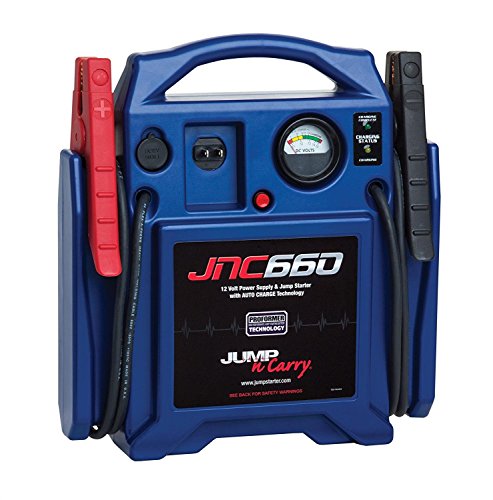
Clore Automotive Jump-N-Carry JNC660 Jump Starter
Lead acid still rules professional bays because it cranks hard and repeats without sulking. Cables run 46 inches, long enough to reach a battery under a rear seat or behind a wheel arch. An onboard charger plugs into the wall, so the pack lives on a shelf ready to work.
Pros
- Cold starts stay strong well below freezing
- 46 inch leads reach awkward battery locations
- Case survives years of being dropped and kicked
Cons
- Roughly triple the weight of a lithium pack
- Left uncharged for months, the internal AGM sulphates

NOCO Boost Pro GB150 Lithium Jump Starter
Lithium shrinks a serious booster to toolbox size. Three thousand peak amps covers petrol engines up to around nine litres and diesels near seven. Spark proof clamps and reverse polarity protection make it safe to hand an apprentice, while USB output feeds a phone or a scan tool.
Pros
- Cranks large diesels from a hand held body
- USB port and 400 lumen lamp double its uses
- Sits in a drawer for months without self draining
Cons
- Short leads keep you crouched over the battery
- Full recharge runs into several hours

CTEK MXS 5.0 Battery Charger
Eight stages include desulphation and a recondition step for AGM packs left standing part charged. Output tops out at 4.3 amps, so treat this as a conditioner rather than a quick turnaround tool. Temperature compensation trims voltage in an unheated workshop, which protects a battery through winter.
Pros
- Recondition cycle claws back stratified AGM
- Rated for months of unattended connection
- Wall mountable body takes no bench space
Cons
- No way to turn a car around inside an hour
- Skips 6 volt and lithium profiles

Schumacher SC1281 Battery Charger and Engine Starter
Wheels and a 30 amp charge rate suit trucks, tractors and equipment on big lead acid batteries. A 100 amp start assist gets a stubborn engine turning once the battery has taken some charge. Voltage detection picks 6 or 12 volt by itself, removing a switch somebody will set wrong.
Pros
- 30 amps recovers a large battery inside an hour
- Start assist covers trucks and farm equipment
- Automatic 6 and 12 volt detection
Cons
- Mains cord ties it to the bay
- Bulky frame needs dedicated floor space

GOOLOO GT4000S Jump Starter
Four thousand peak amps puts a hand held pack into diesel territory. USB C in and out means it shares a laptop brick and revives a phone on a roadside call. Clamp gauge runs lighter than a professional lead acid booster, which shows on back to back starts.
Pros
- High peak rating for a pack this small
- Charges from any USB C brick
- Slips into a glovebox or tool bag
Cons
- Thin cables feel light for daily shop duty
- Heats up and demands a rest after repeated starts

Battery Tender Plus 021-0128 Battery Charger
At 1.25 amps this is a keeper rather than a reviver, dropping to float once a battery reaches full. Quick disconnect leads bolt to the terminals, so a stored bike or classic reconnects in a second. Pair it with a bigger charger for anything genuinely flat.
Pros
- Safe to leave wired up all winter
- Ring terminal pigtail makes reconnection instant
- Small enough to mount inside a trailer
Cons
- Far too slow to recover a dead battery
- Lead acid only, with no lithium profile
How to choose
Charger or jump pack: what each one actually does A charger returns energy over hours and can reverse light sulphation. A jump pack dumps hundreds of amps for a few seconds and does nothing for battery health. Bays keep both, since a booster gets the car onto the lift while a charger decides whether the battery stays in it. Buying one first? Make it the charger.
Matching amps to battery size and chemistry Charge current should sit near ten percent of capacity in amp hours. A 60 amp hour car battery therefore likes about 6 amps, and 10 amps covers most passenger cars comfortably. AGM wants a higher absorption voltage than flooded, while lithium iron phosphate needs its own curve entirely. Selectable modes on one unit save buying three.
Cordless packs for mobile and roadside work Weight and standby charge favour lithium, which holds usable power for months in a drawer. Repeated cranking and deep cold favour lead acid. Cable length is the spec buyers forget, because a compact lithium pack often cannot reach a boot mounted battery. Check clamp gauge too, since peak amp figures are measured across a fraction of a second.
Safety checks before you clip on Reverse polarity protection matters most where somebody else may grab the clamps. Look for leads that stay dead until the unit detects a battery. Flooded cells vent hydrogen, so lift the bonnet and keep sparks away from the caps. During a module reflash, a supply mode holds voltage steady instead of charging.
How they compare
| # | Model | Output | Best for | Score | Price |
|---|---|---|---|---|---|
| 1 | NOCO GENIUS10 Smart Battery Charger | 10 amps | Best overall | 9.4 | Check price |
| 2 | Clore Automotive Jump-N-Carry JNC660 Jump Starter | 1700 peak amps | Best for daily shop use | 9.2 | Check price |
| 3 | NOCO Boost Pro GB150 Lithium Jump Starter | 3000 amps | Best cordless portable | 9.0 | Check price |
| 4 | CTEK MXS 5.0 Battery Charger | 4.3 amps | Best for AGM and long term maintenance | 8.8 | Check price |
| 5 | Schumacher SC1281 Battery Charger and Engine Starter | 30 amp boost plus lower maintenance rates | Best for large batteries | 8.6 | Check price |
| 6 | GOOLOO GT4000S Jump Starter | 4000 amps | Best value cordless pack | 8.3 | Check price |
| 7 | Battery Tender Plus 021-0128 Battery Charger | 1.25 amps | Best budget maintainer | 8.0 | Check price |
Frequently asked questions
Is a jump starter the same as a battery charger?
No. A jump starter supplies a short burst to crank the engine and leaves the battery as flat as it found it. A charger replaces the missing energy over hours. Corded combination units such as the Schumacher SC1281 do both jobs.
What amp battery charger do mechanics use?
Ten amps suits most passenger cars, which is why the NOCO GENIUS10 sits on so many benches. Trucks and equipment justify 30 amps or more. Keeping a stored vehicle topped up needs only one or two amps.
Can you leave a smart charger connected all winter?
Yes, provided it has a float or maintenance stage. Battery Tender Plus and the CTEK MXS 5.0 are both built for months on a parked vehicle. Old unregulated chargers boil electrolyte away instead.
Do lithium jump starters work in cold weather?
Around freezing they crank normally. Colder than that, capacity drops and a chilled pack may refuse to arm until it warms in the cab. Lead acid boosters such as the JNC660 hold up better in deep cold.
How do you charge an AGM battery without damaging it?
Pick a charger with a dedicated AGM mode, since AGM wants higher absorption voltage and no equalisation. Keep current modest, because internal heat is what kills the mat. A recondition cycle helps an AGM that has sat part charged.
Can a charger bring back a completely dead battery?
Sometimes. Below roughly 2 volts most chargers refuse to start unless they offer force or supply mode, which the GENIUS10 provides. Success depends on hard sulphation versus simple self discharge.
How many peak amps to jump start a diesel?
Look for 2000 peak amps or more on a large diesel, then check the stated engine size range. The GB150 is rated to around 7 litres of diesel. Sustained current over several seconds matters more than the headline peak.
Will a battery charger damage a car’s electronics?
A regulated smart charger will not, because it holds voltage inside the normal charging window. Damage comes from unregulated units and from yanking clamps off under load. Switch to supply mode when modules are awake.
Which is better for a mobile mechanic, corded or cordless?
Cordless, almost always. A lithium pack such as the GB150 or GOOLOO GT4000S starts a car on a driveway with no socket in sight. Keep a small maintainer at the workshop for stored vehicles.
How long does a 10 amp charger take on a car battery?
Roughly six to eight hours on a typical 60 amp hour battery from deeply discharged, plus absorption time at the end. Larger truck batteries stretch that overnight. Charging below the ten percent rule is gentler on plate life.
Final word
Buy the NOCO GENIUS10 first, because chemistry coverage and force mode solve more daily problems than raw amperage. Add the Clore Automotive Jump-N-Carry JNC660 once dead cars start arriving several times a week. Mechanics working out of a van should skip both and carry the NOCO Boost Pro GB150 instead.
Tony Russo
Tony trained as an automotive technician and spent years in service and parts retail before moving into writing. He focuses on garage tools, car care products and accessories from a hands-on maintenance perspective.



