Pro Grade Truck Battery Chargers for 12V and 24V
NOCO GENIUSPRO50 leads for shops, covering 6V, 12V and 24V at up to 50 amps from one bench unit. Schumacher SC1281 adds 100 amps of engine start for diesels that will not crank. CTEK MXT 14 handles the 24V banks that most chargers cannot touch.
NOCO GENIUSPRO50 is the pick for a bay that sees pickups one day and a Class 8 tractor the next. One unit covers 6V, 12V and 24V at up to 50 amps, so nothing waits for a second charger. Force mode pushes current into batteries too flat for a normal charger to detect. Drawing 50 amps also loads a shop circuit harder than a home garage usually allows.
Consumer chargers stall on truck work for two reasons: capacity and voltage. We compared amp output, supported voltages, chemistry profiles covering AGM and lithium, engine start ratings and enclosure sealing across current listings. Owner feedback on duty cycle, cable length and clamp bite shaped the ranking, because bench units run far longer sessions than driveway chargers ever face.
What matters most
What separates a shop charger from a driveway unit Three demands split professional gear from consumer gear. Output has to be higher, because a group 31 truck battery holds several times the capacity of a car battery. Voltage coverage comes next, since many heavy rigs start on 24V rather than 12V. Duty cycle finishes the list: a shop unit runs back to back sessions without thermal shutdown, which is where cheap chargers fail first. Cable length and clamp jaw size decide how workable it feels at the bench.
How many amps a truck battery actually needs Roughly 10 percent of capacity in amps is the working rule, so a 100Ah battery pairs with a 10 amp charger. Go lower and one overnight becomes two. Push far higher on cheap flooded cells and they gas off electrolyte. Fleet benches justify 50 amps from the NOCO GENIUSPRO50, while a single pickup is well covered by the GENIUS10. Anything under 5 amps belongs in the maintainer category, not the charger category.
12V vs 24V truck electrical systems Pickups and light trucks run 12V, same as a car. Class 7 and 8 rigs, buses and much agricultural equipment wire two 12V batteries in series for 24V starting. Clamp a 12V charger across that pair and you charge half of it, leaving the bank unbalanced and both batteries shorter lived. A dedicated 24V unit like the CTEK MXT 14 solves it, as does a multi voltage charger that switches modes. Disconnecting and charging each battery separately also works when no 24V unit is available.
Charging AGM, lithium and long stored batteries safely Chemistry changes the target voltage. AGM wants a slightly different absorption point than flooded, and lithium needs its own curve plus a different cutoff. Running lithium on a lead acid setting risks the pack’s management board. Ventilate the space for flooded work, since those batteries release hydrogen while gassing. Engine start mode exists to move a truck, not to charge it, and repeated cranking attempts stress the transformer. When a battery still will not hold voltage after a full cycle and a recondition attempt, the cells are done and no charger changes that.
The shortlist, ranked

NOCO GENIUSPRO50
Fifty amps turns an overnight recharge into a working shift. Voltage selection runs through 6V, 6V lithium, 12V, 12V lithium and 24V, which lets one bench unit serve a mixed fleet. Power supply mode holds a steady voltage at the terminals while a technician reprograms an ECU.
Pros
- One unit covers 6V, 12V and 24V fleets
- Force mode revives batteries other chargers refuse
- Power supply mode protects modules during ECU work
Cons
- More charger than a single vehicle household needs
- Fifty amps draws real current from a shop circuit

Schumacher SC1281
Wheels and a tall handle matter when the dead truck sits at the far end of a lot. Output steps through 6 amps for charging, 30 for boost and 100 for cranking a stalled diesel. Auto voltage detection selects 6V or 12V itself, so a rushed tech cannot set it wrong.
Pros
- 100 amps cranks stubborn diesel starters
- Wheels and handle suit yard and lot work
- Auto voltage detection reduces setup mistakes
Cons
- No 24V mode for heavy rigs
- 6 amps is slow for a group 31 battery
CTEK MXT 14
Heavy trucks, buses and agricultural machines wire two batteries in series for 24 volt starting. CTEK built this unit only for those banks, delivering 14 amps through a staged cycle that includes desulphation. Maintenance mode then holds the pair topped up through weeks of seasonal downtime.
Pros
- Purpose built for 24V heavy vehicle banks
- Staged cycle covers desulphation and float
- Sealed housing tolerates workshop dust and splashes
Cons
- No 12V mode, so it works alongside another charger
- 14 amps is modest for very large banks

NOCO GENIUS10
Ten amps fits one pickup, a service van or a trailer battery on standby. Lithium profiles sit alongside AGM and flooded settings, and a repair cycle targets lightly sulphated plates. Sealed weather resistant construction lets it live in a truck box instead of a bench drawer.
Pros
- Small enough to ride in a truck toolbox
- Lithium profile built in rather than optional
- Repair mode recovers mildly sulphated batteries
Cons
- Ten amps means overnight on a group 31 battery
- No engine start or boost function

Clore Automotive PRO-LOGIX PL2320
Clore aims this at technicians charging several batteries a day who need repeatable results. Twenty amps clears most 12V truck batteries within a shift, and lower settings suit powersports cells. Recondition mode runs an extended profile for batteries pulled from vehicles that sat for months.
Pros
- Recondition mode targets long stored batteries
- Heavy clamps bite through terminal corrosion
- Rated for repeated daily duty cycles
Cons
- 12V only, so no 24V fleet coverage
- Interface assumes some technician knowledge

Optima Digital 1200
AGM and spiral cell batteries want a different absorption voltage than flooded cells, and this charger is tuned around that curve. Twelve amps keeps charge times sensible for a truck starting battery. Its recovery cycle attempts packs that have dropped below the voltage a standard charger will even acknowledge.
Pros
- Charge profile matches AGM and spiral cell chemistry
- Recovery cycle handles badly drained batteries
- Digital readout names the voltage and the stage
Cons
- No lithium profile
- Cables run shorter than shop users expect
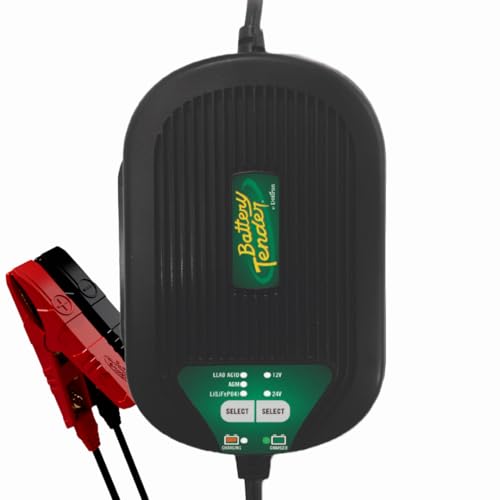
Battery Tender 5 Amp Selectable Battery Charger
Plow rigs, seasonal trucks and spare units bleed charge quietly while parked. Output switches between 1.25 and 5 amps, then settles into a float stage that runs for months without cooking plates. Recovery is not its job, so think of it as prevention rather than rescue.
Pros
- Safe to leave connected through a whole season
- Switchable rate suits small and large batteries
- Handles lead acid and lithium chemistries
Cons
- Too slow to recover a fully flat truck battery
- No engine start or boost function
Side by side
| # | Model | Maximum output | Best for | Score | Price |
|---|---|---|---|---|---|
| 1 | NOCO GENIUSPRO50 | 50A | Best overall | 9.4 | Check price |
| 2 | Schumacher SC1281 | 6A charge, 30A boost, 100A engine start | Best for engine starting | 9.2 | Check price |
| 3 | CTEK MXT 14 | 14A | Best for 24V systems | 9.0 | Check price |
| 4 | NOCO GENIUS10 | 10A | Best value | 8.8 | Check price |
| 5 | Clore Automotive PRO-LOGIX PL2320 | 20A, with lower rate settings | Best for shop benches | 8.6 | Check price |
| 6 | Optima Digital 1200 | 12A | Best for AGM batteries | 8.3 | Check price |
| 7 | Battery Tender 5 Amp Selectable Battery Charger | Selectable 1.25A or 5A | Best for storage and maintenance | 8.0 | Check price |
Questions worth asking
What amp charger do I need for a truck battery?
Target about 10 percent of capacity, so 10 to 15 amps for a typical 100 to 150Ah truck battery. Shops charging several batteries daily benefit from 20 to 50 amps. Below 5 amps you are buying a maintainer.
Can a 12V charger charge a 24V truck system?
Not safely across the pair. You would charge one battery of the series set and leave the bank unbalanced. Either use a 24V charger like the CTEK MXT 14, or disconnect and charge each battery on its own.
How long does it take to charge a large truck battery?
Divide the amp hours needed by charger output, then add roughly 20 percent for the absorption stage. A 150Ah battery at half charge needs about 75Ah, so 10 amps takes around nine hours. Fifty amps brings that under two.
Is a trickle charger enough for a diesel truck?
For holding a parked truck ready, yes, and the Battery Tender does exactly that. For reviving a flat battery, no, because the current is far too low. Diesel cranking loads demand a fully recharged battery rather than a topped up one.
Which chargers work with AGM batteries?
Any unit with a dedicated AGM mode, because AGM wants a different absorption voltage. Optima Digital 1200, both NOCO models and the CTEK MXT 14 all include AGM profiles. Charging AGM on a plain flooded setting shortens its service life.
Can you charge a truck battery without removing it?
Yes, and modern chargers assume you will. Clamp positive to the battery post and negative to clean bare chassis metal away from the battery. Route cables clear of fuel lines, belts and the cooling fan.
What is the difference between a charger and a jump starter?
Chargers replace energy over hours through a controlled multi stage cycle. Jump starters supply a brief burst of high current purely to crank an engine. Schumacher SC1281 does both, which is why it earns space in a service bay.
Do lithium truck batteries need a special charger?
They need a lithium profile, since the charge curve and cutoff voltage differ from lead acid. NOCO GENIUS10, GENIUSPRO50 and the selectable Battery Tender all carry one. Using a lead acid setting on lithium can damage the battery management board.
Should a shop buy one big charger or several small ones?
Bays working several vehicles at once get more done with two mid output units than one large one. A single 50 amp charger wins where batteries come to the bench one at a time. Voltage coverage should decide first, because a 12V only unit cannot serve a 24V rig at any amp rating.
Our pick
Buy the NOCO GENIUSPRO50 if your bay sees pickups, heavy rigs and equipment in the same week, because 6V, 12V and 24V coverage in one unit removes the need for a second charger. Yards that mostly answer no start calls should take the wheeled Schumacher SC1281 instead, for its 100 amp engine start and lot friendly handle. One truck in a home garage needs neither, and the GENIUS10 covers it with room to spare.
Tony Russo
Tony trained as an automotive technician and spent years in service and parts retail before moving into writing. He focuses on garage tools, car care products and accessories from a hands-on maintenance perspective.