How Does a Jump Starter Actually Start a Dead Car Battery?
A jump starter works by temporarily supplying its own stored electrical charge directly to your car’s battery terminals through a pair of clamps, giving the starter motor enough current to turn the engine over even though the car’s own battery cannot supply it alone. Once the engine catches and the alternator takes over, the jump starter’s job is finished, since the running engine recharges the car’s battery on its own from that point.
What actually happens at the terminals
Connecting the clamps to the correct battery terminals, positive to positive and negative to a grounded metal point, completes a circuit that lets the jump starter’s internal battery push current into the car’s electrical system. The starter motor draws a large burst of current for a second or two to crank the engine, and the jump starter is built to supply that burst even when the car’s own battery is too depleted to do it alone.
Why a weak battery can still sometimes start a car without help
A battery that is only moderately discharged can often still crank an engine, just more slowly or with a dimmer response from accessories beforehand. A jump starter becomes necessary once the battery’s voltage has dropped far enough that it cannot supply the large current spike a starter motor demands, even though smaller draws, like interior lights, might still work.
Why portable lithium jump starters work even though they are small
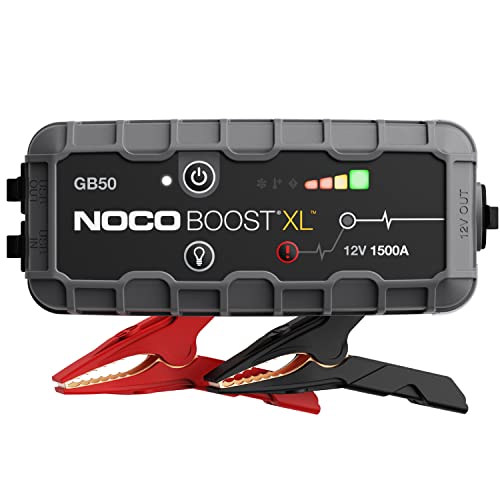
Modern portable jump starters use lithium battery cells capable of discharging a very large current in a short burst, which is what a starter motor actually needs, rather than needing high storage capacity the way a device powering something for hours would. This is why a jump starter the size of a paperback book can start a V8 engine despite weighing a tiny fraction of what the actual car battery weighs.
What the built-in safety features are actually protecting against
Reverse polarity protection prevents damage if the clamps are connected backward, and spark proof clamp designs reduce the risk of ignition near battery gases during connection. These protections exist because a car battery, especially one under load, can produce a spark capable of igniting hydrogen gas that lead acid batteries vent during charging, so the safety circuitry is addressing a real risk, not just a marketing feature.
Why jump starting does not fully recharge the battery
A jump starter supplies only the brief current spike needed to crank the engine, not a sustained charge, so the car’s battery is still significantly depleted immediately after a successful jump start. The alternator recharges it gradually once the engine is running, which is why a battery that needed jumping should usually be driven for a reasonable stretch afterward rather than shut off again right away.
When a jump starter will not be enough to fix the actual problem
If a battery is old, damaged, or has a bad cell, it may crank briefly with help from a jump starter but fail to hold a charge once disconnected, or fail again within hours. A jump starter solves the immediate problem of insufficient current for cranking, but it does not diagnose or fix a battery that is failing for a deeper reason, which still needs testing or replacement.

NOCO Boost Plus GB40
A compact lithium jump starter rated for gasoline engines up to around 6 liters, commonly kept in a glovebox because of its small size relative to its cranking output.

DEWALT DXAEPS2 Power Station Jump Starter
A larger jump starter that combines jump starting capability with an air compressor and USB charging ports, aimed at drivers who want one device covering several roadside situations.
Questions worth asking
Can a jump starter damage a car’s electronics if used incorrectly?
Yes, connecting the clamps backward can send current through the car’s electrical system in the wrong direction, which is why reverse polarity protection is one of the most important safety features to check for, since without it a reversed connection can damage sensitive electronics.
How long should a jump starter stay connected before trying to start the engine?
Most jump starters only need to be connected for a few seconds before attempting to start the engine, since they are supplying a current spike rather than slowly charging the battery, though leaving them connected a bit longer rarely causes harm.
Does a jump starter work on a completely dead battery with zero charge?
Generally yes, as long as the battery itself is not damaged, since the jump starter is supplying the current the dead battery cannot provide rather than relying on the battery to contribute charge, though a battery with an internal fault may still fail to hold even a successful jump.
How often does a portable jump starter itself need recharging?
Most portable lithium jump starters hold their charge for weeks to months of idle storage and are rated for dozens of jump starts per full charge, but manufacturers generally recommend recharging every few months regardless of use to keep the internal cells healthy.
Can you use a jump starter on a diesel engine the same way as gasoline?
Only if the jump starter is rated for the higher current draw diesel engines typically need to crank, since diesel starter motors generally demand more current than gasoline engines of similar size, so checking the device’s rated engine size and fuel type matters.
Is it safe to jump start a car in the rain?
It is generally fine as long as the connections and clamps themselves are not submerged or soaked, though working carefully and avoiding standing water directly under the battery terminals is still good practice given it is an electrical connection.
Why does a jump starter sometimes fail to start a car on the first attempt?
A loose or corroded terminal connection is the most common cause, followed by a battery with an internal fault that cannot hold even a brief charge, or a jump starter that has not been charged itself recently enough to deliver full output.
Can a jump starter replace a battery that keeps dying repeatedly?
No, a jump starter addresses a single instance of insufficient cranking power, but a battery that keeps dying repeatedly has an underlying problem, commonly a failing battery, a parasitic electrical drain, or a charging system issue, that needs its own diagnosis.
Do jump starters work in very cold weather?
Cold weather reduces the output of lithium cells somewhat, similar to how it reduces car battery performance, so a jump starter kept in a freezing trunk may have slightly less punch than one stored at room temperature, though most are still rated to work in cold conditions.
Is it bad to leave a jump starter connected after the engine starts?
It is not harmful to leave it connected briefly after the engine starts, but there is no benefit either since the jump starter is not charging the battery at that point, so most people disconnect it once the engine is reliably running.
Can jump starters damage a car’s onboard computer or sensors?
A properly functioning jump starter with reverse polarity and voltage protection should not harm a car’s computer or sensors, which is one of the main reasons those safety features matter more on a vehicle with extensive onboard electronics than they did on older, simpler cars.
How is a portable jump starter different from old-fashioned jumper cables and another car?
The core electrical principle is the same, supplying current to crank the engine, but a portable jump starter does not require a second running vehicle, cables long enough to connect two cars, or anyone else’s help, which is the main practical advantage.
Do all jump starters work on both cars and trucks?
Not every jump starter is rated for larger truck engines, since bigger engines generally need a bigger current spike to crank, so checking the device’s rated engine size in liters against your specific vehicle matters before assuming any jump starter will work.
Can a jump starter be used to charge a phone or other devices too?
Yes, most portable jump starters include USB output ports specifically for charging phones or small devices, which is a secondary feature built on top of the same internal battery used for jump starting.
Final word
The mechanism is a short, large burst of current, not a slow recharge, which is why a small device can start a big engine but still leaves the car’s actual battery depleted afterward. A jump starter fixes the moment, not necessarily the reason the battery was dead in the first place.
Tony Russo
Tony trained as an automotive technician and spent years in service and parts retail before moving into writing. He focuses on garage tools, car care products and accessories from a hands-on maintenance perspective.