Chef’s Knife Buying Guide: Steel, Tang and Balance Compared
The Wusthof Classic 8-Inch Chef’s Knife leads this comparison for daily home cooking, thanks to its full tang and forged balance. The Victorinox Fibrox Pro 8-Inch matches much of that performance at a lower price. Beginners on a budget get a solid forged blade from the Mercer Culinary Renaissance 8-Inch.
Home cooks who chop daily get the most from the Wusthof Classic 8-Inch Chef’s Knife. Its full tang and forged German steel add stability that stamped blades cannot match. That stability comes at a higher price than the Victorinox Fibrox Pro.
Steel type, tang construction and handle shape change how a knife feels differently for every cook, which makes shopping confusing. We compared blade steel, edge angle, tang construction and handle material across seven listings to separate real performance gaps from marketing claims.
How to choose
What to Look for in a Chef’s Knife Balance matters as much as sharpness in a chef’s knife. Full tang construction extends the steel through the handle, adding stability for chopping dense vegetables. Blade steel decides both edge retention and how often you’ll sharpen. Weight plays a role too: heavier forged blades power through squash, while lighter stamped blades ease wrist fatigue during long prep.
Chef’s Knife vs Santoku: Which Blade Shape Fits Your Cooking A curved edge lets a chef’s knife rock through herbs and onions without lifting off the board. Santoku blades run flatter, with a sheep’s foot tip built for straight up-and-down cuts. Global’s G-2 leans toward that flatter, lighter Japanese profile despite being sold as a chef’s knife. Owners of a santoku may not need a second knife with a nearly identical cutting motion.
How Steel Hardness Affects Sharpening Frequency German steels in the Wusthof and Zwilling models sit in the mid-50s on the Rockwell scale, which makes home resharpening straightforward. Shun’s VG-MAX core runs harder and holds an edge longer between sharpenings. Harder steel also chips more easily against bone or frozen food. Honing between full sharpenings keeps any of these blades closer to their factory edge.
Matching a Knife to Your Budget and Kitchen Habits Beginners often do better with a forgiving, neutral-balance knife like the Zwilling Pro than a premium blade that punishes careless handling. Cooks who chop daily and plan to keep one knife for years can justify the Wusthof or Shun. Mercer’s Culinary Renaissance still beats most unbranded stamped knives sold in department stores. Dishwasher heat and detergent dull edges and degrade handle materials, so all seven knives here call for hand washing.
The shortlist, ranked
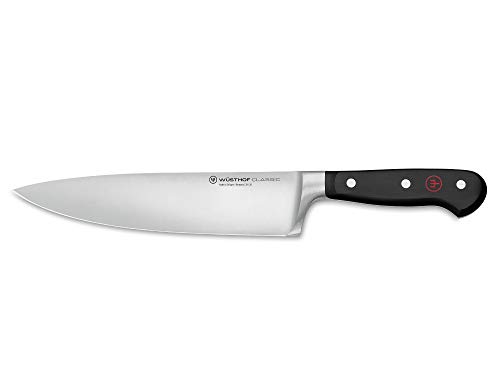
Wusthof Classic 8-Inch Chef’s Knife
Forged from German high-carbon stainless steel, this knife carries a full tang for stability through heavy chopping. A triple-riveted POM handle stays secure even when hands are damp. Owners note the edge responds well to routine honing between sharpenings.
Pros
- Full tang adds balance during dense vegetable prep
- POM handle resists slipping in humid kitchens
- Edge responds well to standard whetstone sharpening
Cons
- Priced above stamped blades like the Victorinox
- Needs hand washing to protect the forged finish

Shun Classic 8-Inch Chef’s Knife
A VG-MAX steel core sits beneath layered Damascus cladding on this blade. Sixteen-degree edge angles per side cut thinner than most German knives out of the box. Right-handed cooks get the most from its D-shaped Pakkawood handle.
Pros
- VG-MAX core holds an edge longer than softer steels
- Thin edge angle slices produce with less resistance
- Damascus cladding gives the blade a distinct pattern
Cons
- Price runs well above forged German alternatives
- D-shaped handle fits right-handed grips better than left

Victorinox Fibrox Pro 8-Inch Chef’s Knife
Restaurant kitchens have used this stamped X50CrMoV15 blade for decades. Its Fibrox TPE handle stays grippy even when wet from rinsing produce. Skipping a forged bolster keeps weight low and price down without sacrificing edge performance.
Pros
- Fibrox handle grips well during wet prep work
- Lighter stamped blade eases long chopping sessions
- NSF certification suits frequent, heavy kitchen use
Cons
- Thinner blade flexes more than forged competitors
- Utilitarian look lacks the polish of pricier knives

Global G-2 8-Inch Chef’s Knife
CROMOVA 18 stainless forms this knife from a single piece of steel, with sand inside the hollow handle for balance. Fifteen-degree edge angles favor fine slicing over heavy chopping. Cooks switching from a santoku often adapt to this shape quickly.
Pros
- Single-piece build has no crevices to trap food
- Light weight reduces wrist strain during prep
- Thin edge favors precise cuts on produce and herbs
Cons
- Smooth handle turns slippery when hands are greasy
- Thin edge chips more easily against bone

Zwilling Pro 8-Inch Chef’s Knife
Zwilling forges this blade from one piece of steel, then ice-hardens it through the FRIODUR process. Its bolster and handle taper create a balance point that feels neutral rather than blade-heavy. That neutrality suits cooks still building knife control.
Pros
- Neutral balance forgives an inconsistent grip
- FRIODUR hardening improves long-term edge durability
- Ergonomic taper fits a range of hand sizes
Cons
- Bolster shape blocks full access when sharpening
- Weighs more than comparable Japanese-style blades

Dalstrong Gladiator Series 8-Inch Chef Knife
ThyssenKrupp high-carbon steel gives this blade extra thickness for breaking down squash and root vegetables. A full tang and Pakkawood handle add durability under forceful daily use. Weight runs higher than most 8-inch knives, a tradeoff some cooks prefer for momentum.
Pros
- Added blade weight speeds through dense produce
- Full tang construction holds up to daily force
- Included sheath simplifies drawer or block storage
Cons
- Heavier build tires the wrist during fine slicing
- Bulkier handle crowds smaller hands

Mercer Culinary Renaissance 8-Inch Chef’s Knife
Mercer prices this forged knife below most full-tang competitors. A textured POM handle resists slipping during oily or wet prep. Culinary students building a first knife roll often start with this model.
Pros
- Forged full-tang build at an entry-level price
- Textured grip cuts down on slipping
- Balanced weight for a knife in its price range
Cons
- Bolster shape takes adjustment for some grips
- Edge retention trails costlier forged blades
Side by side
| # | Model | Blade Steel | Best for | Score | Price |
|---|---|---|---|---|---|
| 1 | Wusthof Classic 8-Inch Chef’s Knife | German high-carbon stainless | Best overall | 9.4 | Check price |
| 2 | Shun Classic 8-Inch Chef’s Knife | VG-MAX core, Damascus cladding | Best premium pick | 9.2 | Check price |
| 3 | Victorinox Fibrox Pro 8-Inch Chef’s Knife | X50CrMoV15 stainless | Best value | 9.1 | Check price |
| 4 | Global G-2 8-Inch Chef’s Knife | CROMOVA 18 stainless | Best for a lightweight Japanese-style blade | 9.0 | Check price |
| 5 | Zwilling Pro 8-Inch Chef’s Knife | German special formula steel | Best for cooks who want a beginner-friendly balance | 8.8 | Check price |
| 6 | Dalstrong Gladiator Series 8-Inch Chef Knife | German high-carbon stainless (ThyssenKrupp) | Best for heavy-duty chopping | 8.6 | Check price |
| 7 | Mercer Culinary Renaissance 8-Inch Chef’s Knife | German high-carbon stainless | Best budget | 8.0 | Check price |
Common questions
What is the best all-around chef’s knife for home cooks?
Based on the specifications compared here, the Wusthof Classic 8-Inch Chef’s Knife offers the strongest mix of full tang stability and forged edge retention for daily use.
How is a chef’s knife different from a santoku?
A chef’s knife carries a curved edge for rocking cuts, while a santoku has a flatter edge and shorter blade built for straight chopping strokes.
Is a heavier or lighter chef’s knife better for daily cooking?
Heavier forged knives such as the Dalstrong Gladiator add momentum for dense vegetables, while lighter models like the Victorinox Fibrox Pro reduce fatigue over long sessions.
Can chef’s knives go in the dishwasher?
Manufacturers recommend hand washing for all seven knives here, since dishwasher heat and detergent dull edges and can damage handle materials.
How often should a chef’s knife be sharpened?
Most home cooks need a full sharpening every few months, with regular honing on a steel rod recommended between uses.
Which blade length works best for a chef’s knife?
An 8-inch blade fits most home kitchens and cutting boards, though cooks with larger hands sometimes prefer a 10-inch length.
Is German steel or Japanese steel better for a kitchen knife?
German steel resharpens more easily and resists chipping, while Japanese steel such as Shun’s VG-MAX core holds a sharper edge for longer between sharpenings.
Does a chef’s knife need full tang construction?
Full tang construction adds durability and balance by running steel through the entire handle, though one-piece designs like the Global G-2 reach similar stability differently.
What makes the Victorinox Fibrox Pro a good value pick?
Its stamped X50CrMoV15 blade and Fibrox handle deliver near-professional performance without the cost of a forged bolster.
Which chef’s knife suits someone with smaller hands?
The Global G-2’s lightweight, one-piece design suits smaller hands better than bulkier handles like the Dalstrong Gladiator’s.
Final word
The Wusthof Classic 8-Inch Chef’s Knife stays the strongest pick for cooks who chop daily and want an easily sharpened, durable blade. Shoppers on a tighter budget should choose the Victorinox Fibrox Pro 8-Inch, which delivers similar cutting performance in a lighter, less expensive package. Cooks who want a thinner, sharper Japanese-style edge should look at the Shun Classic instead.
Dana Whitfield
Dana spent eight years buying and merchandising for a regional kitchenware retailer before moving into editorial work. She has handled thousands of SKUs across cookware, small appliances and kitchen organization, and focuses on the practical differences that matter once a product is actually in daily use.