Which Chair Mat Fits Your Floor Type and Desk Setup
The Cleartex Ultimat fits hardwood and tile best, the Vitesse Office Chair Mat holds up on low-pile carpet, and the RollerMat Heavy Duty covers the wider rolling zone of a sit-stand desk. Floor type and chair weight decide which thickness and material actually last.
Hardwood and tile owners get the most protection from the Cleartex Ultimat, a scratch-resistant polycarbonate mat sized for most L-shaped desks, though it costs more than PVC and needs a flat subfloor to sit properly.
Carpet pile height, caster type, and desk footprint each push the choice toward a different material, so specs, construction, and owner reports on cracking or sliding drove this comparison rather than a single universal pick.
The best picks, ranked

Cleartex Ultimat Polycarbonate Chair Mat
Solid polycarbonate replaces the PVC found in most mats, cutting down on yellowing and cracking under daily rolling. Owners report it stays flat on hardwood and tile instead of curling at the edges. At 47 by 35 inches it covers a single-desk rolling zone.
Pros
- Resists cracking and yellowing over time
- Lies flat without curling at edges
- Smooth glide for standard casters
Cons
- Higher cost than PVC alternatives
- No cleats, so it can shift on uneven floors

Vitesse Office Chair Mat for Low-Pile Carpet
Beveled edges and bottom grips target low to medium pile carpet up to half an inch thick. Rigid PVC construction keeps casters from sinking during long typing sessions. A lip design anchors the mat instead of letting it creep with each chair push.
Pros
- Grips carpet fibers to resist sliding
- Beveled edges reduce chair-caster snagging
- Rigid enough to stop wheel sinkage
Cons
- Not rated for thick or plush carpet
- Can emit a mild PVC smell when new

RollerMat Heavy Duty Chair Mat for Standing Desks
Sit-stand users shift position dozens of times a day, and this mat’s 1/8 inch thickness resists denting under a heavier standing-desk base. Extended length covers the full range of desk height adjustment. Reinforced PVC tolerates constant caster rotation without tearing.
Pros
- Extra length suits sit-stand desk movement
- Resists denting from heavier desk bases
- Reinforced material tolerates frequent rotation
Cons
- Bulkier size needs more floor clearance
- Slightly stiffer, takes days to flatten fully

Duraliner Clear Vinyl Chair Mat
A straightforward vinyl build keeps this mat affordable and sized for compact desks. No special cleats are needed on hard floors or thin carpet. Shipping in a rolled tube means it needs a few days to flatten, but daily light use is no problem.
Pros
- Lower cost entry point
- Compact size fits small desks
- Lightweight and easy to reposition
Cons
- Arrives rolled and takes days to lie flat
- Thinner material shows wear faster under heavy chairs

Marvelux Glasstop Chair Mat
Tempered glass swaps out plastic entirely, so there is no off-gassing odor and no scratching from grit trapped under wheels. Metal casters still glide across the surface without leaving marks. Anyone sensitive to vinyl smell or long-term plastic degradation gets a cleaner option here.
Pros
- No plastic odor or off-gassing
- Scratch-resistant surface holds up to metal casters
- Does not degrade or yellow with age
Cons
- Heavier and harder to reposition
- Higher cost than vinyl or polycarbonate mats

Casa Pura Ambos Chair Mat
A reversible build gives this mat two faces, a smooth side for hard floors and a cleated side for carpet. Rooms where a desk moves between a carpeted office and a tiled sunroom benefit most. Owners cite easy wipe-down cleaning on the smooth side.
Pros
- Reversible for two floor types
- Smooth side wipes clean easily
- Useful for offices that relocate desks
Cons
- Cleat side less effective on thick carpet
- Smaller size than some competitors
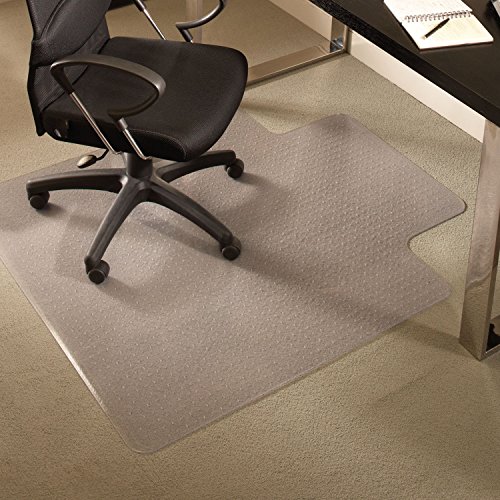
ES Robbins EverLife Chair Mat
Corner and L-shaped desks need coverage on two sides, which is where this mat scales up. An extended lip tucks under the desk so no gap opens for a chair to catch. Vinyl construction keeps total weight manageable despite the larger footprint.
Pros
- Covers full L-shaped desk footprint
- Lip design closes the desk-to-mat gap
- Manageable weight for the size
Cons
- Large size limits placement in small offices
- Lip can lift if desk legs sit unevenly
What matters most
What to look for in a chair mat Floor type decides material first. Hardwood and tile pair well with polycarbonate or glass, since both resist scratching from grit trapped under wheels. Carpet needs cleats or grip strips underneath to stop sliding. Anything under 1/10 inch thick tends to dent under heavier chairs within months.
Best for carpet vs hard floors Carpet mats need enough rigidity to stop casters sinking into pile, which is why the Vitesse uses a stiffer PVC blend rated for pile up to half an inch. Hard-floor mats prioritize a flat lie and scratch resistance instead, favoring polycarbonate or tempered glass over standard vinyl. Pairing the wrong mat with the wrong floor causes premature cracking or constant sliding.
Sizing for sit-stand and L-shaped desks Standard desks need roughly 45 by 35 inches to cover the seated rolling zone. Sit-stand desks need extra length since the base shifts position through the height range, which the RollerMat’s 60-inch mat addresses. Corner desks need a shaped mat like the ES Robbins EverLife, since a rectangular mat leaves gaps where a chair can roll off the edge.
Material tradeoffs and edge cases PVC and vinyl cost less but can off-gas an odor for the first few weeks and curl at the corners after shipping. Polycarbonate and glass avoid both problems but weigh more and cost more upfront. Anyone relocating a desk between rooms with different flooring can look at a reversible mat like the Casa Pura Ambos, trading peak performance on either side for flexibility.
How they compare
| # | Model | Material | Best for | Score | Price |
|---|---|---|---|---|---|
| 1 | Cleartex Ultimat Polycarbonate Chair Mat | Polycarbonate | Best overall | 9.4 | Check price |
| 2 | Vitesse Office Chair Mat for Low-Pile Carpet | PVC | Best for carpet | 9.1 | Check price |
| 3 | RollerMat Heavy Duty Chair Mat for Standing Desks | Reinforced PVC | Best for standing desks | 8.9 | Check price |
| 4 | Duraliner Clear Vinyl Chair Mat | Vinyl | Best budget | 8.5 | Check price |
| 5 | Marvelux Glasstop Chair Mat | Tempered glass | Best for allergy-sensitive users | 8.7 | Check price |
| 6 | Casa Pura Ambos Chair Mat | Polypropylene | Best for shared or dual-floor rooms | 8.6 | Check price |
| 7 | ES Robbins EverLife Chair Mat | Vinyl | Best for large L-shaped desks | 8.4 | Check price |
Frequently asked questions
What is the best chair mat for hardwood floors?
Polycarbonate mats like the Cleartex Ultimat resist scratching from grit and lie flatter than vinyl, making them the common pick for hardwood.
Do chair mats work on carpet?
Yes, but they need a rigid PVC or polypropylene base with grip cleats. Soft or thin mats sink into carpet pile and lose their protective flatness.
How thick should a chair mat be?
Most hard-floor mats run between 1/10 and 1/8 inch. Carpet mats often run slightly thicker, closer to 0.12 to 0.15 inch, to resist sinkage.
Can I use a hard floor chair mat on carpet?
It will slide and may crack under caster pressure, since it lacks the grip cleats or rigidity carpet requires. Match the mat to the floor type it lists.
Chair mat vs floor protector pads, which is better?
Floor protector pads suit stationary furniture legs, not rolling chairs. A chair mat spreads wheel pressure across a wider surface, which pads cannot do.
Do glass chair mats scratch floors?
Tempered glass mats like the Marvelux Glasstop sit flat without moving, so they do not scratch floors when placed correctly, unlike some vinyl mats with rough undersides.
What size chair mat do I need for an L-shaped desk?
Measure the full rolling path on both desk sections, then look for a shaped mat like the ES Robbins EverLife rather than a rectangular one, which leaves gaps at the corner.
Are chair mats worth it for standing desks?
Yes. Sit-stand desks add extra wear from base movement during height changes, and a longer mat like the RollerMat covers that wider rolling zone.
How long do chair mats typically last?
Polycarbonate and glass mats often outlast vinyl by several years, since they resist the cracking and yellowing that thinner PVC develops under daily rolling.
Do chair mats need cleats to stay in place?
Only on carpet. Hard-floor mats rely on flat, heavy material instead, since cleats would scratch tile or hardwood rather than grip it.
The bottom line
The Cleartex Ultimat is the strongest pick overall for anyone with hardwood, tile, or laminate, thanks to its scratch resistance and flat lie. Carpet users should choose the Vitesse Office Chair Mat instead, since its grip cleats and rigid PVC handle pile that would sink a smoother mat. Anyone splitting time between two flooring types can look at the Casa Pura Ambos for its reversible design, even though it trades some peak performance for that flexibility.
Marcus Chen
Marcus covered consumer electronics for enthusiast tech publications for six years before joining ChoiceCrest. He specializes in translating manufacturer spec sheets into plain-language buying advice, with a focus on audio, computing accessories and smart-home gear.


